Unlock predictable, cost-effective growth with a clear, practical guide to B2B affiliate marketing. Learn how to design, launch, and scale an affiliate program that attracts trusted partners, drives qualified leads and demos, and delivers measurable revenue for SaaS and high-ticket services.
November 17, 2025 (3mo ago) — last updated January 5, 2026 (1mo ago)
B2B Affiliate Marketing Guide for SaaS & Services
Design, launch, and scale a B2B affiliate program that drives qualified leads, demos, and recurring revenue for SaaS and high-ticket services.
← Back to blog
B2B Affiliate Marketing Guide for SaaS & Services
Summary: Unlock growth with this practical guide to designing, launching, and scaling high-ROI B2B affiliate programs that deliver qualified leads, demos, and measurable revenue.
Introduction
Unlock predictable, cost-effective growth with a clear, repeatable approach to B2B affiliate marketing. This guide shows how to design, launch, and scale an affiliate program that attracts trusted industry partners, drives qualified leads and demos, and contributes measurable revenue for SaaS and high-ticket services.
B2B affiliate marketing rewards partners—industry bloggers, consultants, agencies, or power users—for referring qualified prospects or new customers. Unlike consumer coupon campaigns, B2B affiliate programs focus on strategic partnerships, long-term value, and recommendations built on credibility.
What B2B Affiliate Marketing Really Means
When people hear “affiliate marketing,” they often picture consumer influencers sharing discount codes. B2B affiliate marketing is different: it builds a trusted network of advisors who recommend your solution for complex business problems.
A B2B affiliate doesn’t just push a product; they recommend a solution. Sales cycles are longer, deal sizes are larger, and endorsements carry industry credibility. Quality referrals can outweigh broad, low-intent traffic.
From Transactions to Partnerships
B2B programs prioritize qualified leads, demo requests, and trial sign-ups—actions that can mature into long-term contracts. A few well-targeted referrals can outperform thousands of untargeted clicks.
“Publishers and content creators monetize by recommending tools. If they can earn an affiliate commission for recommending Product C, they will—especially if Products A and B don’t offer a competitive program. Over time that visibility compounds, which is why affiliate programs are strategic.”
The affiliate market continues to grow, with some forecasts projecting the global market could top $31.7 billion by 20311.
B2B vs B2C Affiliate Marketing at a Glance
| Attribute | B2B Affiliate Marketing | B2C Affiliate Marketing |
|---|---|---|
| Primary goal | Generate qualified leads, demos, trials | Drive immediate, high-volume sales |
| Typical partners | Industry experts, consultants, agencies, review sites | Influencers, bloggers, coupon sites, mass media |
| Sales cycle | Long and complex (weeks or months) | Short and simple (minutes or days) |
| Commission structure | Higher, often recurring, or fixed fee per lead | Lower percentage of a smaller sale |
| Audience relationship | Built on authority and trust | Built on trends and social proof |
| Decision-making | Logical, ROI-driven, involves multiple stakeholders | Emotional, impulsive, usually a single buyer |
B2B programs nurture considered purchases while B2C focuses on immediacy.
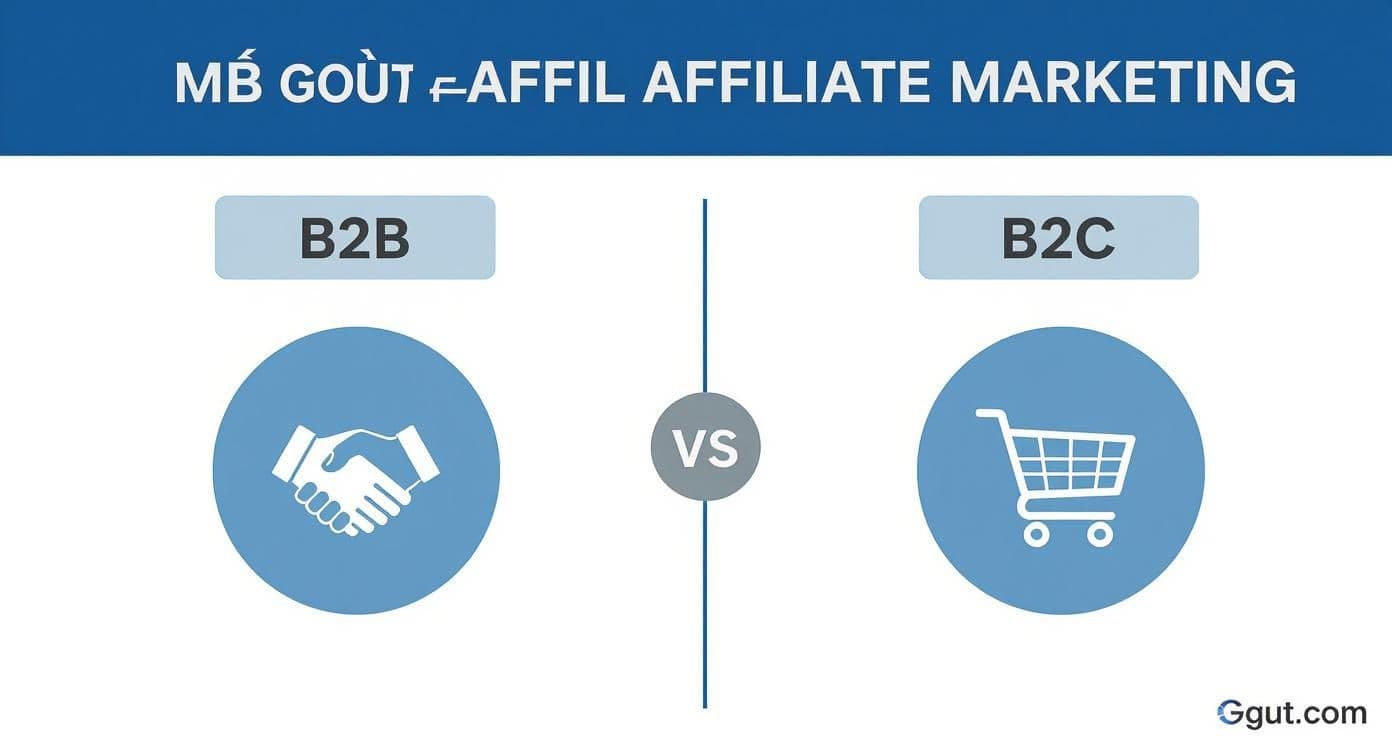
B2B affiliates are consultants, analysts, and thought leaders whose endorsement moves buyers through the decision path. That makes affiliate programs particularly powerful for SaaS and high-ticket services.
Why Your Business Needs an Affiliate Program

An affiliate program is more than an extra channel. It’s a strategic engine for predictable, cost-effective growth.
At its core, an affiliate program taps into existing networks of trust. Your ideal customers already follow industry blogs, consultants, and niche review sites. Rather than competing for attention with ads, you enable trusted voices to recommend your solution.
That produces a steady stream of warm, high-intent leads and typically lowers customer acquisition cost compared with many paid channels.
Build Credibility That Money Cannot Buy
A respected industry figure’s endorsement is more than a testimonial; it’s a co-sign that accelerates trust and shortens buying cycles.
“A strong affiliate program transforms marketing from a monologue into a dialogue. It gets influential voices in your industry actively championing your product to their audiences.”
Third-party validation is vital for complex products; affiliates often shape buyer decisions by publishing reviews, tutorials, and case studies. See our guide on affiliate marketing for SaaS for SaaS-specific tactics.
A Truly Performance-Based Growth Channel
The most compelling reason to launch an affiliate program is the financial model: you pay for results—qualified leads, booked demos, or closed sales. This reduces much of the upfront risk present in other channels.
Clear advantages:
- Controlled costs: Spend tied directly to revenue, producing predictable ROI.
- Scalable outreach: Add partners to expand reach without proportional increases in headcount.
- Measurable impact: Track conversions and identify which partners drive value.
Many brands report strong returns from affiliate marketing; in some cases companies see as much as $15 for every $1 spent2, and an increasing number of brands include affiliate programs in their growth mix3.
A well-run B2B affiliate program is an investment in predictable growth, stronger brand authority, and healthier margins.
Designing a High-Impact B2B Affiliate Program
You can’t wing a successful B2B affiliate program. Treat it like engineering a high-performance system: define the objective before you design the mechanics.
Design your program around business goals. Are you aiming to generate qualified leads, increase trial sign-ups, or win direct purchases? Each goal requires a different program architecture.
Choosing the Right Commission Structure
Pick a commission model that aligns partner incentives with your goals. Common B2B models include:
- Recurring commission: Fits SaaS and subscription models—affiliates earn a percentage of subscription fees for a set period or lifetime.
- One-time payout (CPA): A single commission for each new paying customer—useful for high upfront purchases.
- Fixed fee per lead (CPL): Pay a flat fee for each qualified lead, such as a verified demo request or trial sign-up.
Your chosen model signals what you value: recurring commissions favor retention, CPLs favor lead generation, and CPA favors closed deals. Typical SaaS recurring commission ranges are often in the 20–30% range for the first year, though your numbers should align with expected CLV and margin targets4.
Technical and Legal Foundations
After goals and commissions, build the technical and legal foundations that ensure fair attribution and partner trust.
Key operational elements:
- Attribution and cookie duration: B2B sales can take months. Consider 90 to 180 days to fairly credit affiliates who influenced early-stage interest.
- Transparent tracking: Reliable, auditable tracking builds partner confidence; if affiliates doubt attribution, engagement drops.
- Legal compliance: Draft a clear affiliate agreement and require disclosure consistent with FTC guidelines.
A solid legal and technical stack protects both parties and makes your program attractive to top-tier partners.
How to Find and Recruit the Right Partners
A brilliant program without the right partners is an empty shell. In B2B affiliate marketing, success is quality over quantity. Target partners who have earned trust with your ideal customers.
Identifying Your Ideal Partner Profile
Define your ideal partner before outreach. Great partners have the right audience and a reputation for delivering value.
Prioritize:
- Industry blogs and publications that publish in-depth reviews and tutorials.
- Consultants and agencies who advise your target buyers.
- Podcasters and YouTubers with engaged, industry-focused audiences.
- Power users—happy customers who already advocate for your product.
Favor niche experts with engaged audiences and no exclusive competitor commitments.
Crafting a Compelling Outreach Message
Generic outreach fails. Keep messages personal, concise, and focused on value.
- Get specific: Reference a recent piece of content they created.
- Explain the value: Show how your product solves their audience’s problem.
- Highlight benefits beyond cash: Emphasize audience value and credibility gains.
- Make “yes” easy: Offer a 15-minute demo, a free trial, or a dedicated affiliate landing page.
Treat prospective partners as collaborators, not traffic sources.
Frictionless Onboarding
A clunky onboarding process kills momentum. Move partners from sign-up to promotion quickly with a helpful portal and resource kit.
Provide:
- Marketing assets: Pre-approved logos, banners, screenshots, and swipe copy.
- Tracking links: Easy access to unique affiliate links and clear instructions.
- Product information: Demos, case studies, and comparison sheets.
- Onboarding guides: Quick-start documents covering rules, commission structure, and best practices.
Fast, supportive onboarding sets the tone for long-term success.
Measuring Success and Optimizing Performance

Launching your program is only the start. Use data to iterate and improve outcomes.
Essential KPIs for Your B2B Affiliate Program
| KPI | What it measures | Why it matters |
|---|---|---|
| Affiliate-driven conversion rate | Percent of visitors from an affiliate link who complete a key action (trial, demo, purchase) | Indicates whether a partner’s audience fits your product |
| Lead quality score | Likelihood that an affiliate lead converts to a paying customer | Identifies partners sending sales-ready prospects |
| Customer lifetime value (CLV) | Revenue expected from a referred customer over time | Measures a partner’s long-term value |
| Program ROI | Total affiliate-driven revenue minus program costs, as a percentage | Demonstrates the program’s financial health |
Track these KPIs to identify top partners and optimization opportunities.
Actionable Optimization Strategies
Use data to run tests and strengthen partner relationships.
- Reward top performers: Offer higher commission tiers, exclusive assets, or co-marketing opportunities.
- Re-engage dormant partners: Share new creative, offer personal onboarding help, or invite them to product briefings.
- Test creatives: A/B test banners, email templates, and landing pages to improve conversion rates.
Regular communication—product updates, performance reports, and timely support—turns good partners into great ones.
Common B2B Affiliate Marketing Mistakes to Avoid
Many programs stumble on execution rather than strategy. Avoid these common traps.
Recruiting Misaligned Partners
Quantity-over-quality backfires. Broad audiences that aren’t relevant will send low-value traffic.
Create a clear ideal partner profile before recruiting. Audit content, check engagement, and favor niche experts who attract your target buyers.
Neglecting Partner Support and Communication
Affiliates are partners, not a list. Poor support drives affiliates to competitors who offer better resources.
Build a resource hub, set a consistent communication cadence, and be responsive. A dedicated affiliate manager can be a major differentiator.
By vetting partners carefully and supporting them relentlessly, you’ll build a resilient program that becomes a predictable growth engine.
Frequently Asked Questions
How much should I pay B2B affiliates?
It depends on CLV and your business model. For SaaS, recurring commissions of 20–30% for the first year are common. For high-ticket, one-time sales, a flat CPA is often more appropriate4.
How long should my cookie duration be?
B2B purchases take time. A cookie duration of 90 to 180 days is standard and fair for partners who influence early-stage decisions.
Can I start an affiliate program with a small budget?
Yes. Choose a cost-effective platform, recruit top fans and power users, and focus on a few high-quality partners to prove the channel before scaling.
Ready to turn your best customers into your most effective promoters? ShareMySaaS makes it simple with one-click affiliate activation, automated tracking, and seamless Stripe payouts. Launch your program in minutes and watch growth multiply. Learn more about ShareMySaaS and get started today.
Quick Q&A — 1
Q: What’s the fastest way to get value from a B2B affiliate program?
A: Start with a small set of vetted partners—power users, niche bloggers, or consultants—provide strong onboarding and assets, and test a CPL or recurring commission that aligns with your goals.
Quick Q&A — 2
Q: How do I ensure affiliates send high-quality leads?
A: Vet partners by audience fit, track lead quality and CLV, and maintain open communication and support to guide promotions toward qualified outcomes.
Quick Q&A — 3
Q: What should I measure first?
A: Focus on affiliate-driven conversion rate, lead quality score, and program ROI. These metrics reveal fit and long-term value faster than vanity metrics.
💸 Get 10x More People SharingWith Zero-Friction Signup
Traditional sharing programs lose most potential promoters at signup. ShareMySaaS eliminates that barrier completely — users start sharing with one click, no forms required. Turn every satisfied customer into an active promoter and watch your reach explode.