Discover the best partner management software for SaaS. Compare 12 top platforms on features, pricing, and use cases to scale your partner programs.
January 17, 2026 (1mo ago)
The 12 Best Partner Management Software Platforms for SaaS in 2026
Discover the best partner management software for SaaS. Compare 12 top platforms on features, pricing, and use cases to scale your partner programs.
← Back to blog
Title: Best Partner Management Software 2026
Summary: Compare 12 partner management platforms for SaaS—features, pricing, and use cases to scale affiliate, referral, and channel programs.
Introduction: Partner programs—from simple affiliate links to complex reseller channels—are powerful growth engines for SaaS and subscription companies. The right partner management software automates tracking, streamlines payouts, and gives you the data to grow your ecosystem. This guide compares 12 top platforms on ease of use, tracking accuracy, payout automation, and scalability to help you choose the best fit for your program.
Why partner management software matters
Partner programs can scale acquisition while reducing paid acquisition costs, but manual approaches quickly break down as complexity grows. Spreadsheets and ad-hoc payments increase the risk of attribution errors and delayed commissions, which harms partner trust and program performance1. A purpose-built platform centralizes tracking, automates payouts, and provides reporting to measure ROI and optimize incentives.
This guide evaluates the 12 best partner management software platforms for SaaS teams in 2026, from lightweight in-app referral tools to full-featured PRM systems for enterprise channels. Each profile highlights strengths, typical use cases, pricing cues, and pros and cons to help you decide faster.
How we evaluated these platforms
We prioritized criteria that matter to modern SaaS businesses:
- Ease of setup and time-to-value
- Tracking accuracy and cross-device attribution
- Payout automation and global payment support
- Support for common partnership types: affiliates, referrals, resellers, and channel partners
- Integration surface with CRMs, billing platforms, and marketing tools
Where available, platform claims were checked against vendor docs and category research to provide practical guidance for selection and pilot planning2.
1. ShareMySaaS
Best for: Zero-friction in-app affiliate and referral programs
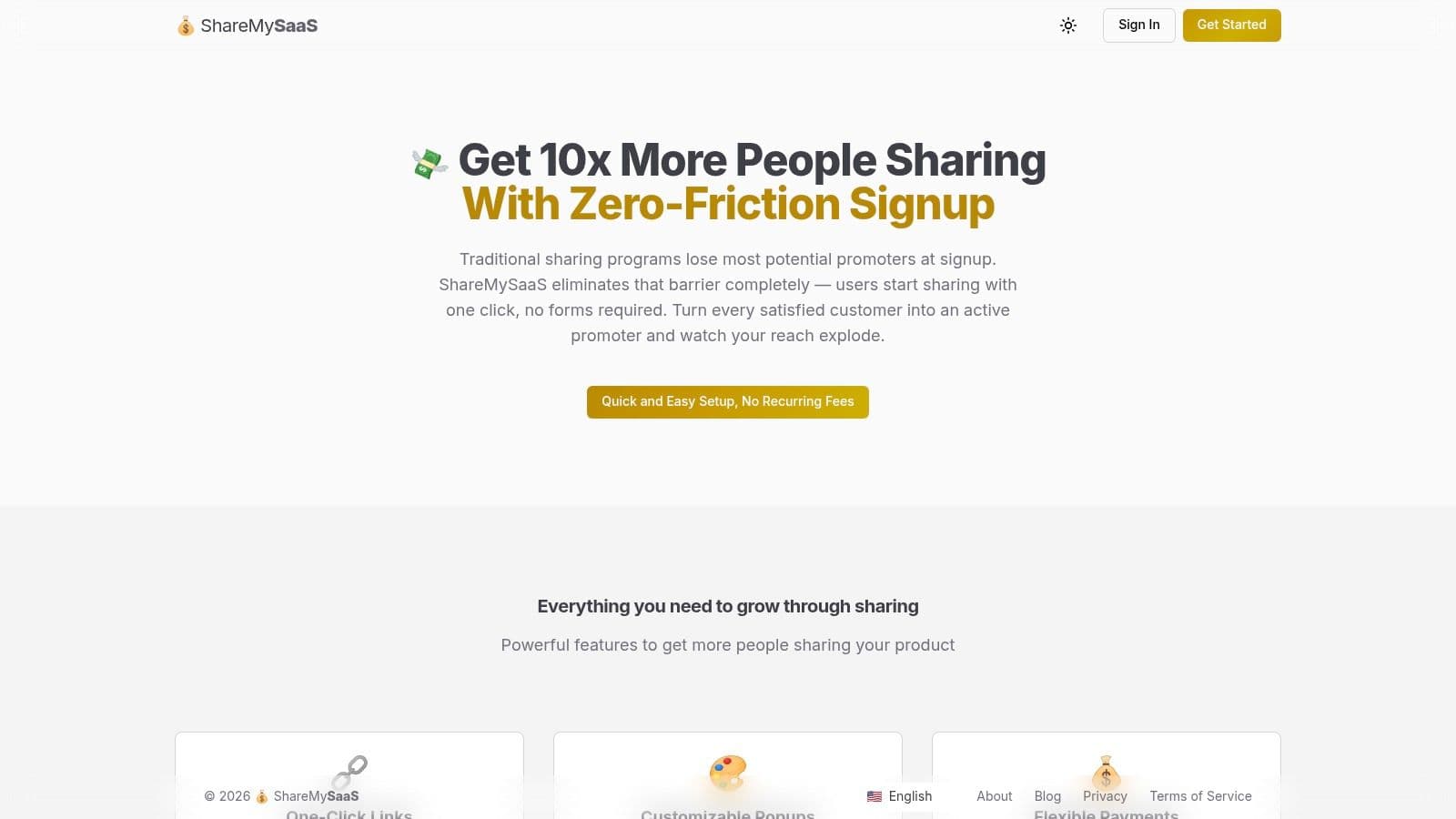
ShareMySaaS helps logged-in users become promoters with a single click, instantly generating a unique sharing link via a customizable in-app pop-up. That low-friction approach drives higher partner activation because you capture intent at the moment of engagement.
Key strengths and use cases:
- Instant promoter activation from within the product
- Real-time analytics for clicks and conversions
- Stripe integration for automated payouts
- Flexible reward models: percentage, fixed, tiered, and custom
Pricing and implementation:
ShareMySaaS uses a success-based pricing model with no monthly or setup fees; you pay a percentage of commissions paid to partners. This lowers upfront risk and can be cost-effective for startups and product-led teams.
Pros:
- Very fast setup and time-to-value
- Success-based pricing aligns cost with results
- Native in-app experience boosts sign-ups
Cons:
- Requires authenticated users for one-click link generation
- Stripe dependence for payouts may not fit all businesses
Website: https://sharemysaas.com
2. impact.com — Partnership Cloud
Impact.com provides an end-to-end Partnership Cloud that supports affiliates, influencers, B2B alliances, and app partnerships. Its marketplace includes a large directory of vetted partners, plus tools for contracting, tracking, and payments.
Key features and use cases:
- Extensive partner discovery marketplace
- Cross-device attribution and flexible tracking methods
- Contracting, fraud controls, and payout automation
Best for mid-market to enterprise teams scaling diverse partner programs. Pricing typically includes transaction fees on partner-driven revenue.
3. PartnerStack
PartnerStack focuses on B2B SaaS and automates the partner lifecycle: onboarding, resource delivery, payouts, and performance reporting. It pairs platform tools with an active B2B partner network to accelerate discovery and recruitment.
Key features and use cases:
- Automated onboarding journeys and partner resources
- Global payouts via Stripe and PayPal
- Marketplace access to an extensive B2B partner community
PartnerStack offers a pay-as-you-earn option for pilots and custom pricing for full platform use.
4. Channelscaler (Allbound + Channel Mechanics)
Channelscaler combines PRM features with deep channel program automation for multi-tier distribution. It targets mid-market and enterprise teams that require deal registration, MDF management, and compliance features.
Key features and use cases:
- Branded partner portals and training
- Deal registration workflows and MDF management
- AI-assisted analytics for partner enablement
Best for established channel organizations that need an integrated PRM and channel operations platform.
5. Impartner
Impartner delivers PRM plus through-channel marketing automation (TCMA) to syndicate campaigns, distribute leads, and align partner activity with CRM pipelines. It’s built for enterprise channel teams that run co-branded marketing and certification programs.
Key features and use cases:
- Content syndication and co-marketing execution
- Deep CRM integrations for pipeline alignment
- Training and certification modules for partners
Impartner is quote-based and typically adopted by mature channel programs.
6. Zift Solutions — ZiftONE
ZiftONE merges PRM with marketing automation and LMS capabilities, centralizing partner enablement and campaign execution. It’s suited to businesses with formal reseller and distributor networks.
Key features and use cases:
- Lead and deal registration to avoid channel conflict
- Learning Management System for partner certification
- Co-branded campaign execution and reporting
Pricing is available via demo and consultation.
7. Kiflo
Kiflo is a lightweight PRM tailored to SMB and mid-market teams that need straightforward partner onboarding, deal registration, and commission tracking. It integrates with HubSpot, Salesforce, Stripe, and Chargebee.
Key features and use cases:
- Branded partner portal and resource sharing
- CRM integrations to sync leads and deals
- Transparent pricing tiers for growing partner counts
Kiflo is ideal for teams launching their first formal channel program.
8. Partnerize
Partnerize is an enterprise partnership platform with flexible pricing models (license or performance-based), multi-currency support, and managed services. It’s built for global brands running complex, regionally segmented partner programs.
Key features and use cases:
- Advanced multi-region and multi-currency payout support
- Robust analytics and fraud protection
- Managed services for strategy and execution
Partnerize is best for large enterprises that require scale and customization.
9. Everflow
Everflow unifies affiliate, partner, and paid media tracking with deep attribution and reporting. Its Everflow Pay feature simplifies global payouts and invoicing for international partner networks.
Key features and use cases:
- Granular multi-event tracking and dashboards
- Marketplace connections to recruit new partners
- Consolidated global payouts via Everflow Pay
Everflow is popular with high-volume performance marketers and networks3.
10. TUNE
TUNE is a mature performance-marketing platform focused on precise tracking, API flexibility, and fraud prevention. It provides real-time reporting and cross-device attribution for advertisers and networks at scale.
Key features and use cases:
- Real-time reporting and advanced targeting
- Comprehensive fraud protection
- Two-way API for deep integrations
TUNE publishes pricing for certain plans, which helps teams budget for scaling partner programs.
11. Refersion
Refersion targets ecommerce and DTC brands, integrating tightly with Shopify, BigCommerce, and WooCommerce. It supports SKU-level attribution, unlimited affiliates, and one-click PayPal payouts.
Key features and use cases:
- Storefront integrations for fast setup
- SKU or email-level attribution for granular rewards
- Unlimited affiliates on most plans
Refersion is one of the best choices for merchants prioritizing ecommerce workflows and simple affiliate management.
12. G2 — PRM category
G2’s PRM category offers vendor-agnostic comparison data, verified user reviews, and quarterly Grid rankings to help shortlist vendors and validate real-world performance. Use G2 to triangulate satisfaction, ease of use, and common pros and cons before engaging sales teams2.
Key features and use cases:
- Verified user reviews and feature comparisons
- Filters for company size, category, and feature needs
- Market context to validate vendor claims
G2 is a free starting point for vendor research and shortlisting.
Comparison at a glance
| Product | Best for | Pricing clue |
|---|---|---|
| ShareMySaaS | Product-led in-app referral programs | Success-based (no monthly fee) |
| impact.com | Multi-channel enterprise partnerships | Quote + transaction fees |
| PartnerStack | B2B SaaS partner networks | Custom pricing; pay-as-you-earn options |
| Channelscaler | Multi-tier channel automation | Custom enterprise pricing |
| Impartner | PRM + TCMA for enterprise | Quote-based |
| ZiftONE | Formal reseller and distributor programs | Demo required |
| Kiflo | SMB and mid-market PRM | Transparent tiers |
| Partnerize | Global enterprise partnerships | License or performance pricing |
| Everflow | High-volume performance marketing | Quote-based + payout fees |
| TUNE | Data-driven affiliate and mobile partners | Published plans + custom quotes |
| Refersion | Ecommerce brands | Affordable entry tiers |
| G2 | Vendor research and validation | Free to browse |
How to choose the right platform
Start by defining the model you need to support:
- Product-led referrals: focus on frictionless in-app activation and success-based pricing.
- B2B partner networks: prioritize partner discovery, onboarding automation, and CRM alignment.
- Enterprise channel programs: require PRM features like LMS, MDF, deal registration, and compliance controls.
- Performance marketing: choose platforms with granular attribution, anti-fraud measures, and consolidated payouts.
Consider total cost of ownership, including implementation, integrations, and internal resources to manage the program. A platform is only valuable if your team and partners actually use it.
Final takeaway
There’s no single best partner management software for every company. The right choice depends on your program’s maturity, partner types, and budget. For product-led SaaS teams, ShareMySaaS offers a low-friction way to start converting users into advocates. For B2B and enterprise channels, look to PartnerStack, Kiflo, Channelscaler, Impartner, or ZiftONE depending on scale and feature needs. For performance-driven programs, impact.com, Everflow, and TUNE give you the attribution and payout controls you need.
Choose the tool that reduces friction for partners, automates manual work for your team, and lets you measure the impact of partnership-driven revenue.
Ready to turn your happiest customers into your most powerful growth channel? ShareMySaaS launches native, in-app affiliate and referral programs in minutes. See how at https://sharemysaas.com.
Frequently asked questions
Q: When should we move from spreadsheets to partner management software?
A: Move when attribution errors, delayed payouts, or partner onboarding time start to slow growth or damage relationships. If partner volume or complexity exceeds manual workflows, a platform will usually pay for itself in saved time and fewer disputes1.
Q: Which platform is best for product-led SaaS growth?
A: Choose a tool that activates users in-app with minimal friction and supports success-based pricing if you want low upfront costs. ShareMySaaS is designed for this use case.
Q: How do I evaluate total cost of ownership?
A: Add subscription or performance fees, implementation and integration costs, payment fees for global payouts, and the internal headcount required to run the program. Factor in expected uplift from partner-driven revenue when modeling ROI3.
1.
HubSpot, “How to Start an Affiliate Program,” HubSpot Blog, accessed January 2026, https://blog.hubspot.com/marketing/affiliate-marketing.
2.
G2, “Partner Relationship Management (PRM) Software,” G2 Category Page, accessed January 2026, https://www.g2.com/categories/prm.
3.
Everflow, “Everflow Pay — Global Payouts for Partners,” Everflow product page, accessed January 2026, https://everflow.io/everflow-pay.
💸 Get 10x More People SharingWith Zero-Friction Signup
Traditional sharing programs lose most potential promoters at signup. ShareMySaaS eliminates that barrier completely — users start sharing with one click, no forms required. Turn every satisfied customer into an active promoter and watch your reach explode.