Learn how to write a clear disclosure for affiliate links. Our guide covers FTC rules, best practices, and real-world examples to ensure you're compliant.
February 1, 2026 (Today)
Mastering Disclosure for Affiliate Links A SaaS Founder's Guide
Learn how to write a clear disclosure for affiliate links. Our guide covers FTC rules, best practices, and real-world examples to ensure you're compliant.
← Back to blog
Affiliate Link Disclosures for SaaS Founders
Summary: Learn how to write a clear disclosure for affiliate links. This guide covers FTC rules, placement, wording, global considerations, and program-level compliance to keep your SaaS brand transparent and compliant.
Learn how to write a clear disclosure for affiliate links that is simple, visible, and trustworthy. This guide covers the FTC’s expectations, placement best practices, wording examples, global considerations, and how to scale disclosure across an affiliate program.
A solid disclosure for affiliate links is a straightforward statement letting your audience know you might earn a commission if they buy something through a link you’ve provided. It’s essential for transparency and staying on the right side of consumer-protection rules.
Why affiliate link disclosures are really about trust
Affiliate disclosures often feel like a legal box to check. In reality, they’re a core element of trust. When you move past “because the FTC says so” and focus on being upfront, transparency becomes a conversion asset for SaaS brands. People are more likely to act on recommendations they believe are honest.
This guide gives a practical roadmap for disclosures that keep you compliant and strengthen relationships with customers and partners.

Beyond compliance to connection
Think of a disclosure not as a legal hurdle but as proof of your brand’s integrity. A short, clear statement sends the message: “we value your trust more than a quick commission.” That mindset shifts affiliate marketing from a short-term tactic to sustainable growth.
The affiliate channel is a major part of many marketing stacks: data shows strong adoption among brands and rising investment in the space12. The confidence behind those numbers makes trust-building practices essential for long-term success.
“Your audience doesn’t just expect transparency; they reward it. A clear disclosure isn’t a conversion killer—it’s a trust builder that validates the authenticity of your recommendation.”
What this guide covers
You’ll get practical advice on:
- Crafting the perfect wording — clear, simple disclosures that readers understand immediately.
- Strategic placement — where to put disclosures on websites, in emails, social posts, and inside apps.
- Global considerations — the basics for key markets outside the U.S.
- Scaling your program — embedding disclosure into onboarding, agreements, and monitoring.
By the end, you’ll have a complete framework for compliant, effective affiliate disclosures.
How to write a disclosure that actually works
A good disclosure isn’t legalese; it’s clarity. The goal is for someone to glance at your copy and understand, “If I buy, the author may earn a commission.” Avoid vague phrases like “partner links” or “compensated links.” Be direct and concise.
The foundation of clear language
The FTC wants consumers to get a clear picture. Write disclosures the way you’d explain them to a colleague. Short, plain-language examples that work well:
- “This post contains affiliate links. If you make a purchase, I may earn a small commission at no extra cost to you.”
- “Just so you know, some of the links in this article are affiliate links, which means we may get a commission if you decide to buy something.”
- “(As an Amazon Associate, I earn from qualifying purchases.)”
Confident, informative tone beats apologetic or evasive language. You’re providing recommendations; being paid for that is legitimate.
Examples you can adapt today
For a blog post or product review: Place the disclosure at the top of the article, before the first affiliate link. A short sentence in italics is effective.
Heads up: This article contains affiliate links. If you click and make a purchase, we may receive a small commission at no extra cost to you. It helps us keep the lights on!
For an email newsletter: A brief note in the header or next to the CTA is best. A footer-only disclosure is a helpful backup but shouldn’t be the only place for prominent affiliate CTAs.
- Example: “This email may contain affiliate links. We only recommend products we love and use ourselves.”
For social media captions: Lead with a clear marker like #ad or #sponsored at the start of the caption. On platforms with limited space, use the platform’s paid partnership tools or put “(affiliate link)” right beside the URL.
- Example: “Loving this new project management tool! #ad Check it out here: [link]. It’s been a game-changer for our team. #affiliatelink”
Do’s and don’ts for wording
Do use direct phrases that make the relationship obvious. Don’t hide disclosures in vague language or long blocks of hashtags.
| Do say this | Don’t say this (too vague) |
|---|---|
| “I earn a commission from purchases made via this link.” | “This link helps support our site.” |
| “This is a sponsored post.” or “#ad” | “Thanks to our partners at [Brand] for this post.” |
| “Affiliate link” | “Partner link” or “Compensated link” |
| “(Paid link)” | “Click here to buy” (with no other context) |
Clear wording protects both your audience and your brand.
Strategic placement: where to put your disclosures
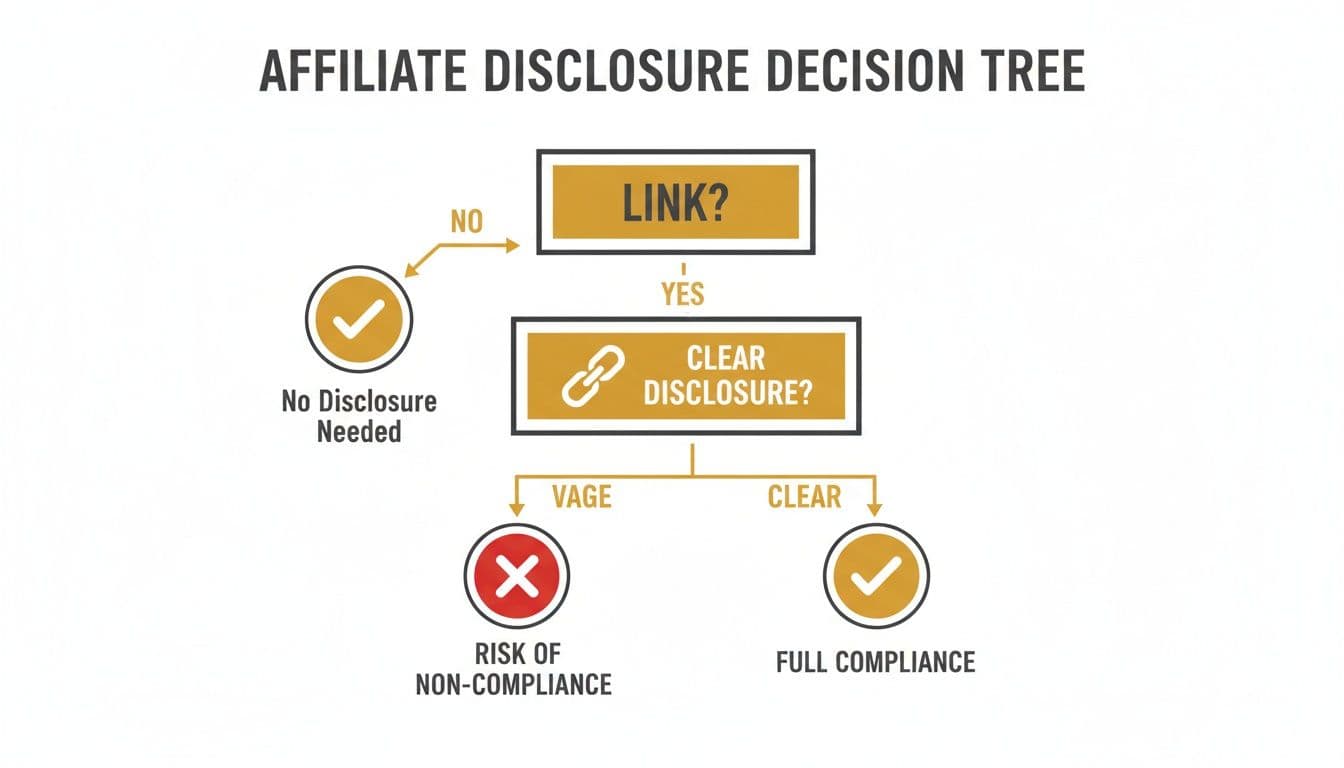
A good disclosure must be seen before a user clicks an affiliate link. Proximity matters: place disclosures near the link, not hidden in footers or on separate legal pages.
Website and blog post disclosures
On blogs, put the disclosure above the fold and before the first affiliate link. A short italicized sentence under the title or in the first paragraph works well.
Heads-up: This page contains affiliate links. If you buy something through one of our links, we may earn a commission at no extra cost to you. Thanks for your support!
This ensures visitors see the disclosure immediately.
Email and social media placement
- Email campaigns: Place a disclosure near the CTA or at the top of the message; a footer-only disclosure is not sufficient for prominent affiliate promotions.
- Social posts: Put #ad or #sponsored at the start of the caption. Don’t hide disclosures in long hashtag lists.
In-app disclosures for SaaS companies
When users create or share affiliate links from your product, remind them at the moment of action. Good places include:
- Referral pop-ups: “Remember to disclose this is an affiliate link when you share it!”
- Affiliate dashboards: A persistent banner or short reminder message.
- Link-sharing modals: Place disclosure text next to social share buttons.
As affiliate-driven spending grows, correct placement protects your program and reputation3.
Thinking globally about your affiliate disclosures
If your SaaS has international users, follow local regulators in addition to the FTC. The core rule is the same worldwide: disclosures must be clear and conspicuous56789.
A snapshot of international rules
- United Kingdom: The Advertising Standards Authority requires marketing to be “obviously identifiable,” so clear labels like #ad are essential.6
- European Union: The Unfair Commercial Practices Directive requires disclosures to be prominent and easy to understand.7
- Canada: The Competition Bureau expects disclosure of any “material connection” between promoter and brand.8
- Australia: The ACCC requires truthful, clear disclosure of paid endorsements.9
Crafting a universal disclosure strategy
Aim for a “highest common denominator” disclosure: plain English, placed above the fold, and unambiguous. A single, well-written policy can serve most markets and scale with your program.
Building a compliant and scalable affiliate program
Scaling an affiliate program means making compliance easy for partners. Two essentials: clear expectations and automation.
Your affiliate agreement should include a dedicated, visible clause requiring disclosures. Give partners specific examples they can copy.
Educating and onboarding affiliates
Provide simple, scannable resources on disclosure best practices:
- Welcome kit: One-page PDF with visuals and examples.
- Compliance email: Include disclosure guidance in the onboarding sequence.
- Resource hub: Permanent portal with templates, FAQs, and links to official guidelines.
These materials reduce mistakes and save time.
Automating and monitoring compliance
Use platform features and processes to reduce manual work:
- In-app prompts: Remind affiliates to disclose when they generate links.
- Automated reminders: Quarterly compliance emails to active affiliates.
- Spot-checks: Periodic scans of top-performing affiliates to catch issues early.
With affiliate spending and program scale on the rise, a system for compliance is essential4.
When violations occur, address them quickly and constructively. A friendly reminder often fixes the problem while preserving the partner relationship.
Your affiliate disclosure compliance checklist
| Compliance checkpoint | Current status (Yes/No) | Next steps |
|---|---|---|
| Is disclosure a mandatory clause in your affiliate agreement? | If no, update your T&Cs and notify affiliates. | |
| Do you provide clear disclosure examples during onboarding? | If no, add a one-page guide to your welcome kit. | |
| Is there a permanent compliance section in your affiliate portal? | If no, build a resource hub with templates and official links. | |
| Do you have an automated system for reminding affiliates? | If no, implement in-app prompts or quarterly reminder emails. | |
| Do you spot-check top-performing affiliates? | If no, schedule monthly or quarterly audits of your top partners. | |
| Is there a clear process for handling violations? | If no, outline a simple escalation process (warning → termination). |
Got questions? We’ve got answers on affiliate disclosures
Here are common edge cases and practical answers to keep your disclosures tight.
Is a single disclosure page enough?
No. A central disclosure page is useful for full details, but the FTC requires disclosures to be clear and conspicuous next to the claim or link they relate to. Don’t make readers hunt for the information.
How do I disclose on platforms with no space?
Lead with #ad or #sponsored at the start of the post. Use built-in platform tools (e.g., Instagram’s “Paid Partnership”) or add “(affiliate link)” next to short URLs.
Do I need a disclosure for every single link?
You need a clear disclosure each time a user sees a link. In long-form content, one conspicuous disclosure at the top can cover multiple links in the same piece. But on social, email, or separate pages, include a disclosure for each context.
Ready to turn your happiest customers into your best marketers? ShareMySaaS makes it happen with zero friction. Launch your affiliate program in minutes at https://sharemysaas.com.
Common questions (Q&A)
Q: Where should I put a disclosure on a blog post?
A: Put a short disclosure above the fold and before the first affiliate link so every visitor sees it without scrolling.
Q: What wording works best for social posts?
A: Start with #ad or #sponsored. If space allows, add “(affiliate link)” next to the URL or use the platform’s paid partnership feature.
Q: How do I enforce disclosure across many affiliates?
A: Make disclosure mandatory in your agreement, provide ready-to-copy templates during onboarding, and automate reminders and spot-checks in your affiliate platform.
1.
Awin, “State of the Industry” and insights on affiliate adoption. https://www.awin.com/us/insights
2.
Rakuten Advertising and industry reports on increased affiliate investment. https://rakutenadvertising.com
3.
Statista and industry research on affiliate-driven e-commerce sales and market size. https://www.statista.com/topics/3626/affiliate-marketing/
4.
Affiliate marketing spend and projections (industry reports). https://www.statista.com
5.
Federal Trade Commission, Endorsement Guides: What People Are Asking. https://www.ftc.gov/news-events/topics/business-center/advertising-and-marketing/endorsements
6.
UK Advertising Standards Authority, Influencer guidance and social media rules. https://www.asa.org.uk/advice-online/social-media-influencer-guidance.html
7.
European Commission, Unfair Commercial Practices Directive. https://eur-lex.europa.eu/eli/dir/2005/29/oj
8.
Competition Bureau Canada, deceptive marketing and endorsements guidance. https://competitionbureau.gc.ca/eic/site/cb-bc.nsf/eng/04290.html
9.
Australian Competition & Consumer Commission, influencer marketing and endorsements guidance. https://www.accc.gov.au/publications/influencer-marketing
💸 Get 10x More People SharingWith Zero-Friction Signup
Traditional sharing programs lose most potential promoters at signup. ShareMySaaS eliminates that barrier completely — users start sharing with one click, no forms required. Turn every satisfied customer into an active promoter and watch your reach explode.