Discover how do affiliate links work, from URL parameters and cookie tracking to automated payouts. A deep dive for SaaS founders and growth marketers.
January 11, 2026 (1mo ago)
How Do Affiliate Links Work A Guide for SaaS Founders
Discover how do affiliate links work, from URL parameters and cookie tracking to automated payouts. A deep dive for SaaS founders and growth marketers.
← Back to blog
How Affiliate Links Work for SaaS Founders
Summary: Learn how affiliate links track referrals, cookies, server-to-server postbacks, and automated payouts—practical guide for SaaS founders.
Introduction
Affiliate links turn a single click into measurable growth. For SaaS founders, understanding how links, cookies, pixels, and server-to-server (S2S) signals work together is essential to build a fair, scalable partner program. This guide explains the mechanics, attribution rules, and payout automation you need to run a reliable affiliate program.
What an Affiliate Link Actually Is
At its core, an affiliate link is a standard URL with a unique affiliate identifier attached. That ID tells your system which partner drove the click. When a visitor clicks the link, tracking begins—typically by storing that identifier in a cookie or by generating a click ID that your servers record.
When the visitor converts, your system matches the conversion back to the affiliate ID and issues a commission according to your rules.
The Hidden Mechanics Behind Every Affiliate Link

That one click sets off a precise tracking process. For the user, it’s invisible—they simply land on your site. Behind the scenes, your system records the affiliate ID, either in a cookie, a click ID, or both. Later, when a conversion happens, the recorded data determines who gets credit.
Modern partner programs have become a major channel for acquisition, with many companies running partner or affiliate programs to scale growth.1
A Powerful Engine for Business Growth
Affiliate and partner programs are performance-based: you only pay for measurable results like trials or paid subscriptions. This model scales effectively and, when done right, becomes a primary acquisition channel. Industry reports and market studies highlight the sizable contribution affiliate programs make to ecommerce and SaaS revenue.2
Tools such as ShareMySaaS simplify link generation, attribution, and payouts—so you don’t have to build the entire stack yourself.
The Anatomy of a SaaS Affiliate Link
A typical SaaS link without tracking might look like:
https://projectflow.com/pricing
Add a unique affiliate identifier and tracking parameters, and the URL becomes a data asset:
https://projectflow.com/pricing?ref=partner123&utm_campaign=q3_launch&subid=twitter_promo
Core Components
- Base URL — the landing page you want the visitor to see.
- Affiliate ID (e.g.,
ref=partner123) — credits the correct partner. - Campaign ID (e.g.,
utm_campaign=q3_launch) — groups clicks under a marketing push. - Sub-ID (e.g.,
subid=twitter_promo) — tracks a specific placement or creative.
These layers turn a simple link into a source of rich data for performance analysis and payout rules.
Following the Digital Breadcrumbs of a Click
Once a user clicks, tracking typically begins with cookies and can be reinforced with pixels and server-side signals.
Cookie-Based Tracking
Cookies act as small, browser-stored records that hold the affiliate ID and an expiration timestamp. If the user returns and converts within the attribution window, the cookie ties the sale to the affiliate.
Pixel Tracking
A tracking pixel on a confirmation page fires when a conversion occurs. The pixel signals back to the tracking server that a cookie-bearing user completed the desired action, confirming the conversion.
Server-to-Server (S2S) Tracking
S2S or postback tracking is the most reliable method for SaaS companies because conversions often happen across devices, sessions, or inside apps where cookies aren’t available. With S2S, your server sends a direct postback to the affiliate platform including a click ID, ensuring robust attribution even when cookies fail or users switch devices.3
Benefits of S2S tracking:
- Immune to cookie deletion and ad blockers
- Works across devices and mobile apps
- Recommended for long SaaS trial-to-paid timelines
Setting Rules for Fair Affiliate Commissions
Technology solves tracking, but your business rules define who gets paid. Clear, fair rules maintain partner trust and keep your program healthy.
Attribution Window
The attribution window is the period after a click during which the affiliate can earn a commission. Typical choices:
- 30 days — common starting point
- 60 days — for longer consideration cycles
- 90 days — for high-ticket or enterprise deals
Choose a window that fits how customers evaluate and buy your product.
Attribution Models
When a customer clicks multiple affiliate links, your attribution model decides who earns the commission. Common options:
- Last-click attribution — credit goes to the final affiliate before conversion (industry standard).
- First-click attribution — credit goes to the first touchpoint that introduced the customer.
More advanced models (linear, time-decay, weighted) can split credit across multiple touches, but first- and last-click are usually best for getting a clean program off the ground.
Turning Tracked Conversions Into Automated Payouts
Tracking alone isn’t enough. You need a reliable payout workflow that validates conversions, waits out refund/chargeback windows, and pays partners accurately and on time.
The Problems with Manual Payouts
Manual payout workflows—exporting data, matching conversions in spreadsheets, issuing payments one-by-one—are slow and error-prone. As your program grows, manual processing undermines trust and consumes operations time.
Integrated Payout Automation
A purpose-built affiliate platform integrates tracking and payments to automate the full cycle: validate a conversion, calculate the commission, and initiate payment through a gateway like Stripe. Automation reduces errors, improves partner trust, and saves time.4
Automating payouts also helps with compliance—collecting tax forms and storing payment details securely—so you can scale without a proportional increase in overhead.
Putting Your SaaS Affiliate Program Into Action
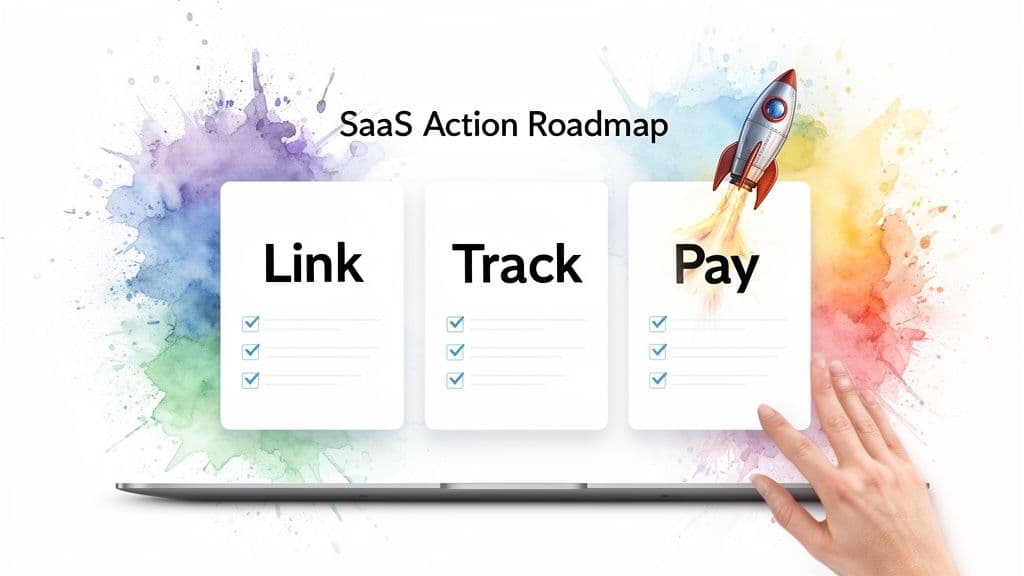
To summarize the flow: create unique links, track conversions accurately (prefer S2S for reliability), and pay commissions on a consistent, automated schedule. Each pillar must work well for the program to scale.
Many businesses find that affiliate marketing delivers strong ROI—industry sources report notable returns and continued growth in affiliate-driven revenue—underscoring the value of getting the operations right.2
The ShareMySaaS Approach
ShareMySaaS is built to remove friction from affiliate programs: instant in-app link generation, real-time tracking, flexible reward structures, and automated Stripe payouts. The goal is to make it simple for product teams to launch and scale a trustworthy partner program.
Affiliate Link FAQs
Can I be an affiliate for my own product?
No. Most programs prohibit self-referrals because affiliates are meant to bring new customers. Allowing self-referrals effectively gives a permanent discount to existing users and undermines the program.
How long does an affiliate link last?
The link remains valid indefinitely, but the tracking cookie’s duration—your attribution window—determines how long a click can earn a commission (e.g., 30, 60, or 90 days).
Do I need a website to be an affiliate?
No. Affiliates can use email, social media, YouTube descriptions, or paid ads. What matters is an audience that trusts their recommendations.
Quick Q&A (3 concise user-focused sections)
Q: What tracking method should my SaaS use first?
A: Start with cookie + pixel tracking for simplicity, then implement server-to-server postbacks for reliable attribution across devices and long conversion windows.
Q: Which attribution window should I pick?
A: Match the window to your sales cycle. Use 30 days for short cycles, 60 days for mid-length, and 90 days for enterprise or long-consideration purchases.
Q: How do I scale payouts without errors?
A: Use an integrated affiliate platform that automates validation and payouts via a payment gateway so you avoid spreadsheets and manual reconciliation.
1.
Many companies now run partner or affiliate programs as part of their acquisition strategy; see Partnerize, “The State of Partnerships.” https://partnerize.com/resources/state-of-partnerships/
2.
Affiliate programs contribute a meaningful share of ecommerce sales and deliver strong ROI; see FirstPromoter, “Affiliate Marketing Stats 2025.” https://firstpromoter.com/blog/affiliate-marketing-stats-2025
3.
Server-to-server (postback) tracking provides accurate cross-device attribution and resilience to cookie loss; see Adjust, “Server to Server (S2S) Tracking.” https://www.adjust.com/glossary/server-to-server/
4.
Automated payout systems integrate with payment gateways such as Stripe to validate and pay commissions; see Stripe documentation and payout solutions. https://stripe.com
💸 Get 10x More People SharingWith Zero-Friction Signup
Traditional sharing programs lose most potential promoters at signup. ShareMySaaS eliminates that barrier completely — users start sharing with one click, no forms required. Turn every satisfied customer into an active promoter and watch your reach explode.