Learn how to build a referral program that fuels sustainable growth. This guide covers actionable strategies for designing rewards, automation, and promotion.
January 14, 2026 (1mo ago)
How to Build a Referral Program That Drives Real SaaS Growth
Learn how to build a referral program that fuels sustainable growth. This guide covers actionable strategies for designing rewards, automation, and promotion.
← Back to blog
How to Build a Referral Program That Drives Real SaaS Growth
Learn how to build a referral program that fuels sustainable growth. This guide covers actionable strategies for designing rewards, automation, and promotion.
Introduction
A great referral program is a predictable growth channel, not a lucky break. Start by defining what “success” means for your SaaS, model the economics, and remove friction so sharing becomes an impulse. This guide walks through goals, rewards, UX, automation, promotion, and measurement so you can launch a program that scales.
Before You Build Anything
Before you think about in-app prompts or catchy email copy, lay the groundwork. A well-engineered referral program ties directly to your financial metrics and is measured from day one. This is the difference between a program that fizzles and one that becomes a reliable source of customers and revenue.
Building the Foundation for a Winning Referral Program
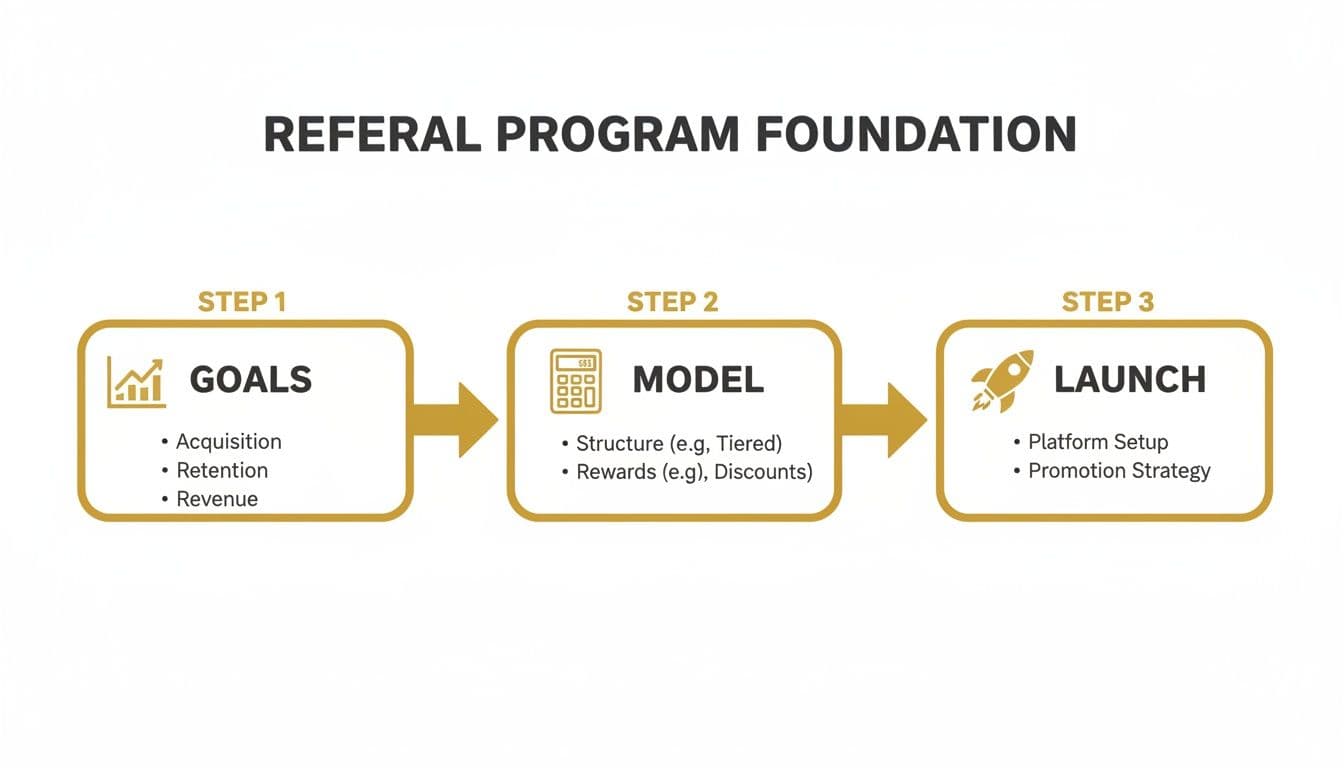
Let’s be honest: a referral program without clear goals is just a shot in the dark. The aim is to turn your most enthusiastic customers into a predictable acquisition engine, not to chase short-term buzz. Anchor your program to the financial KPIs that matter to your business.
Define Your Key Business Objectives
Decide which SaaS KPI you want to move:
- Increase Monthly Recurring Revenue (MRR): target new subscribers who retain.
- Lower Customer Acquisition Cost (CAC): referrals often cost far less than paid channels.
- Boost Customer Lifetime Value (LTV): referred customers typically perform better on retention and value.1
A common mistake is treating referrals as only a top-of-funnel tactic. A well-designed program can improve conversion, retention, and the loyalty of existing advocates.
Key Metrics for Your Referral Program Dashboard
Track these essential metrics to measure health and ROI:
| Metric | What It Measures | Why It Matters for SaaS |
|---|---|---|
| Participation Rate | % of active users who joined the program | Shows how compelling your offer is and how well you promote it |
| Share Rate | % of participants actively sharing their link | Indicates advocate engagement |
| Click-Through Rate (CTR) | % of shared links that get clicked | Reveals effectiveness of advocate messaging |
| Conversion Rate | % of clicks that become sign-ups or subscribers | The ultimate test of program quality |
| CAC via Referrals | Reward cost / new customers acquired | Compares channel efficiency against paid channels |
| LTV of Referred Customers | Revenue generated over a referred customer’s lifetime | Compare to non-referred LTV to prove long-term value |
Having these numbers will help you prove the program’s worth and make smarter decisions.
Model the Financial Impact of Your Rewards
Work the math before you launch. Use your LTV and target CAC to determine how much you can afford to pay for a referral.
Example: if LTV = $1,200 and target CAC = $400, that $400 is your acquisition budget. A $100 reward cuts CAC to $100, a 75% reduction versus your target. Whether you run customer-to-customer referrals or a structured affiliate program, the economics must work.
Explore partner marketing and affiliate tools to broaden incentives and distribution when needed.2
Designing a Reward Structure That Truly Motivates
The reward is the engine of your referral program. Get it right and you’ll convert happy customers into motivated advocates.

This isn’t about only tossing cash or credits at people. It’s about tapping into what motivates them and creating a win-win aligned with a recurring revenue model.
Recurring vs. One-Time Payouts
Choose between a simple one-time payout or a recurring commission that mirrors subscription revenue:
- One-time payout: easy to understand, good for lower-priced products or annual-plan incentives.
- Recurring commission: pays a percentage of subscription fees for a period, aligning your advocate’s incentives with retention.
Pick the model that balances acquisition cost with long-term value.
The Power of Dual-Sided Incentives
Rewarding both the referrer and the referred customer removes social awkwardness and increases conversion. A dual-sided offer feels like a gift, creates urgency for the new user, and strengthens the relationship between advocate and brand.
Gamifying with Tiered Rewards
Tiered rewards gamify referrals and nurture super-advocates. Example:
- Referrals 1–5: $50 per sign-up
- Referrals 6–10: $75 per sign-up
- 10+ Referrals: $100 per sign-up plus exclusive perks
Tiering keeps top performers engaged and gives advocates goals to aim for.
Nailing the User Experience: Make Sharing Effortless
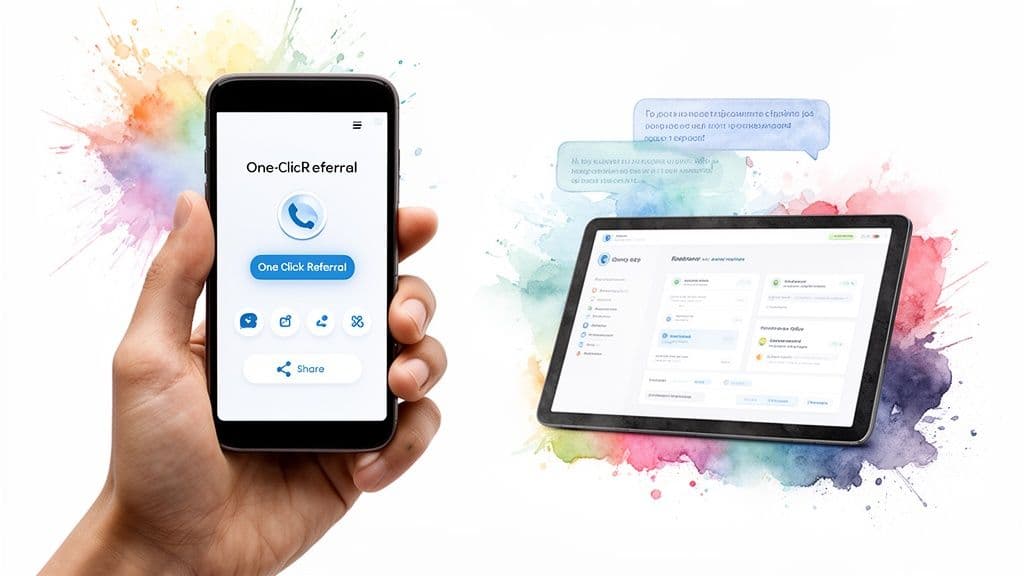
A generous reward won’t matter if sharing is a chore. Remove friction and make sharing a one-click decision at moments of user success.
Weave the Program Directly into Your Product
Place referral touchpoints where users already engage:
- User dashboard or account menu
- Right after a user achieves a milestone
- Billing and account pages
Embedding the program makes it a natural part of the product experience.
Give Them a Ready-Made Sharing Kit
Don’t force advocates to write messages from scratch. Provide a referral dashboard with:
- Unique referral link and a prominent “Copy link” button
- Pre-written social posts for X and LinkedIn
- A pre-written email they can send in seconds
Make sharing painless and transparent.
Use Smart, Timely In-App Prompts
Use subtle, behavior-driven nudges rather than generic pop-ups. If a user has been active frequently or hit an advanced milestone, show a small, dismissible prompt: “Loving our tool? Share it and you both get $50 off.” Contextual timing outperforms broad blasts.
Automating Your Tracking, Attribution, and Payouts
Manual tracking and payouts don’t scale. Build an automated backbone so advocates are credited fairly and paid on time. This builds trust and reduces administrative headaches.
Nailing Your Click and Conversion Tracking
Give each advocate a unique referral link. When someone clicks, record the click and drop a tracking cookie that stores the referrer’s ID. A 30–60 day cookie window is common for SaaS, ensuring the advocate gets credit if the new user converts later.3
Choosing the Right Attribution Model
Last-touch attribution—crediting the last referral link clicked—is simple and easy for advocates to understand, which is why most programs adopt it. As your program matures, consider tools that handle multi-touch attribution.
Automating Payouts to Build Trust
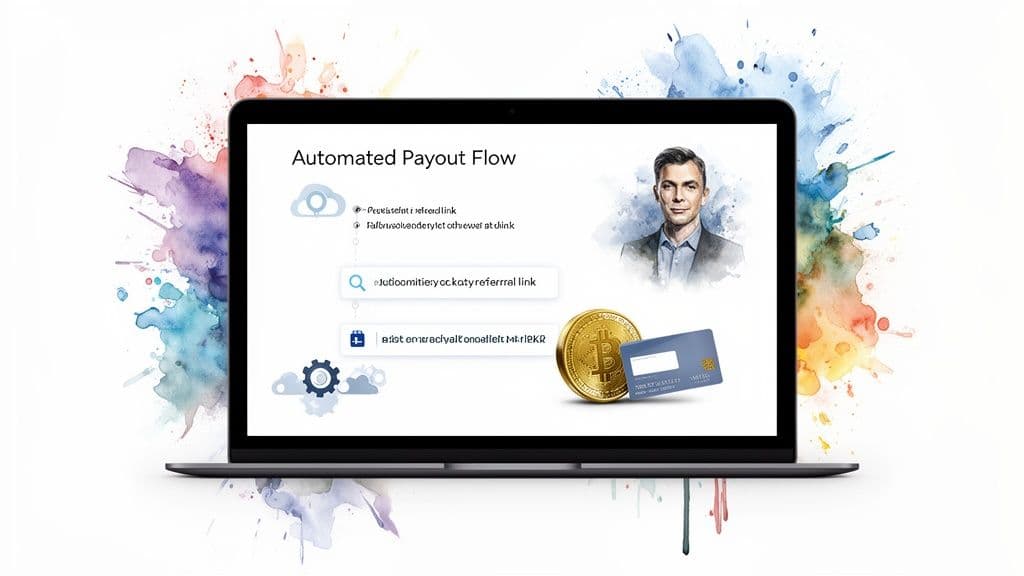
Automate payouts to avoid delays and errors. Integrations with payment processors like Stripe Connect handle commission calculation, payout scheduling, and tax compliance, so advocates get paid reliably and on time.4
Getting the Word Out and Scaling for Growth
Building the program is the start. Promotion and continuous optimization make it a sustainable acquisition channel.
Your Launch and Promotion Playbook
Make sure every user knows the program exists. Use:
- Targeted email sequences that highlight rewards and ease of sharing
- Contextual in-app notifications after moments of success
- A permanent spot in your app UI so the program is always a click away
Marketing automation tools help trigger the right message at the right time.
Find and Empower Your Super Advocates
Identify the top 1–5% of advocates who drive most referrals. Treat them like partners: send personal thank-you notes, offer higher commissions, early access, or direct product feedback channels. These relationships multiply your results.
Adopt a Mindset of Constant Improvement
Run A/B tests on reward models, messaging, and landing pages. Test one-time payouts versus recurring commissions, different headlines, and layout variations to reduce friction and improve conversions.
Frequently Asked Questions About SaaS Referral Programs
How Much Should I Actually Pay for a Referral?
Base rewards on your unit economics. Use your LTV-to-CAC target as a guide; a healthy target is often around 3:1 LTV:CAC. For recurring commissions, model the total payout over a defined period and compare it to expected LTV.
What’s the Real Difference Between a Referral and an Affiliate Program?
Referral programs target existing customers and leverage relationships, often with small rewards or dual-sided discounts. Affiliate programs target external marketers and publishers, rewarding performance at scale with commissions.
How Do I Stop People from Gaming the System?
Prevent fraud by counting referrals only after a valid payment, setting payout thresholds, and monitoring for suspicious patterns like multiple sign-ups from one IP address.
Ready to turn your happiest customers into your most powerful growth channel without the friction? ShareMySaaS lets you launch a one-click referral program directly inside your app. Automate tracking, streamline payouts, and make sharing effortless for your users.
Get started with ShareMySaaS today
Quick Q&A (Concise)
Q: What’s the first step to build a referral program?
A: Define the business objective—MRR, CAC, or LTV—and model the reward so it fits your unit economics.
Q: How do I make users share more?
A: Remove friction: embed referral touchpoints in the app, offer a ready-made sharing kit, and use contextual prompts at success moments.
Q: How do I ensure fair attribution and payouts?
A: Use unique referral links, persistent cookies with a clear window, adopt a simple attribution model like last-touch, and automate payouts via a payment platform.
1.
Nielsen, “Global Trust in Advertising” (2015), https://www.nielsen.com/us/en/insights/article/2015/global-trust-in-advertising-2015/
2.
Referral marketing and partner program overview, Referral Rock, https://referralrock.com/blog/referral-marketing-statistics/
3.
Best practices for attribution windows and tracking, Branch blog, https://branch.io/resources/
4.
Stripe Connect documentation, https://stripe.com/docs/connect
💸 Get 10x More People SharingWith Zero-Friction Signup
Traditional sharing programs lose most potential promoters at signup. ShareMySaaS eliminates that barrier completely — users start sharing with one click, no forms required. Turn every satisfied customer into an active promoter and watch your reach explode.