Learn how to build a performance-driven affiliate program for SaaS. This practical guide explains goals, reward models, tracking, payouts, compliance, and scaling so you can turn advocates into predictable revenue.
November 19, 2025 (3mo ago) — last updated January 26, 2026 (1mo ago)
SaaS Affiliate Program Guide: Setup, Tracking & Payouts
Step-by-step guide to build and scale a SaaS affiliate program: setup, reward models, reliable tracking, payouts, compliance, and analytics for predictable growth.
← Back to blog
SaaS Affiliate Program Guide: Setup, Tracking & Payouts
Learn how to build a performance-driven affiliate program for SaaS. This guide walks through goals, reward models, tracking, payouts, compliance, and scaling so you can turn advocates into predictable revenue.
How to Create an Affiliate Program That Works
Learn how to create an affiliate program with this complete SaaS guide. Follow actionable steps for setup, rewards, tracking, payouts, and scaling to turn advocates into a predictable growth channel.
Building an affiliate program comes down to a few clear decisions: set measurable goals, pick the right reward structure, choose reliable tracking, make link creation instant, and publish fair rules. For SaaS, the aim is to turn your happiest customers and trusted creators into a performance-driven growth channel with minimal friction.
A SaaS Playbook for Affiliate-Led Growth
If you want to scale user acquisition predictably, an affiliate program is one of the smartest plays. It amplifies word-of-mouth and converts it into a measurable acquisition channel. Instead of paying for impressions, you pay for results — new trials or paying customers — making affiliate marketing capital-efficient for early-stage SaaS.
Give your advocates simple tools and a clear incentive, and you create a distributed marketing team that has skin in the game. A well-designed program removes barriers so people can sign up, share, and earn.
Key Components of a Modern Program
A successful program combines a few critical elements:
- Zero-friction activation: Unique affiliate links should be available instantly inside your app.
- Clear reward structures: Keep commissions simple — recurring percentage, flat fee, or tiered bonuses — and aligned with your margins.
- Automated tracking and payouts: Reliable attribution and on-time payments (for example, via Stripe) build trust.
- Support and resources: Provide swipe copy, brand assets, and best-practice guides so partners can promote effectively.
This guide walks through each component step by step.
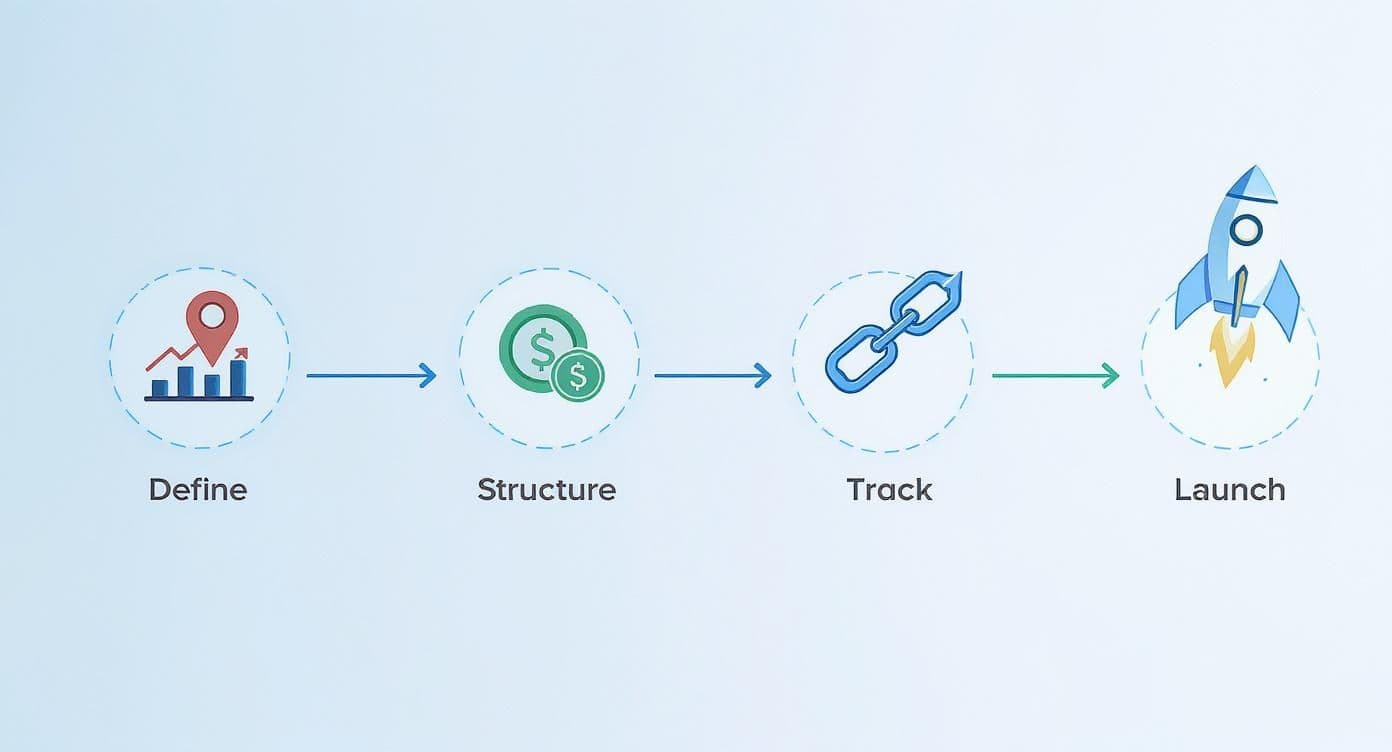
Affiliate Program Launch Framework
| Phase | Key Action | Outcome |
|---|---|---|
| 1. Strategy & Design | Define goals and set reward structure | A motivating incentive model aligned with business goals |
| 2. Technical Setup | Choose and integrate tracking software; enable in-app link generation | A seamless, automated system for affiliates to join and share |
| 3. Legal & Compliance | Draft clear affiliate terms and conditions | A compliant program that protects you and your partners |
| 4. Launch & Promotion | Announce the program and distribute assets | A launch that attracts your first wave of quality affiliates |
Why Your SaaS Needs an Affiliate Program
An affiliate program is more than another channel — it’s a performance-first growth engine. You partner with creators, experts, and customers who already have trust with your target audience. You only pay commission when they deliver tangible results, which converts fixed marketing spend into a scalable variable cost.
This model can improve customer quality and retention while maintaining predictable customer acquisition costs (CAC). Affiliates often introduce your product via trusted recommendations, which accelerates buyer confidence and shortens the sales cycle.

The affiliate channel is growing rapidly; investing in a program now positions your SaaS to ride that momentum1.
Tapping into Trusted Voices
Recommendations from respected bloggers, YouTubers, and industry peers carry far more weight than most ads. Target these partner types:
- Content creators who review software in your niche
- Industry influencers and consultants who recommend tools to clients
- Happy customers who already refer friends
Each group connects you with engaged, relevant audiences that are costly to reach with paid ads.
A Cost-Effective Acquisition Channel
Affiliate marketing ties acquisition costs directly to revenue, which de-risks your budget and helps you scale profitably. With the right commission structure, you can keep customer acquisition profitable while expanding reach.
Affiliate programs also scale as your network grows, and affiliates frequently send better-fit customers who convert and retain at higher rates. For deeper retention tactics, see our SaaS retention strategies.
Market Context and Growth
Affiliate marketing spend in the U.S. is projected to keep rising through the mid-2020s, and industry reports show strong ROI potential for disciplined programs12.
Designing Your Goals and Reward Structures
Decide up front whether your primary objective is trial sign-ups, paid conversions, or enterprise leads. This choice drives partner selection, messaging, and payout math.
- Align incentives with goals: Reward the specific action you want (trial, paid signup, demo).
- Match rewards to margins: Protect long-term value by sizing commissions against lifetime value.
- Measure what matters: Track conversion rates, average deal size, and partner ROI.
Understanding Your Program Objectives
Clear objectives sharpen affiliate messaging and reporting. If trials are the priority, affiliates will promote risk-free evaluations; if paid conversions are the focus, content should push full signups or demos.
Exploring Reward Structures
Common structures include:
| Structure Type | Typical Rate | Best For |
|---|---|---|
| Percentage | 20–30% recurring | Subscription SaaS |
| Fixed | $50–$200 per referral | High-ticket or one-time sales |
| Tiered | 10%→40% at volume | Scaling top performers |
Test new models with a small affiliate group before a full rollout. Cap commissions sensibly and revisit limits quarterly.
Writing Clear Terms
Draft plain-language affiliate terms that cover:
- Payment clarity: Rates, payout schedule, minimum thresholds
- Attribution rules: Cookie duration and crediting model
- Conduct guidelines: Approved promotion methods and disclosure requirements
Run a pilot to catch edge cases, then publish the final terms in your partner resource kit. For implementation ideas, review our affiliate marketing for SaaS guide.
Setting Performance Benchmarks
Track these early metrics:
- Conversion rate from referred traffic
- Time to first referral per affiliate
- Partner retention and activation rates
A clear dashboard helps you spot underperforming tiers or attribution issues quickly.
Setting Up Tracking and Attribution Systems
Your program depends on reliable tracking. Affiliates expect unique links in seconds and transparent reporting. Build a user-friendly dashboard and ensure your backend supports:
- Click, view, and conversion tracking
- Configurable cookie windows and attribution rules
- Multi-touch crediting when appropriate
- Fraud detection and dispute workflows
Many teams integrate tools like ShareMySaaS, PartnerStack, or Impact to speed setup and reduce errors.
Key Tracking Software Options
| Software | Setup Time | API | Pricing Model |
|---|---|---|---|
| ShareMySaaS | ~5 mins | Yes | Success-based |
| PartnerStack | ~10 mins | Yes | Tiered fees |
| Impact | ~15 mins | Yes | Subscription |
Choose a tool that supports your attribution model and integrates with your CRM and billing.
Multi-Touch Attribution Explained
Attribution options include:
- Last-click: Credits the final referrer
- First-click: Credits the initial touch
- Linear: Splits credit across touches
- Time-decay: Places more weight on recent interactions
Multi-touch models increase fairness but add complexity. Decide based on partner expectations and product buying cycles.
Integrating With Stripe Payouts
Automating payouts is essential. Use a webhook to trigger payments when rewards hit minimum thresholds, schedule weekly or monthly disbursements, and flag failed transfers instantly. This reduces disputes and builds trust.
Optimizing Tracking Over Time
Maintain tracking accuracy by:
- Reviewing webhook logs for failures
- Testing cookie behavior across browsers and devices
- Adjusting attribution windows as products and campaigns evolve
Regular audits can reduce tracking errors and disputes significantly.
Connecting Data to Insights
Link affiliate logs to BI tools to:
- Map referrals to customer lifetime value
- Run cohort analyses to identify top performers
- Align reward tiers with margin impact
These insights turn raw clicks into a roadmap for growth.
Pre-Launch Compliance and Activation Checklist
A smooth launch requires legal, technical, and operational checks before you go live. Your terms of service and privacy policy must explicitly cover affiliate tracking and data use.
Provide a commission agreement that explains payout timing, refund treatment, and dispute resolution. Supply disclosure guidance so affiliates comply with FTC rules — give them simple copy like “#ad” or “I may earn a commission from links on this page.”
Getting Legal and Compliance Right
Define approved marketing methods and explicitly ban actions like bidding on your branded keywords or using misleading coupon sites. Include attribution details — cookie window and crediting model — in your terms.
Package onboarding materials (sample emails, social posts, brand assets) into a resource kit so new partners can start promoting immediately.
Testing and Activation: The Dry Run
Run a full staging test: create links, simulate signups, confirm tracking, and validate payouts in Stripe. Test mobile, desktop, and email client flows to avoid attribution black holes.
Testing checklist:
- Create a unique affiliate link in-app and verify it’s generated instantly.
- Use the link to simulate a conversion and confirm tracking logs.
- Verify payout notifications and sample commission statements.
- Confirm the point person for launch-day affiliate support.
The Final Go/No-Go Checklist
Run a final alignment check across teams and consider a small private beta with trusted affiliates to capture last-minute feedback.
| Task | Status | Owner |
|---|---|---|
| Legal documents reviewed | Done | Legal team |
| Links tested across platforms | In progress | Dev team |
| Payout settings validated | Done | Finance |
| Resource kit distributed | Ready | Marketing |
Pro Tips
- Keep onboarding copy in templates so affiliates can join in minutes.
- Version-control legal docs and record consent dates.
- Set automated reminders for contract renewals and failed payouts.
- Create a Slack channel for affiliate support to build community and speed responses.
Scaling Your Program with Smart Payouts and Analytics
Once live, focus on two things: paying partners on time and using data to improve performance. Automate payouts (Stripe is a common choice) and set rules like minimum thresholds and post-refund waiting periods.
Mastering Your Affiliate Analytics
Track a compact KPI set:
- Click-through rate (CTR)
- Conversion rate (CVR)
- Average revenue per affiliate (ARPA)
- Earnings per click (EPC)
These metrics help you prioritize support and scale the partners who drive the best value.
Identifying and Empowering Top Performers
Expect the Pareto Principle: a small percentage of affiliates will drive most revenue. Identify your top performers and give them VIP support — higher commissions, co-branded assets, or early feature access — to multiply their impact.
Troubleshooting Common Hurdles
Common issues include cookie expiration confusion and payment errors. Communicate cookie windows clearly and set up automated alerts for failed Stripe transfers so you can fix problems before partners notice.
Look for new affiliates in B2B networks and niche communities, and consider contests or leaderboards to boost engagement.
Frequently Asked Questions
A SaaS affiliate program pairs verified users or niche influencers with your product. Partners share an exclusive link and earn commission when a referred user signs up for a trial or becomes a paying customer.
Top FAQs
-
How do I pick the right commission structure? Recurring commissions (typically 20–30%) reward partners who refer long-term subscribers. One-off fees work for high-margin or short-lifecycle sales. Use tiered incentives to reward volume.
-
What tracking setup actually works? Cookie-based tracking with a fair window (30–90 days) is standard. Consider multi-touch attribution if you want to reward multiple contributors to the same conversion.
-
What are best practices for payouts? Lock in payout currency and minimums before launch, trigger payouts once refund windows close, and provide clear statements to partners so they understand earnings.
Quick Q&A — Common Founder Questions
Q: What’s the first thing I should do?
A: Define a clear objective — trials, paid users, or enterprise leads — and choose a commission model that preserves margin while motivating partners.
Q: How do I avoid disputes over tracking?
A: Use reliable tracking software, publish your cookie and attribution policy, and audit logs and webhook failures regularly to catch issues early.
Q: How do I scale without losing control?
A: Automate payouts, segment top performers for VIP treatment, and tie analytics to margin impact so expansion remains profitable.
Three Concise Q&A for Quick Reference
Q: What metrics should I watch first? A: CTR, CVR, ARPA, and EPC give a fast view of channel health and partner value.
Q: How should I size commissions initially? A: Start conservative, aligned to expected LTV, then raise rates for proven top performers.
Q: How long should the cookie window be? A: 30–90 days is typical; pick based on your sales cycle and test adjustments.
1.
Statista, “Affiliate marketing spending in the United States from 2018 to 2028 (in billion U.S. dollars),” https://www.statista.com/statistics/1126014/affiliate-marketing-spending-usa/
2.
Fluent Affiliate, “Is Affiliate Marketing Worth It?,” https://fluentaffiliate.com/blog/is-affiliate-marketing-worth-it/
💸 Get 10x More People SharingWith Zero-Friction Signup
Traditional sharing programs lose most potential promoters at signup. ShareMySaaS eliminates that barrier completely — users start sharing with one click, no forms required. Turn every satisfied customer into an active promoter and watch your reach explode.