Start by measuring the full cost to acquire a customer. This guide shows how to calculate a fully loaded CAC, segment it by channel, optimize your funnel and ads, and increase retention so each acquisition dollar goes further.
December 23, 2025 (1mo ago) — last updated January 21, 2026 (6d ago)
Reduce Customer Acquisition Cost (CAC) - SaaS Growth Tips
Lower your SaaS CAC with actionable tactics: measure true CAC, optimize funnels, use AI for ads, grow organic channels, and boost retention.
← Back to blog
Reduce Customer Acquisition Cost (CAC) - SaaS Growth Tips
Summary: Proven SaaS tactics to lower CAC: measure fully loaded CAC, optimize funnels, use AI for ads, grow organic channels, and boost retention.
Introduction
Start by measuring the full cost to acquire a customer. This guide shows how to calculate a fully loaded CAC, segment it by channel, optimize your funnel and ad spend, and increase retention so each acquisition dollar goes further.
Establishing Your Baseline to Understand True CAC
You can’t fix what you don’t measure. The first critical step is establishing a clear, comprehensive baseline for customer acquisition cost (CAC). Too many teams track only ad spend, which gives an incomplete picture.
Thinking CAC is just Ad Spend / New Customers is a common mistake. A fully loaded CAC accounts for all direct and indirect costs tied to acquisition.
Calculating a Fully Loaded CAC
A fully loaded CAC includes more than clicks and impressions. Typical line items are:
- Salaries: portion of marketing and sales salaries devoted to acquisition.
- Tools and software: CRM, marketing automation, analytics, and ad tools.
- Content creation: blog posts, videos, webinars, and assets meant to attract and convert leads.
- Ad spend: paid campaigns on Google, LinkedIn, Facebook, and other platforms.
- Overhead: prorated share of general marketing and office costs.
A truly accurate CAC calculation is the foundation of sustainable growth. Without it, you’re flying blind and can’t tell profitable channels from money pits.
For a deeper guide, see How to Reduce Customer Acquisition Cost.
Segmenting CAC by Channel
A blended CAC is a start, but the real insights come from channel-level CAC. Paid social might have a high CAC while organic search brings customers at a fraction of that cost. Segmenting helps you reallocate budget where it will have the biggest impact.
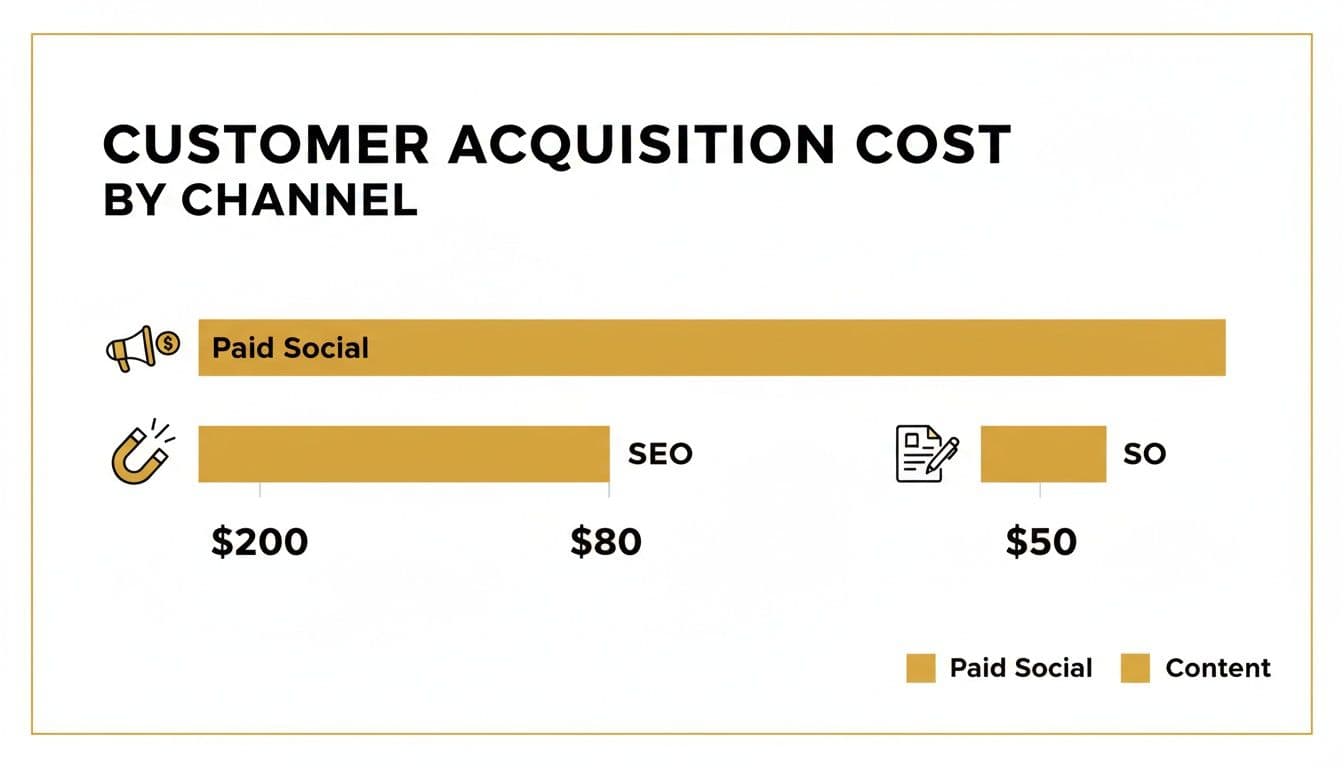
Here’s a simple template to think about which expenses to attribute to each channel.
| Expense Category | Paid Social | Organic Search (SEO) | Content Marketing |
|---|---|---|---|
| Ad Spend | Direct campaign costs | Not applicable | Promotion spend for content |
| Team Salaries | Portion of social media manager’s salary | Portion of SEO specialist’s salary | Portion of content creator’s salary |
| Tools/Software | Ad management & scheduling tools | SEO tools (e.g., Ahrefs, SEMrush) | Writing tools, design software |
| Content Creation | Ad creatives (video, images) | Freelance writer fees for SEO articles | Freelance fees, stock assets, video |
| Overhead | Prorated share of marketing costs | Prorated share of marketing costs | Prorated share of marketing costs |
Fill this out with your own numbers to get a clearer, channel-specific view of acquisition costs.
Understanding the LTV to CAC Ratio
Knowing CAC is only half the story. Compare CAC against customer lifetime value (LTV) to see if your spending is sustainable. A commonly cited healthy LTV/CAC ratio is about 3:1 or higher1. In short, every dollar spent to acquire a customer should return about three dollars in revenue over that customer’s lifetime.
- Below 1:1 is a red flag — you’re losing money on each new customer.
- Around 1:1 means you’re breaking even on acquisition, with no margin for operations or profit.
- 3:1 or higher suggests a solid, profitable model.
A high CAC can be acceptable if LTV is also high. This ratio helps distinguish good spending from wasted spending and clarifies the real return on your marketing investment.
With these baselines established, you’ll be ready to make strategic decisions to bring CAC down for good.
Optimizing Your Funnel to Maximize Conversions
Traffic is only half the battle. Turning visitors into paying customers is where CAC is truly decided. A leaky funnel burns budget fast because you pay for clicks that don’t convert.
Fixing those leaks will get you more customers from the same ad spend. Conversion rate optimization (CRO) is about understanding user behavior, finding friction, and methodically testing improvements. Even small lifts compound into much lower CAC.

Find the Friction with User Behavior Analysis
Don’t guess — watch. Use qualitative and quantitative tools to find where people get stuck.
- Heatmaps: Tools like Hotjar or Crazy Egg show where users click, move, and scroll. You might discover people trying to click non-links or missing your main CTA.
- Session recordings: Watch anonymized recordings of real users to spot confusion and friction that metrics alone can’t show.
These insights point you to the parts of your funnel that need attention.
High-Impact Areas for SaaS Funnel Optimization
Common high-impact areas:
- Landing pages: Ensure the ad promise matches the page. Make your value proposition crystal clear above the fold.
- Sign-up forms: Ask for the minimum. One company cut a seven-field form to three fields and saw a 35% jump in trial sign-ups.
- First product experience: Guide users to the “aha” moment quickly using product tours, checklists, and tooltips.
Key takeaway: Every extra form field or unclear step is a reason to leave. Get users to value fast, then gather more info later.
Running Data-Driven A/B Tests
A/B testing moves you from guessing to knowing. Approach it like this:
- Form a hypothesis based on research.
- Create a variation with the single change to test.
- Run the test with a tool like Google Optimize or Optimizely.
- Analyze results once statistically significant.
By iterating on pages, forms, and onboarding, you’ll lower CAC through steady, compounding improvements.
Making Your Paid Ad Spend Work Smarter, Not Harder
Paid acquisition can scale fast, and it can also burn cash fast. Stop spraying and start aiming. Use data to serve ads only to prospects likely to convert.

Use AI to Build Hyper-Targeted Audiences
AI and machine learning can find patterns humans miss. Letting AI optimize campaigns can lower acquisition costs significantly; some teams report declines up to 50% when they apply AI-driven targeting and optimization2.
Practical tactics:
- Lookalike audiences: Upload a list of your best customers to Facebook or Google to find similar high-intent prospects.
- Predictive targeting: Use tools that score website visitors in real time and serve ads only to users likely to convert.
Move from demographic targeting to behavioral and predictive targeting to avoid paying for clicks that won’t convert.
Let the Machines Handle Bidding and Optimization
Automated bidding tools like Google’s Performance Max use machine learning to optimize bids for your goals. They analyze signals such as device, time of day, and user behavior to improve efficiency. That said, automated systems need clean data — if conversion tracking is messy, results will be too. Get your UTM parameters and conversion tracking right4.
Win Back Lost Leads with Smarter Remarketing
Most visitors don’t convert on the first visit. Segment remarketing lists and tailor messages:
- Pricing page visitors: Address pricing objections or highlight top features.
- Trial sign-ups who ghosted: Offer tutorials or invite them to a quick walkthrough.
- Cart abandoners: Remind them what they left behind, possibly with a time-limited incentive.
Relevant messaging increases the chance of winning them back at a fraction of the cost of a brand-new lead.
Building Long-Term Growth with Organic Channels
Paid wins can be fast, but sustainable CAC reduction comes from building owned assets. Organic channels are long-term investments that compound: publish valuable content and you’ll attract high-intent customers without ongoing ad spend.
Dominate Search with Value-Driven SEO and Content
Great SEO answers your customer’s real questions better than anyone else. Focus on problem-aware content, long-tail keywords, and evergreen assets that continue to attract traffic and leads over time.
- Problem-aware content: Write in-depth guides and original research that solve core pain points.
- Long-tail keywords: Target specific phrases that signal deep interest, like “how to automate client onboarding for agencies.”
- Evergreen assets: A single comprehensive post or free tool can drive leads for years.
Content compounds: an article published today can keep generating customers long-term and push the effective CAC for that channel toward zero.
Turn Customers Into a Powerful Acquisition Channel
Happy customers are your most believable promoters. A structured referral or affiliate program turns word-of-mouth into a predictable channel. Creator and partner initiatives can produce substantially lower costs per lead compared with traditional ads, sometimes 30–40% lower3.
Implementing In-App Referral Programs
Ask for referrals when users have a great experience inside your product. In-app referral tools make sharing instant and frictionless. A simple checklist:
- Automate link generation inside the app.
- Offer compelling rewards and test what works — credits, upgrades, or cash?
- Provide real-time tracking so referrers see clicks, sign-ups, and rewards.
Forge Strategic Affiliate and Creator Partnerships
Partner with creators whose audiences match your ideal customer. Typical commission structures:
| Partner Type | Best For Reaching... | Typical Commission |
|---|---|---|
| Industry Bloggers | Niche, high-intent audiences | 20–30% recurring |
| YouTubers | Visual demos and tutorials | 15–25% recurring or flat fee |
| Newsletter Creators | Engaged, loyal readers | 25–35% recurring |
Give partners demo accounts and authentic briefings so they can create honest, effective content.
Boosting Retention to Lower Your Effective CAC
Acquiring a customer is expensive. Keeping them is the ultimate way to lower effective CAC because retention increases LTV. Focus on the first 90 days — most preventable churn happens here. Nail the initial experience and your acquisition dollars go much further.
Perfecting the First 90 Days
Get users to the “aha” moment fast. Practical moves:
- Smarter welcome emails personalized with sign-up data.
- In-app checklists that guide new users through critical setup steps.
- Proactive check-ins, automated or from success managers, to catch issues early.
Improving early retention increases the LTV side of the LTV/CAC equation, making each acquisition dollar more valuable.
Using Data to Prevent Churn
Monitor usage patterns to spot churn risk. Identify users who log in less or stop using key features and re-engage them with targeted content, feature highlights, or one-on-one support. For more retention tactics, see SaaS retention strategies.
Every customer you retain is one you don’t have to replace.
Quick Guide to Reducing CAC
| Strategy | Primary Goal | Key Metric to Track | Expected Impact |
|---|---|---|---|
| Optimize conversion funnel | Increase visitors who become customers | Lead-to-customer conversion rate | Significant reduction |
| Improve onboarding & retention | Reduce churn and increase LTV | Churn rate, LTV | Major long-term reduction |
| Boost organic & referral channels | Acquire customers through low-cost channels | Organic traffic, referral signups | Drastic reduction |
| Refine paid targeting | Spend only on high-intent profiles | CPC, CPL | Moderate to significant reduction |
Ready to turn your happiest customers into your most effective acquisition channel? ShareMySaaS makes it effortless to launch a zero-friction, in-app referral program that gets real results. Activate your user base with a single click at https://sharemysaas.com.
Top CAC Questions
Q: What single metric should I watch first to lower CAC?
A: Track your fully loaded CAC and the LTV/CAC ratio together; they tell you whether acquisition is sustainable and where to prioritize fixes.
Q: Should I prioritize paid ads or organic growth?
A: Do both. Paid delivers speed while organic and referral channels compound and lower long-term CAC.
Q: Where do I get the biggest short-term wins?
A: Improve conversions in your funnel and patch onboarding leaks; small lifts in conversion rates dramatically cut CAC.
1.
SaaS Capital, “What is a Good LTV:CAC Ratio?” https://www.saas-capital.com/blog/ltv-cac-ratio/
2.
inbeat.agency, “Customer Acquisition Statistics” https://inbeat.agency/blog/customer-acquisition-statistics
3.
Growth-onomics, “Customer Acquisition Cost by Industry: 2025 Trends” https://growth-onomics.com/customer-acquisition-cost-by-industry-2025-trends/
4.
HubSpot, “How to Calculate Customer Acquisition Cost (CAC)” https://blog.hubspot.com/marketing/how-to-calculate-customer-acquisition-cost
💸 Get 10x More People SharingWith Zero-Friction Signup
Traditional sharing programs lose most potential promoters at signup. ShareMySaaS eliminates that barrier completely — users start sharing with one click, no forms required. Turn every satisfied customer into an active promoter and watch your reach explode.