Learn how to start a referral program that drives real growth. Our guide covers goal setting, reward design, automation, and scaling for SaaS companies.
November 20, 2025 (2mo ago)
How to Start a Referral Program That Works
Learn how to start a referral program that drives real growth. Our guide covers goal setting, reward design, automation, and scaling for SaaS companies.
← Back to blog
How to Start a Referral Program That Works
Learn how to start a referral program that drives real growth. This guide walks you through goal setting, reward design, frictionless sharing, automation, promotion, and scaling for SaaS companies.
Define Success Before You Pick Rewards
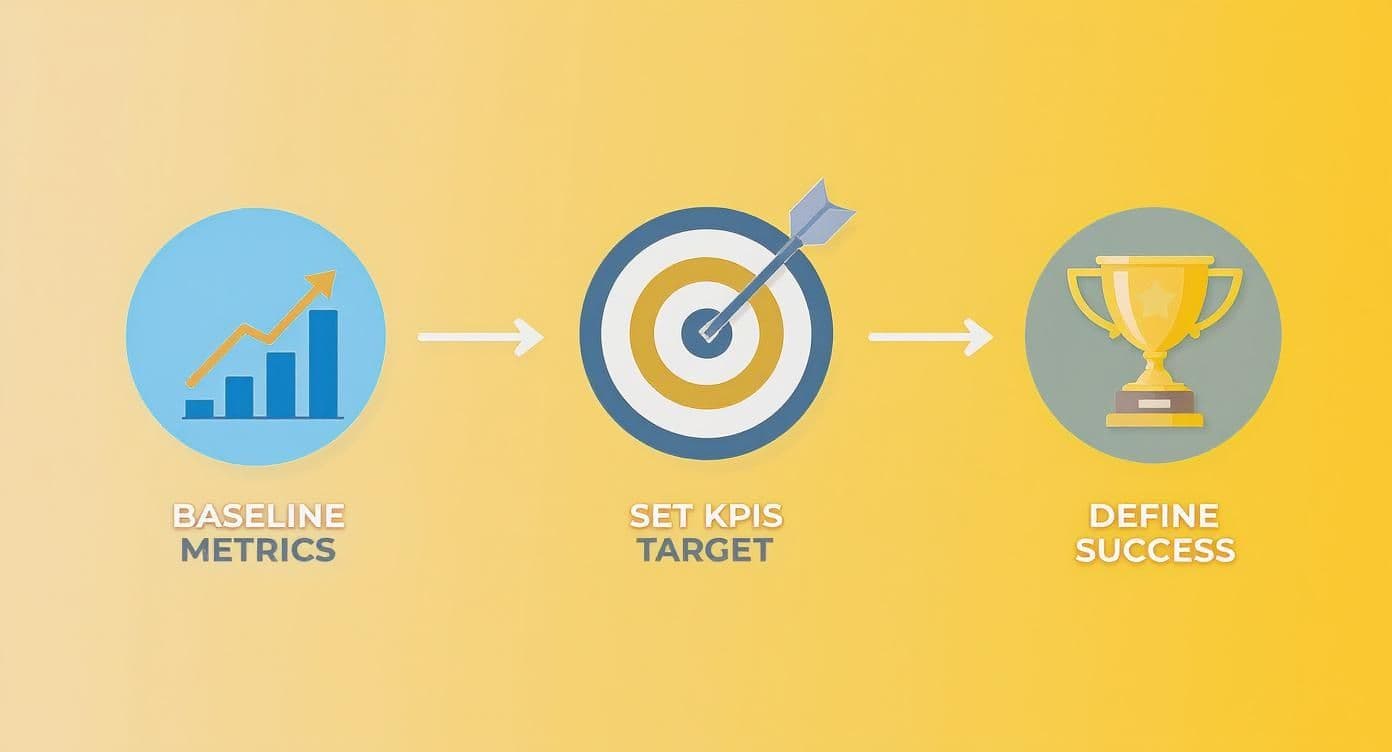
Before you think about rewards, define what success looks like. Are you trying to lower customer acquisition cost, boost lifetime value, or improve trial-to-paid conversion? Clarifying this up front turns a one-off marketing tactic into a repeatable growth engine.
Set Clear, Actionable Goals
Vague goals like “get more signups” won’t move the needle. Link your referral program to a measurable business objective that your team already tracks, such as CAC, LTV, trial conversion rate, or new-market adoption. That alignment will shape your reward structure, messaging, and targeting.
Common SaaS goals to consider:
- Boost trial-to-paid conversion
- Drive adoption of a new premium feature
- Expand into a new region or market
- Increase team invitations and product usage
A referral program without a clear goal is like a ship without a rudder. Anchor it to a single business metric everyone understands.
Establish Baseline Metrics
Take a snapshot of current metrics before launch. If your goal is lower CAC, record your average CAC today. If it’s higher LTV, measure the LTV of non-referred customers. These benchmarks let you prove the program’s impact.
Choose the Right KPIs
Pick KPIs that map directly to your goal. Top KPIs for referral programs include:
- Advocate participation rate: percentage of eligible users sharing links
- Referral conversion rate: clicks-to-paid customers from referral links
- Cost per acquisition (CPA) from referrals: total reward cost per new customer
- Revenue from referrals: MRR or ARR attributed to referred customers
The best SaaS teams often see referrals drive 15–30% of revenue1, and referred customers can have substantially higher lifetime value2. Track these numbers from day one so you can measure growth and ROI.
Design Rewards That Actually Motivate
Rewards are the heart of your program. A weak reward won’t get shared. Pick incentives that feel valuable and relevant to your users, and model the financial impact before you launch.
What your users value depends on your product and audience. For some audiences cash is top motivator; for others, account credits, feature upgrades, or early access are more compelling. Non-cash incentives can outperform cash in the right context5.
Common SaaS Reward Models
- Account credits: Ties the reward to product usage and drives retention. Example: $50 credit for a successful referral.
- Recurring commission: Advocate earns a percentage of the referred customer’s subscription for a set period.
- Cash bonuses: Simple and direct. Works well for high-ticket products.
- Feature upgrades or early access: Great for passionate user bases and builds loyalty.
The best rewards deepen a customer’s relationship with your product. Credits and upgrades reinforce the value they already get from you.
Two-Sided Incentives Win
Two-sided incentives—rewarding both the advocate and the referred friend—create a true win-win. Advocates can say, “Use my link for 25% off,” which reduces social friction and improves conversion.
Model the Financial Impact
Run a simple financial model using LTV and CAC. Your total reward cost must be meaningfully less than your CAC to be profitable. For example, if CAC is $400 and LTV is $2,000, offering $50 to the advocate and $50 to the new customer is likely profitable.
Reward Model Comparison
| Reward Type | How It Works | Best For | Potential Downside |
|---|---|---|---|
| Percentage commission | Advocate gets a % of new customer’s subscription | High-LTV subscriptions | Harder to track, costly if churn is high |
| Fixed cash bonus | One-time cash payment per conversion | High-ticket products, simplicity | Less incentive for long-term referrals |
| Account credits | Credit applied to advocate’s bill | Retention and engagement | Less useful if advocate’s account is pre-paid |
| Exclusive features | Early access or premium upgrade | Highly engaged user base | Subjective value; won’t motivate everyone |
Choose rewards that make sense for your economics and for what motivates your users.
Build a Frictionless Sharing Experience
If referring feels like a chore, users won’t do it. Make sharing seamless: instant personal links, contextual prompts at moments of peak happiness, and an intuitive advocate dashboard.

Instant Unique Links
Every authenticated user should have a referral link generated automatically. One-click in-app buttons that surface a personal link remove the biggest barrier to sharing. Capture advocates at the moment they feel positive about your product.
Prompt at Peak Moments
Trigger sharing prompts when users hit success milestones, leave a high NPS score, or upgrade their plan. These contextual invites feel natural and significantly increase participation.
Examples of peak moments:
- After completing a major task or hitting a milestone
- Following a positive support interaction
- Immediately after a plan upgrade
The most effective prompts feel like a natural next step after a positive experience, not a marketing interruption.
Advocate Dashboard
Provide a clear dashboard where advocates can:
- Access and share their unique link with one click
- Track clicks, signups, and conversions in real time
- View pending, approved, and paid rewards
- Use pre-written messages and shareable assets
Transparency and easy sharing remove excuses and keep advocates engaged.
Automate Tracking and Payouts to Build Trust
Trust is everything. Accurate attribution and timely payouts are essential. Automation removes human error and gives advocates confidence their work will be recognized and rewarded.

Pick an Attribution Model
Decide how you’ll assign credit. Two common models:
- First-touch attribution: Credit goes to the first referral link clicked.
- Last-touch attribution: Credit goes to the final referral link clicked before purchase.
Most SaaS companies prefer last-touch attribution because it rewards the advocate who closed the deal and is easier to track.
Set a Sensible Cookie Duration
Match cookie duration to your sales cycle. Suggested windows:
| Sales cycle | Recommended cookie duration |
|---|---|
| < 24 hours | 30 days |
| 1–4 weeks | 60–90 days |
| > 1 month | 90–120 days |
Aligning cookie length to buying behavior prevents missed attributions and avoids over-crediting short-cycle purchases6.
Automate Payouts via Payment Gateway
Integrate with a payment gateway like Stripe to automate payouts. When a referral converts and is approved, the system should trigger the payment automatically. Automated payouts build trust and reduce operational overhead. By automating tracking and payments you create a reliable program advocates can trust 3.
Launch, Promote, and Keep Momentum
A great program is useless if nobody knows about it. Treat launch as a coordinated campaign across email, in-app, and social channels. Then bake the program into ongoing touchpoints so it stays visible.
Launch Playbook
- Dedicated email announcement with a clear subject like “Earn $50 for Sharing [Product].”
- In-app banners, tooltips, and pop-ups for engaged users
- Social posts with concise visuals and a direct link to the referral dashboard
Onboard Advocates with Tools
Provide pre-written messages, shareable images, and short instructions on tracking and payouts. Make sharing as easy as copy-and-paste so advocates feel confident promoting your product.
Keep the program visible in onboarding sequences, website footers, and email signatures so it becomes a steady acquisition channel.
Iterate, Test, and Scale
Treat launch as version 1.0. Use data to replace assumptions with evidence. Focus testing on the elements that most influence sharing and conversion.
High-Impact Tests
- Reward amount: Is $50 meaningfully better than $25?
- Reward structure: Two-sided “Give $25, Get $25” versus one-sided “Get $50”
- Hook and copy: Benefit-driven vs. direct-money headlines
- Email subject lines: Which drives opens and clicks?
Small gains in critical areas compound into large improvements over time.
Metrics to Watch While Scaling
Keep a dashboard with these metrics front and center:
- Advocate participation rate
- Referral conversion rate
- Time to first referral
If participation is high but conversion is low, focus on the referral landing page and the offer for the referred friend. If time to first referral is long, improve onboarding and prompt timing.
Common Questions
How much should we budget for rewards?
Use your average CAC as a guide. The total reward per acquired customer should be comfortably below your CAC so the program lowers acquisition cost overall.
Should we reward the referrer only, or both parties?
Two-sided incentives are generally more effective for SaaS because they reduce social friction and improve conversion. Give the friend a meaningful trial discount or credit and reward the advocate when that friend converts.
When should we ask for a referral?
Ask at moments of peak happiness: after a major milestone, upon an upgrade, or right after a high NPS score. Timing the ask to a positive experience dramatically increases participation.
Quick Q&A — Top 3 User Questions
Q: How do I know if a referral program will reduce my CAC?
A: Compare your current CAC to the total reward cost per referral in a simple model. If the reward cost is meaningfully lower than CAC and referred customers have higher LTV, referral programs typically reduce CAC.
Q: What reward structure should I start with?
A: Begin with a two-sided reward tied to product value, such as account credits or a short premium upgrade for advocates and a discount for friends. Monitor conversion and adjust amounts based on CPA and participation.
Q: How do I prevent fraud and low-quality referrals?
A: Require a conversion event that signals genuine use — for example, a paid plan activation or a usage threshold — before approving rewards. Combine behavioral checks with automation to flag suspicious patterns.
1.
Referral program benchmarks and impact on revenue, ReferralCandy, “Referral Program Statistics.” https://www.referralcandy.com/blog/referral-program-statistics
2.
Data on higher value of referred customers, Extole/industry research. https://www.extole.com
3.
Prediction on automation adoption in B2B referral tracking, Gartner. https://www.gartner.com
4.
Study on digital payouts improving referral completion rates. https://www.paymentsdive.com
5.
Research on non-cash incentives effectiveness in referral and loyalty programs. https://www.bain.com
6.
Best practices for cookie duration and attribution in referral programs, Chargebee blog. https://www.chargebee.com/blog/referral-programs
💸 Get 10x More People SharingWith Zero-Friction Signup
Traditional sharing programs lose most potential promoters at signup. ShareMySaaS eliminates that barrier completely — users start sharing with one click, no forms required. Turn every satisfied customer into an active promoter and watch your reach explode.