Learn how to start affiliate program for your SaaS with a practical step-by-step guide: set goals, design commissions, recruit partners, and scale revenue.
December 10, 2025 (2mo ago)
How to Start Affiliate Program: how to start affiliate program for growth
Learn how to start affiliate program for your SaaS with a practical step-by-step guide: set goals, design commissions, recruit partners, and scale revenue.
← Back to blog
Start an Affiliate Program for SaaS Growth
Summary: Step-by-step guide to launch a SaaS affiliate program: set goals, design commissions, choose tracking software, recruit partners, and scale revenue.
Introduction
Before you choose software or finalize commission rates, start with strategy. Too many SaaS founders rush into building an affiliate program and end up spending a fortune while attracting the wrong customers. A reliable program rests on four clear stages: define your strategy, design a motivating commission structure, pick tracking and payout software, and then recruit the right partners.
Get the foundation right and every tactical decision that follows becomes easier and more effective.
Building the Foundation for Your Affiliate Program
A successful affiliate program plugs directly into your company’s growth goals. Skip strategy and you’re building on sand. Performance-based marketing can scale fast, but only when it’s aligned to the right KPIs and partner profiles.1
Define Your Program Goals and KPIs
“More sales” is not a goal. Connect the affiliate channel to the SaaS metrics that matter most so the program becomes a genuine growth engine, not a vanity channel.
Consider these objectives:
- Lower Customer Acquisition Cost (CAC): Aim for affiliate CAC to be better than paid channels like Google or Facebook Ads.
- Increase Customer Lifetime Value (LTV): Target partners who send customers likely to stick around and upgrade.
- Drive Specific Product Adoption: Use affiliates to push a new premium plan or a feature trial.
- Expand into New Markets: Partner with local voices to build a beachhead in a new country.
A precise example: “Achieve a 4:1 LTV:CAC ratio from our affiliate channel within 12 months.” That clarity guides everything from commission levels to partner approvals.
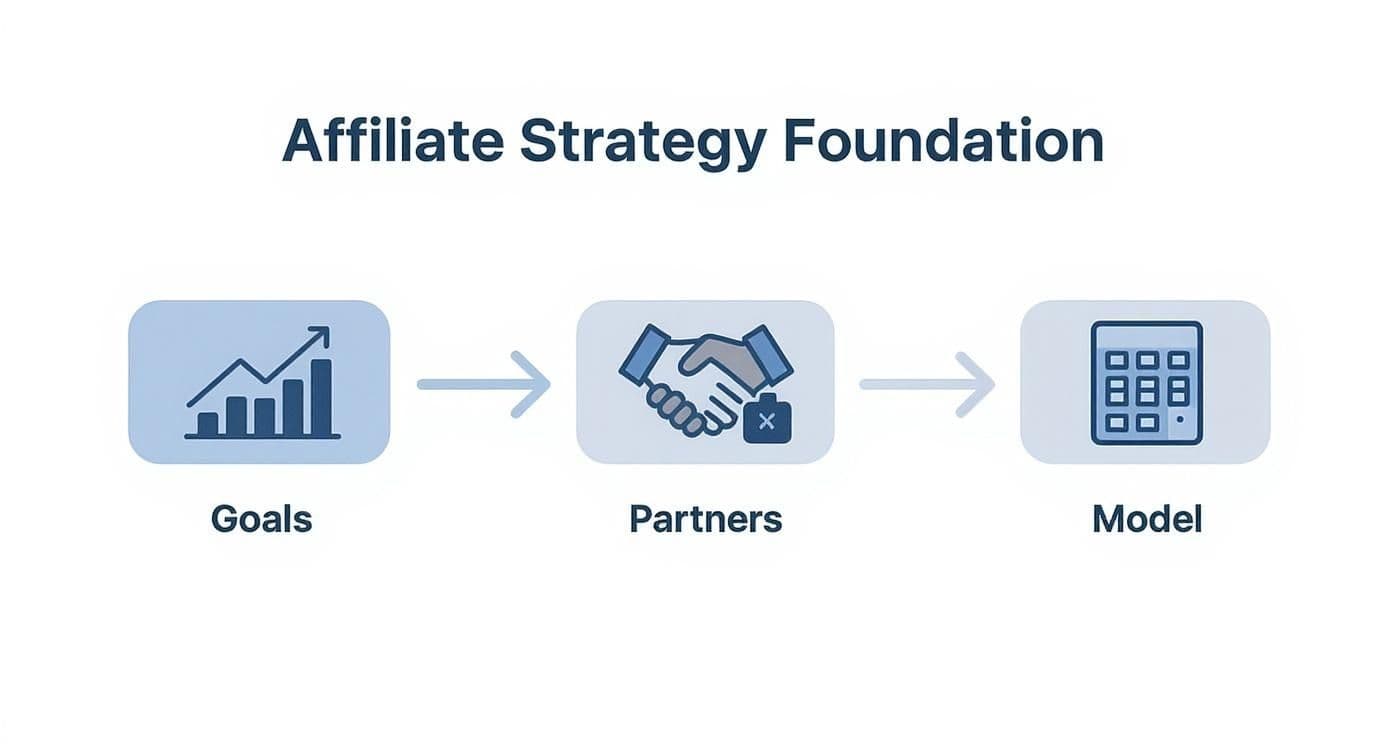
This sequence matters: goals inform partner selection, which determines the financial model you build.
Key Strategic Decisions Before Launch
| Decision Area | Key Considerations | Example Objective |
|---|---|---|
| Primary Goal (KPI) | Which business metric must the program impact? CAC, LTV, MRR, market expansion? | Lower blended CAC by 15% within 9 months by making the affiliate channel our most efficient paid channel. |
| Ideal Partner Persona | Who already has the trust of your target customer? Content creators, agencies, tech partners, influencers? | Recruit 25 B2B marketing bloggers with an audience of agency owners and marketing managers. |
| Competitive Landscape | What commission structures and terms do competitors use? How can you offer more value beyond %? | Offer a 90-day cookie window, compared to the industry standard of 30, to attract top content partners. 6 |
| Budget & Financial Model | What’s the maximum CAC you’ll accept via affiliates? How does that align with LTV? | Maintain a 3:1 LTV to CAC ratio for all customers acquired through affiliates. |
| Brand & Compliance Rules | What are non-negotiables for partner messaging? (e.g., no bidding on branded keywords.) | Prohibit PPC brand bidding to protect paid search from cannibalization. |
Making these decisions upfront prevents confusion and ensures every part of your program aligns to a clear purpose.
Identify Your Ideal Affiliate Persona
Not all affiliates are equal. The partners you recruit will determine the customers you acquire. Don’t approve everyone—define the persona of your perfect partner.
Who already influences your ideal customer?
- Industry bloggers and content creators, who write tutorials, reviews, and comparison posts.
- Complementary tech partners, like tools in your customers’ stack.
- Consultants and agencies, who can bring sticky, high-value clients.
- Existing power users, your happiest customers who already advocate for you.
Focusing outreach on this persona saves time and brings higher-quality referrals.
Designing a Commission Structure That Motivates
Your commission structure is the engine of the program. Get it right and you’ll attract partners who promote for the long term. Get it wrong and engagement will lag while costs rise.

Recurring vs One-Time Payouts
For subscription businesses, recurring commissions align affiliates’ incentives with yours. Typical recurring rates sit around 20–30% of subscription revenue, depending on LTV and margins.5
One-time commissions offer a larger immediate payout, which can attract affiliates focused on fast cash flow, like paid ad specialists. The downside is they may drive less-retained customers.
Pro tip: hybrid models can work well, for example a higher first-month payout plus a smaller recurring share thereafter.
Advanced Commission Tactics
Move beyond a flat rate to supercharge performance:
- Tiered Commissions: Increase rates as affiliates drive more sales to gamify growth.
- Limited-Time Bonuses: Use short sprints or cash bonuses around launches.
- Performance-Based Rewards: Pay extras for high-quality outcomes, like customers who stay beyond three months or upgrade tiers.
Example tiered structure:
| Tier Level | Monthly Sales Required | Commission Rate |
|---|---|---|
| Partner | 1–10 sales | 20% recurring |
| Pro | 11–25 sales | 25% recurring |
| Elite | 26+ sales | 30% recurring |
This gives affiliates clear goals and rewards top performers.
Choosing the Right Tech for Flawless Tracking
Trust is everything. If affiliates don’t believe conversions are tracked correctly, they’ll stop promoting you. Your platform must generate unique tracking links, calculate commissions, and automate payouts reliably.
Core Features Your Platform Must Have
Focus on non-negotiables:
- Rock-solid tracking and attribution, including server-to-server (postback) options for durability beyond browser cookies.
- An intuitive affiliate dashboard where partners can grab links, see clicks, conversions, and commissions in real time.
- Seamless automated payouts, integrated with a processor like Stripe so payments are on time and accurate.
Choosing a platform without automated payouts creates ongoing manual work that distracts from strategic growth.
Understanding the Technical Side of Tracking
Most platforms use cookie-based tracking with a cookie window, often 30, 60, or 90 days. With browser privacy changes, server-to-server tracking is increasingly important for reliability. Use UTMs for campaign-level insight and link them to your analytics setup to understand which content drives quality referrals. See our guide on Google Analytics UTM parameters for setup details: https://sharemysaas.com/blog/google-analytics-utm-parameters.
Self-Hosted vs SaaS Affiliate Platforms
Building in-house looks cheaper but hides ongoing maintenance, security, and reliability costs. For most businesses, a mature affiliate SaaS platform is the sensible choice. These vendors handle tracking complexities and updates so you can focus on growth.
Recruiting and Onboarding Your First Affiliates
With strategy and tech in place, start recruiting partners who already have the trust of your ideal customers. Focus on quality rather than mass sign-ups.

Finding Your First High-Potential Affiliates
Start inward:
- Power users who already love your product.
- People who’ve given testimonials or taken part in case studies.
- Social mentions on X, LinkedIn, or niche groups—these organic evangelists are ideal first partners.
Aim for a small core group of 5–15 engaged affiliates to start, then scale once you have a repeatable activation playbook.
Crafting Outreach That Gets a Response
Avoid generic emails. Be personal, concise, and focused on what’s in it for them:
- Reference a specific piece of their content.
- Lead with the value to their audience—commission, cookie window, or exclusive promos.
- Keep it scannable and end with a single call to action.
For outreach templates and deeper tactics, see our recruiting guide: https://sharemysaas.com/blog/how-to-recruit-affiliates.
Designing a Seamless Onboarding Experience
The goal is activation, not just sign-ups. Give new partners a Welcome Kit to remove friction and set them up for a quick win.
Elements of a great Welcome Kit:
| Resource | Description | Why It Matters |
|---|---|---|
| Welcome Video | Short, personal video from the partnership manager. | Builds a human connection. |
| Program Guide (PDF) | One-page policy sheet with rates, cookie window, and rules. | Reduces confusion and support volume. |
| Marketing Assets | Shared folder with logos, banners, screenshots, and copy. | Makes promotion easy. |
| Link Generation Guide | Quick GIF or tutorial showing how to create the first tracking link. | Removes a common activation barrier. |
A strong onboarding flow increases the percentage of affiliates who drive their first referral.
Keeping the Momentum: Manage and Scale for the Long Haul
Launching is only the beginning. Sustainable growth means consistent management: nurturing partners, monitoring the program’s health, and scaling what works.
Affiliate programs are growing quickly, and savvy brands that build trust with partners win market share. In the U.S., affiliate spend and business adoption continue to rise, showing how critical these channels have become for growth-oriented companies.2
Nurture Your Affiliates Like a Community
Treat affiliates as partners, not lead sources. Provide regular value:
- Share success stories and playbooks from top performers.
- Give product roadmaps so partners can plan content.
- Offer partner-only webinars and resources that help affiliates grow their own businesses.
A partner newsletter should help affiliates succeed, not just sell to them.
Monitor Program Health with the Right KPIs
Measure beyond top-line revenue. Vital signs include:
- Affiliate Activation Rate: Percentage of approved affiliates who drive their first click or referral.
- Conversion Rate by Partner: Identifies who’s sending high-intent traffic.
- Revenue Per Affiliate: Shows where your wins are concentrated.
This data-first approach helps you focus time on the highest-leverage activities.
Identify and Empower Your All-Stars
Expect the 80/20 rule: a small group will drive most revenue. Invest in those all-stars with VIP treatment—custom commission tiers, co-hosted events, or exclusive bonuses. Re-engage dormant affiliates with automated email sequences and short-term incentives.
Common Questions About Starting an Affiliate Program
How much should I pay affiliates?
It depends on your margins and LTV. For many SaaS businesses, recurring commissions in the 20–30% range are competitive, but model this against your LTV and CAC so affiliate CAC remains attractive versus other channels.5
How do I prevent affiliate fraud?
Use a layered approach: pick software with fraud detection, set clear terms banning deceptive tactics, manually review applications, and hold payments briefly (for example, 30 days) to catch refunds or churn before paying commissions.
How many affiliates do I need to start?
Quality beats quantity. Start with 5–15 ideal affiliates you can support individually. Once you prove activation and ROI with this cohort, scale recruitment.
Turn your happiest customers into your most powerful promoters with ShareMySaaS. Our platform makes launching an affiliate program as easy as a single click, embedding referral links directly into your app for zero-friction sharing. Automate your growth with ShareMySaaS today.
1.
Business of Apps, “Affiliate Marketing Statistics,” https://www.businessofapps.com/data/affiliate-marketing-statistics/.
2.
HubSpot, “Affiliate Marketing Statistics,” https://blog.hubspot.com/marketing/affiliate-marketing-stats.
3.
Grand View Research, “Affiliate Marketing Market Size, Share & Trends Analysis Report,” https://www.grandviewresearch.com/industry-analysis/affiliate-marketing-market.
4.
BrightLocal, “Local Consumer Review Survey,” https://www.brightlocal.com/research/local-consumer-review-survey/.
5.
PartnerStack, “How to Choose Affiliate Commission Rates,” https://partnerstack.com/blog/affiliate-commission.
6.
Awin, “Cookie Tracking and Attribution Explained,” https://www.awin.com/us/blog/cookie-tracking.
💸 Get 10x More People SharingWith Zero-Friction Signup
Traditional sharing programs lose most potential promoters at signup. ShareMySaaS eliminates that barrier completely — users start sharing with one click, no forms required. Turn every satisfied customer into an active promoter and watch your reach explode.