In the crowded SaaS landscape, customer recommendations are one of the most trusted acquisition channels. This article presents 10 practical referral program ideas — from in-app sharing and tiered rewards to affiliate integration and automated payouts — with implementation tips and metrics to scale.
January 15, 2026 (1mo ago) — last updated February 28, 2026 (4d ago)
10 Referral Program Ideas for SaaS Growth
Boost SaaS growth with 10 proven referral program ideas: in‑app prompts, tiered rewards, affiliate integration, and tracking tips to scale.
← Back to blog
10 Referral Program Ideas That Drive SaaS Growth
Summary: Discover 10 practical referral ideas to boost SaaS growth with reward models, UX patterns, and optimization tips you can implement today.
Introduction
In the crowded SaaS landscape, recommendations from customers are one of the most trusted signals, and referral programs turn that trust into predictable growth1. Many programs fail because of friction, weak incentives, or poor visibility. The difference between a program that drives a few sign-ups and one that fuels sustained growth is the reward structure, the user experience, and the automation behind it.
A well-designed referral program turns your happiest customers into a reliable acquisition channel, lowering customer acquisition cost and improving retention. This article offers ten practical ideas: in-app UX patterns that capture users at the right moment, tiered and performance-based incentives, community tactics, and the operational systems you need to scale.
You’ll find real-world examples, implementation tips, and the metrics to measure success so you can build a referral engine that scales.
1. In-App Pop-Up Referral Links
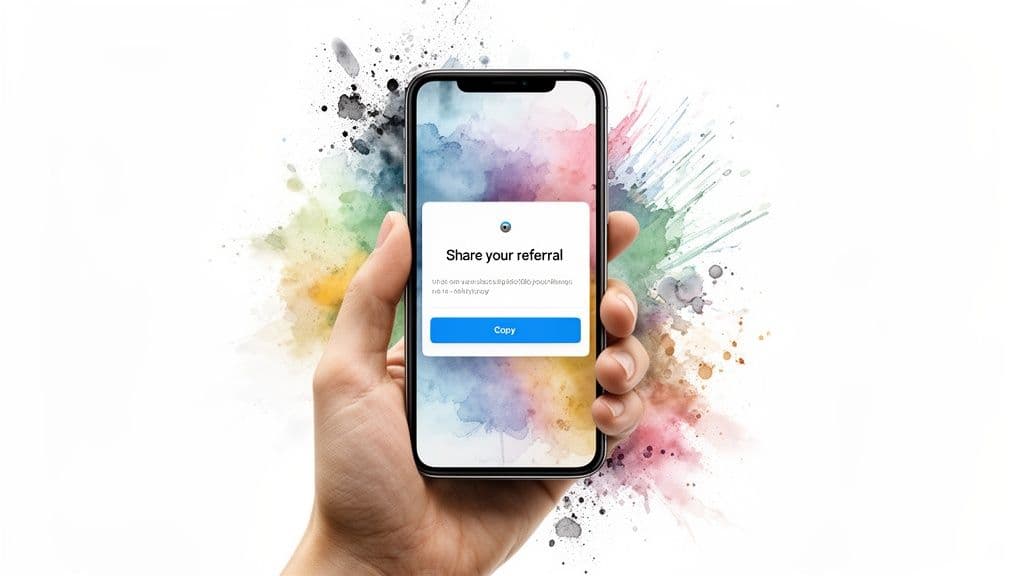
Embed referrals directly in your product with subtle, contextual in-app pop-ups, modals, or sticky bars that surface a unique, pre-generated referral link. The goal is to remove friction so users can copy and share instantly without leaving their workflow.
Show the prompt at “aha moments” — after a user completes onboarding, exports a report, or hits a milestone — when they’re most likely to share. Dropbox and other product-led growth examples used in-product prompts to accelerate viral loops2.
Why this works
Contextual prompts reduce friction and feel like a product feature, not a marketing interruption. When timed to user success, conversion and share rates rise.
How to implement
- Trigger after value moments rather than on login.
- Use benefit-focused copy: “Give 20% off, get $20 in credits.”
- Segment audiences: target engaged users or high-NPS customers first.
- A/B test placements: modal, corner slide-in, or persistent bar. Always include a clear dismiss option.
2. Tiered Reward Structures
Tiered rewards gamify referrals: advocates unlock bigger rewards as they hit milestones. Instead of a flat fee, offer increasing cash, credits, or VIP perks at defined levels to turn casual sharers into high-performing advocates.
Why this works
Tiered systems use gamification and clear goals to encourage repeat behavior and reward top performers.
How to implement
- Set clear thresholds and show partner progress.
- Add non-monetary perks for higher tiers (early access, account managers, co-marketing).
- Publicly celebrate new tier achievements for social proof.
- Review thresholds regularly and adjust to keep partners motivated.
3. Dual-Sided Incentive (Referrer + Referee)
Give both the referrer and the new customer a reward. This makes the referral an attractive offer rather than a favor — lowering social friction and increasing conversion. Famous referral launches like Uber's used mutual incentives to accelerate growth3.
Why this works
Reciprocity and shared value make recommendations more persuasive. Both parties benefit, which increases sign-ups and activation.
How to implement
- Make the referee offer compelling: extended trials, meaningful discounts, or $20–$50 credits.
- Keep messaging simple and transparent.
- Balance rewards so unit economics stay healthy; monitor CAC to LTV closely.
4. Performance-Based Commission Tiers
Pay partners based on the value they deliver, such as referred MRR or plan type. This aligns partner incentives with your business goals and rewards promoters who bring high-quality customers.
Why this works
Performance-based pay scales acquisition cost to customer value and discourages low-quality traffic.
How to implement
- Communicate tiers clearly: show commission rates by plan.
- Provide a real-time dashboard for attributing MRR and tracking conversions.
- Offer performance bonuses and review rates as margins evolve.
5. Community and Leaderboard Gamification
Use public leaderboards, badges, and recognition to convert referrals into a shared, ongoing activity. Social status and competition motivate sustained participation beyond one-off rewards.
Why this works
Achievement, recognition, and social proof encourage users to continue referring. Publicizing success inspires others.
How to implement
- Embed a visible leaderboard or community page.
- Celebrate top referrers in newsletters or social posts.
- Offer status-based rewards and seasonal competitions.
- Provide co-marketing opportunities for top advocates.
6. Automated Payout and Compliance Management
Automate payouts, tax forms, and compliance to remove operational friction. Integrate with processors like Stripe to handle global payouts and tax reporting at scale4.
Why this works
Reliable, timely payments build partner trust and free your operations team to focus on growth. Automated systems also reduce fraud and errors.
How to implement
- Set a clear payout schedule and rules.
- Automate tax form generation for partners who meet thresholds.
- Offer dashboards showing payouts and history.
- Use global-capable processors for multi-currency payouts and compliance.
- Add fraud detection to protect program integrity.
7. Partner-Exclusive Content and Resources
Give partners a promotional toolkit: co-branded assets, email swipes, social templates, and product playbooks. Make promotion effortless so partners focus on distribution, not content creation.
Why this works
Many partners lack time or marketing skill. Providing a business-in-a-box removes barriers and ensures consistent messaging.
How to implement
- Provide multiple asset lengths and formats for different channels.
- Include educational content and case studies, not just sales copy.
- Update resources regularly and track which assets drive conversions.
- Offer personalization or white-glove support for top partners.
8. Exclusive Beta Access and Feature Prioritization
Offer top partners early access to new features or a voice in your roadmap. Non-monetary incentives like influence and insider status appeal to power users who value impact over cash.
Why this works
Exclusivity and influence create loyalty and produce high-quality product feedback.
How to implement
- Reserve beta access for top-performing partners.
- Create formal feedback channels (Slack, monthly calls, design reviews).
- Be transparent about the roadmap and set expectations for beta quality.
- Publicly credit partners whose feedback leads to improvements.
9. Affiliate Marketing Network Integration
Plug your offer into established affiliate networks like Impact, Refersion, or CJ Affiliate to access professional affiliates, agencies, and creators quickly.
Why this works
Networks provide scale and infrastructure for tracking and payments, helping you reach affiliates who may not find your direct program otherwise4.
How to implement
- Start with one or two networks that match your buyer persona.
- Offer competitive commissions and cookie windows.
- Supply network-specific creative and promotions.
- Monitor performance and remove low-quality affiliates.
10. Segmented Campaigns and Partner-Specific Tracking
Move beyond one-size-fits-all by creating segment-specific campaigns and tracking. Treat agencies, influencers, and customer advocates differently with unique landing pages, payout structures, and dashboards.
Why this works
Segmented programs are more personalized and efficient; they let you reward different partner types according to the value they deliver.
How to implement
- Start with simple tracking and evolve to UTM parameters and unique links.
- Use user IDs for internal referrals to attribute sign-ups reliably.
- Offer different reward models per segment (recurring commissions for agencies, credits for customers).
- Provide partner dashboards with transparent metrics.
Comparison: Top 10 Referral Program Ideas
| Idea | Complexity | Resources | Outcomes | Ideal Use Cases | Advantage |
|---|---|---|---|---|---|
| In-App Pop-Up Links | Low–Medium | Low | High participation | PLG SaaS | Frictionless sharing at peak satisfaction |
| Tiered Rewards | Medium | Medium | Sustained repeat referrals | Scaling SaaS | Gamified progression |
| Dual-Sided Incentive | Low–Medium | Medium | Higher conversion | Rapid-growth SaaS | Mutual incentives reduce trial friction |
| Performance-Based Tiers | High | High | Higher-quality referrals | Mature SaaS | Aligns acquisition cost with value |
| Leaderboard Gamification | Medium | Medium | Sustained engagement | Community-driven products | Drives intrinsic motivation |
| Automated Payouts | Medium–High | High | Lower ops overhead | All SaaS | Scalable, compliant payouts |
| Partner Content | Medium | Medium–High | Faster partner ramp | B2B SaaS | Removes friction for partners |
| Beta Access & Prioritization | Medium | Low–Medium | Strong loyalty | Developer/API-first SaaS | Cost-effective incentive |
| Affiliate Network | Low–Medium | Medium | Rapid scale | Mature SaaS | Immediate affiliate pool |
| Segmented Tracking | High | High | Precise attribution | Data-driven teams | Enables targeted optimization |
From Ideas to Implementation: Activating Your Growth Engine
A successful referral program is integrated, automated, and low friction. Combine ideas to match your business model:
- PLG SaaS: Pair in-app pop-ups with a dual-sided incentive to capture shares at the moment of delight.
- High-ACV B2B: Use performance-based tiers and partner resources to turn agencies into sales extensions.
- Marketplaces and community platforms: Use leaderboards and exclusive beta access to reward engagement.
Start small, measure relentlessly, and iterate. Launch a single experiment, track CAC to LTV, and optimize the levers that move the needle.
Frequently Asked Questions (concise)
Q: What reward model should I start with?
A: Start simple with a dual-sided credit or extended trial. It’s low friction, encourages sharing and activation, and is easy to measure.
Q: How do I prevent fraud and low-quality sign-ups?
A: Add fraud detection rules, monitor link abuse, and hold rewards until the referee reaches an activation milestone, such as a first paid month.
Q: When should I invest in automation and payouts?
A: Automate when monthly partner payouts or partner count make manual handling error-prone. Automation builds trust and reduces ops cost.
Internal Links
- See our guide to product-led growth: ShareMySaaS PLG Guide
- Learn more about automated payouts: ShareMySaaS Payouts
- Explore partner management tools: ShareMySaaS Partner Tools
Ready to launch? Choose one or two ideas that align with your goals, instrument tracking, and iterate based on data.
1.
Nielsen, “Global Trust in Advertising,” 2015, https://www.nielsen.com/us/en/insights/article/2015/global-trust-in-advertising/
2.
Andrew Chen, “How Dropbox Grew From 100K to 4M Users,” Growth and Startups essays, https://andrewchen.com/how-dropbox-got-4-million-users/
3.
Case examples and reporting on mutual-incentive launches, including Uber’s referral program; see company blogs and coverage at https://techcrunch.com/
4.
Best practices for affiliate networks and partner programs, including HubSpot and Stripe partner resources: https://www.hubspot.com/partners and https://stripe.com/partners
💸 Get 10x More People SharingWith Zero-Friction Signup
Traditional sharing programs lose most potential promoters at signup. ShareMySaaS eliminates that barrier completely — users start sharing with one click, no forms required. Turn every satisfied customer into an active promoter and watch your reach explode.