Discover how marketing automation for small business can drive growth. Learn to implement affordable email, CRM, and referral automation with our expert guide.
February 10, 2026 (24d ago)
Your Guide to Marketing Automation for Small Business
Discover how marketing automation for small business can drive growth. Learn to implement affordable email, CRM, and referral automation with our expert guide.
← Back to blog
Marketing Automation for Small Business
Discover how marketing automation for small business can drive growth. Learn to implement affordable email, CRM, and referral automation with this practical guide.
Introduction
If you run a small business, time is your most valuable and scarcest resource. Marketing automation helps you get that time back by handling repetitive marketing tasks automatically. From welcome emails to lead follow-ups and behavior tracking, automation frees you to focus on strategy, growth, and customer relationships.
What Marketing Automation Really Means for Your Business
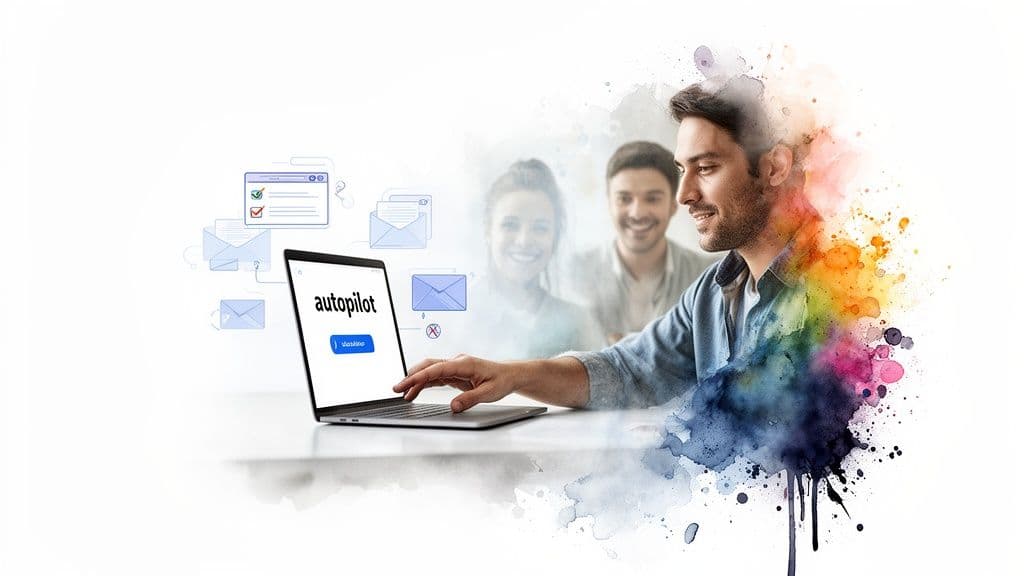
For a small business, every dollar and every hour counts. Marketing automation acts like a digital team member that works around the clock, doing more than scheduling emails. It stitches together your marketing and sales touchpoints so the right message reaches the right person at the right time. For example, when someone signs up for a SaaS trial, an automated system can send a welcome note, follow-up setup tips, and alert your team if the user explores high-value features. This prevents leads from slipping through the cracks and delivers a consistent customer experience.
Why Automation Is No Longer Optional
Automation is moving from a nice-to-have to a competitive necessity. The global marketing automation market has seen rapid growth and is projected to expand significantly in coming years1. Businesses that adopt automation see measurable returns on investment, making it an essential strategy for small teams aiming to scale efficiently2.
At its heart, marketing automation isn’t about replacing the human touch; it’s about scaling it. It handles the predictable work so you can focus on the exceptional.
Start small with a few high-impact workflows and expand as you learn what moves the needle.
Core Benefits of Marketing Automation at a Glance
| Benefit | What It Means for Your Business |
|---|---|
| Increased efficiency | Team members are freed from tedious tasks like manual email sends and data entry, giving them more time for strategy and product work. |
| Improved lead nurturing | Leads are guided automatically through tailored content that improves conversion rates. |
| Enhanced personalization | Messages are triggered by user behavior, making communications feel relevant and timely. |
| Better data and analytics | Actionable insights show what’s working so you can optimize campaigns and prioritize effort. |
Automation lets you do more with less, turning manual work into scalable systems.
Putting Your First Automation Workflows Into Action
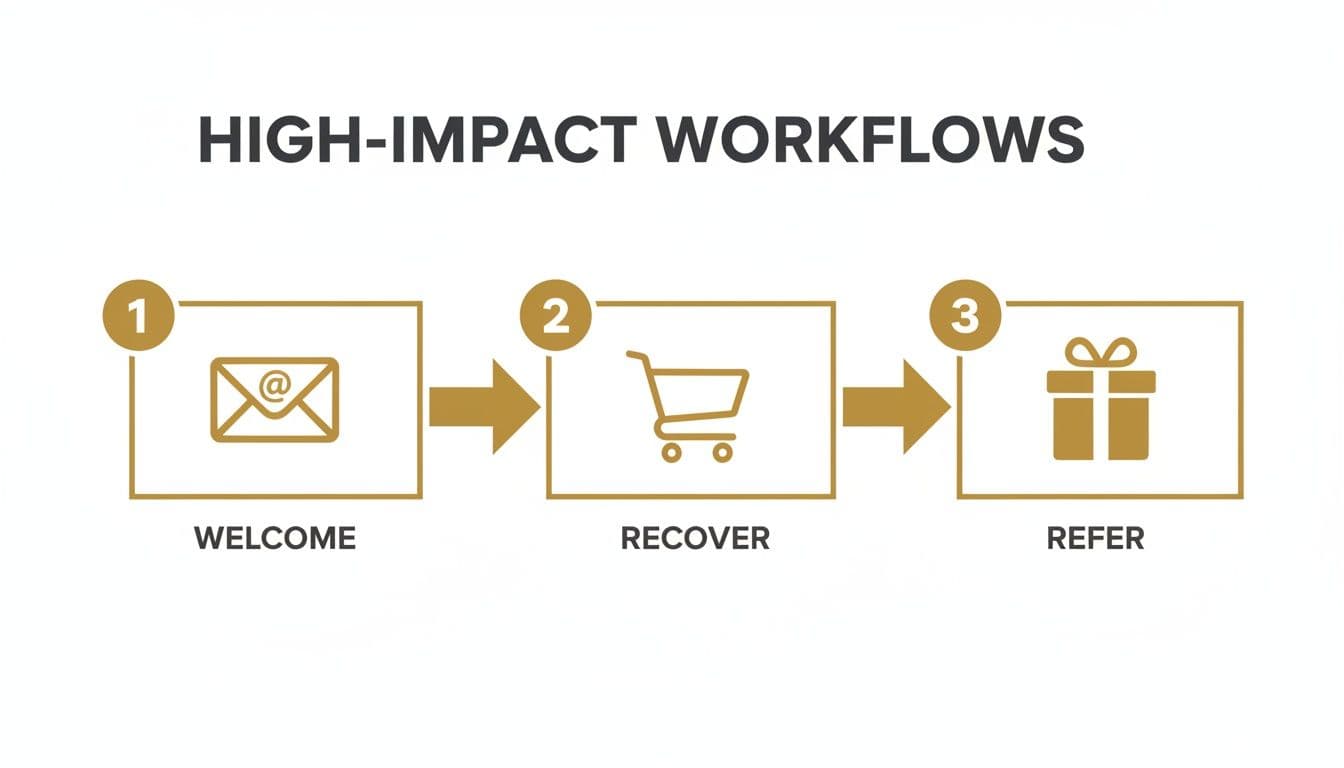
Focus on a few high-impact workflows that map directly to revenue and retention. For SaaS and subscription businesses, the best place to begin is onboarding, cart recovery, and referrals.
The Welcome Series That Turns Trial Users Into Customers
Your first messages set the tone. A welcome sequence should guide new users to an “aha” moment quickly. A simple effective sequence:
- Email 1 (immediate): Warm greeting, login details, and one clear action—create your first project or invite a teammate.
- Email 2 (Day 2): Quick tip or short video highlighting a key feature.
- Email 3 (Day 4): Short customer quote or mini case study showing real value.
- Email 4 (Day 7): Personal check-in from a founder or support lead: “How’s it going? Need help?”
This gives every user a consistent, helpful start and improves trial-to-paid conversions.
Win Back Sales with a Cart Abandonment Flow
People leave carts for many reasons. A timed abandonment flow brings them back with relevant reminders. Well-timed automated flows outperform generic campaigns in recovered revenue per recipient3.
Classic flow:
- Email 1 (1 hour): Friendly “Did you forget something?”
- Email 2 (24 hours): Reminder plus benefits or answers to common questions.
- Email 3 (48 hours): Final nudge, possibly with a small discount or trial extension.
This three-step automation can reclaim meaningful revenue with minimal ongoing effort.
Turn Happy Customers Into Your Best Marketers with Automated Referrals
An automated referral program turns satisfied customers into a low-cost acquisition channel. Trigger referral prompts when users show strong signals of satisfaction, such as a high NPS score or consistent activity. With one-click sharing and automated tracking, referrals become a hands-off growth engine. Choosing a platform with success-based pricing reduces risk and keeps costs aligned with results.
By starting with onboarding, cart recovery, and referrals, you cover critical moments in the customer journey and build a foundation for growth. For tool comparisons and platform choices, see resources like the marketing automation tools guides linked below.
Your Step-By-Step Implementation Roadmap
Launch one or two high-impact workflows rather than trying to design a complex system right away. This five-step roadmap helps lean teams move quickly and with focus.
Step 1: Define Your First Goal
Set a specific, measurable objective tied to an immediate business problem. Examples:
- Increase trial-to-paid conversions by 15% within a quarter.
- Recover at least 10% of abandoned carts each month.
- Generate 20 qualified referral leads per month.
A single focused goal makes tool choice and measurement straightforward.
Step 2: Choose Your Starting Tools
Pick tools that solve your specific problem and fit your budget. You don’t need an expensive all-in-one platform to start.
| Tool Category | Primary Use Case | Typical Pricing Model | Key Feature for Small Biz |
|---|---|---|---|
| Email marketing | Onboarding, nurturing, re-engagement | Tiered by subscribers | Pre-built templates and workflows |
| Simple CRM | Organize customer data, track interactions | Per user/month | Easy integrations with your stack |
| Referral/affiliate | Customer-driven acquisition | Success-based fees | Frictionless sharing and tracking |
Success-based referral tools are low-risk for growing businesses.
Step 3: Map Out Your First Workflow
Design a simple flowchart: trigger, actions, delays, and outcomes. Example welcome sequence:
- Trigger: user signs up for trial.
- Immediate: send welcome email with link to key feature.
- Wait 2 days: send quick tip or tutorial.
- Wait 3 days: check-in before trial ends.
Keep it small, measurable, and repeatable.
Step 4: Integrate and Launch
Connect your tools with native integrations or tools like Zapier. Test everything using a staging or test email so each step fires correctly. After testing, launch and monitor performance.
Step 5: Measure and Optimize
Measure results against the goal you set in Step 1. Track email open rates and clicks, but focus on conversion metrics that impact revenue. Tweak subject lines, calls-to-action, and timing based on performance to turn good flows into great ones.
How AI Transforms Modern Automation
AI adds adaptive intelligence to automation. Instead of following fixed rules, AI learns from behavior and optimizes messages, timing, and offers. For instance, a rule-based flow might send a discount after three days, while an AI system might determine that personalized recommendations convert better for certain users and adjust accordingly.
Moving From Reactive to Predictive Marketing
AI helps you anticipate customer needs rather than only reacting. Practical uses include:
- AI-driven lead scoring to identify trial users most likely to convert.
- Predictive analytics to spot churn risk and trigger re-engagement before cancellation.
- Timing upgrades when users near plan limits.
AI-powered automation can be built into many modern platforms, letting small teams access predictive capabilities without needing a data science team4.
Practical AI Applications for Small Businesses
You don’t need a data science degree to benefit from AI. Examples:
- A subscription box service uses AI to personalize product recommendations in emails.
- A SaaS vendor runs AI-powered A/B tests on landing page headlines to improve conversions.
These features are increasingly common in marketing platforms and can boost customer lifetime value and conversion rates.
Real-World Examples of Automation in Action
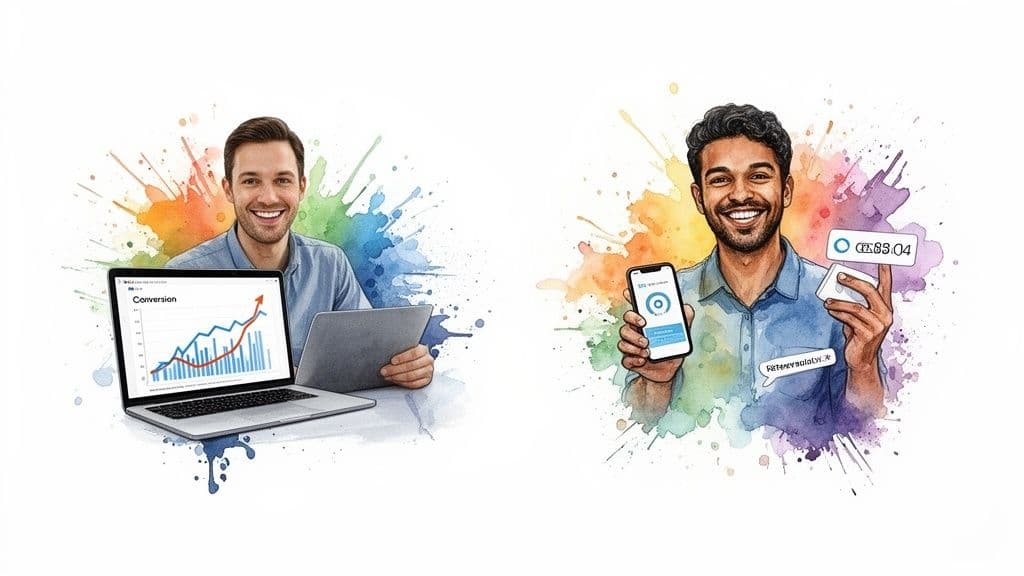
Seeing automation deliver measurable results is the clearest proof of its value. Here are two real-world scenarios.
Case Study One: Fixing a Leaky SaaS Funnel
A B2B SaaS company was converting only 5% of trial users because new sign-ups never hit their “aha” moment. They launched a timed onboarding email series that guided users to core actions. After three months, trial-to-paid conversions rose from 5% to 12%, demonstrating how a targeted workflow can dramatically improve revenue.
Case Study Two: Turning Customers into Marketers
A coffee subscription service added an automated referral flow triggered after a customer’s third delivery. The workflow provided a one-click referral link and automatically applied credits when referrals converted. Within six months, referrals accounted for 18% of new subscribers, becoming one of their top acquisition channels.
Measuring Success with the Right KPIs
Track metrics that tie directly to revenue and retention. Focus on these KPIs for SaaS and subscription businesses:
- Conversion rate — e.g., trial-to-paid conversion.
- Customer lifetime value (CLV) — revenue expected from a customer over time.
- Churn rate — percentage of customers who cancel.
- Cost per acquisition (CPA) — how much it costs to get a paying customer.
Every workflow should map to a KPI so you can measure impact and iterate toward better results.
Common Questions Answered
What’s the Real Cost of Marketing Automation for a Small Business?
You don’t need a huge budget. Many email tools are free up to a certain number of subscribers, and referral platforms with success-based pricing keep costs aligned with results. Start with one tool that does one thing well and prove ROI before expanding.
Is This Too Complicated for a Non-Technical Founder?
No. Modern tools offer drag-and-drop builders, templates, and simple integrations. Start with a single three-step workflow and expand as you gain confidence.
What’s the Single Most Important Thing to Automate First?
For SaaS and subscription businesses, prioritize a welcome/onboarding series and an automated referral program. Together, they improve conversion and acquisition with minimal ongoing effort.
Ready to turn your happy customers into your most powerful growth engine? With ShareMySaaS, you can launch a zero-friction referral program in minutes. Get started today and see how easy it is to automate your customer acquisition.
Quick Q&A: Common User Questions
Q: How quickly will automation pay off? A: You can see meaningful gains in weeks with a focused onboarding or abandoned-cart workflow. Measure conversions and revenue to confirm impact.
Q: Which tools should I start with? A: Begin with a budget-friendly email platform and a simple CRM. Add a success-based referral tool when you’re ready to scale word-of-mouth acquisition.
Q: How do I keep automation feeling personal? A: Use behavior-triggered messages and personalization tokens. Add occasional human touchpoints, like a founder check-in, to maintain authenticity.
1.
MoEngage, “Marketing Automation Statistics,” [https://www.moengage.com/blog/marketing-automation-statistics/]
2.
MoEngage, “Marketing Automation Statistics — ROI and Revenue Impact,” [https://www.moengage.com/blog/marketing-automation-statistics/]
3.
Klaviyo, “Cart Abandonment Email Statistics and Benchmarks,” [https://www.klaviyo.com/blog/cart-abandonment-email-statistics]
4.
Salesforce Research and industry reporting on small-business AI adoption and applications, [https://www.salesforce.com/resource-research/]
💸 Get 10x More People SharingWith Zero-Friction Signup
Traditional sharing programs lose most potential promoters at signup. ShareMySaaS eliminates that barrier completely — users start sharing with one click, no forms required. Turn every satisfied customer into an active promoter and watch your reach explode.