Discover 10 powerful marketing ideas for referrals tailored for SaaS. Learn how to build a program with instant links, tiered rewards, and automated payouts.
January 24, 2026 (8d ago)
10 Actionable Marketing Ideas for Referrals That Drive SaaS Growth in 2026
Discover 10 powerful marketing ideas for referrals tailored for SaaS. Learn how to build a program with instant links, tiered rewards, and automated payouts.
← Back to blog
SaaS Referral Ideas to Drive Growth (2026)
Summary: Discover 10 actionable referral marketing ideas for SaaS: instant links, tiered rewards, automated payouts, analytics, and ambassador strategies to scale growth.
Introduction
Acquiring new customers is getting more expensive and unpredictable, so tapping your happiest users is one of the smartest growth moves you can make.1 A well-built referral program turns satisfied customers into a scalable acquisition channel with better conversion and retention than many paid channels.2 This guide skips theory and delivers 10 practical referral strategies for SaaS teams, with clear implementation tips, reward examples, in-app activation advice, and metrics to track.
Each idea below includes:
- The concept
- When to use it
- Reward structure examples
- In-app activation tips
- Measurement metrics
Implement one or two of these, test, and scale what works.
1. In-App Referral Pop-ups with Instant Link Generation
Embed referral triggers directly where users succeed, so a one-click action generates a unique shareable link. No separate portal, no form—just copy and share.
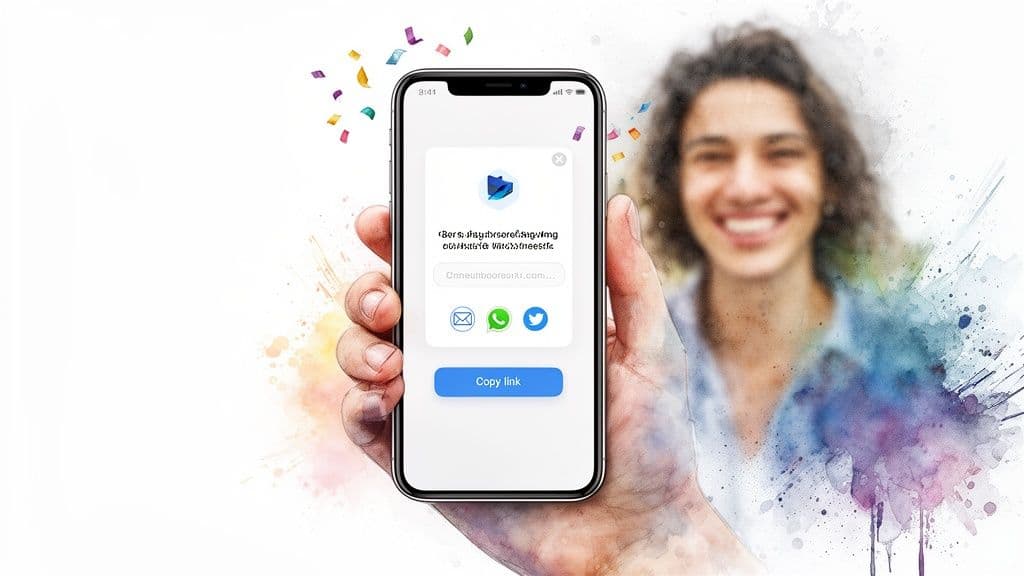
Dropbox popularized this by giving users extra storage for referrals, embedding the incentive at moments of product value.3
When to use this
Use when you can identify clear “aha” moments: completion of a milestone, a successful export, or the creation of a shareable asset.
Reward structure examples
- Fixed credit: “Share and get a $10 credit on your next bill.”
- Percentage discount: “Give 20%, Get 20%.”
- Feature unlock: “Refer 3 friends to unlock advanced analytics.”
In-app activation and measurement
Activation: Add a visible CTA like “Earn Rewards” in the dashboard. Trigger a modal with the unique link and one-click share buttons. Include copy that explains the benefit to the friend.
Measurement: Track CTA CTR, link generation rate, share-to-click ratio, and conversion rate of referred users. Append unique identifiers or UTM parameters for accurate attribution.
2. Tiered Reward Structures Based on Referral Volume
Gamify referrals by increasing rewards as advocates hit higher milestones. This motivates power users to scale their efforts over time.
Historically, companies such as PayPal and Uber used escalating bonuses to accelerate growth during early adoption phases.4
When to use this
Ideal when you can identify high-value advocates and have unit economics that support higher rewards for top performers.
Reward structure examples
- Credit tiers: “Refer 1–4 friends for $10 each; 5+ friends earn $20 each.”
- Commission tiers: “20% on first 10 sales, 30% after.”
- Hybrid tiers: “$50 for first 5 referrals, $75 thereafter plus beta access.”
In-app activation and measurement
Activation: Show a progress bar in the “Referrals” section and send celebratory emails when users advance tiers.
Measurement: Track distribution of referrers by tier, average referrals per user, and ROI per tier to optimize thresholds.
3. Dual-Sided Incentives (Rewards for Both Referrer and Referee)
Offer value to both parties to remove awkwardness and increase conversion. Make it feel like a gift rather than a pitch.
Brands like HelloFresh and Wise use symmetric offers that provide clear, immediate value to new users and their advocates.
When to use this
Best when sign-up friction or initial commitment is high—subscription signups, first purchases, or onboarding-heavy products.
Reward structure examples
- Symmetrical credit: “Give $25, Get $25.”
- Trial + reward: “Referee gets 30 days free; referrer gets $50 after the first payment.”
- Asymmetrical value: “Referee gets a free premium feature; referrer gets a $100 account credit.”
In-app activation and measurement
Activation: Use clear “Give / Get” messaging and a landing page that highlights the friend’s offer. Track invitation status and pending rewards in the referrer’s dashboard.
Measurement: Monitor invitation rate, referee conversion rate, CAC from referrals, and LTV for referred users.
4. Automated Payout System with Stripe Integration
Remove manual payout friction by integrating Stripe (or equivalent) to automate commission and cash rewards. This builds trust and reduces ops overhead.
Stripe Connect is commonly used to automate payouts and manage tax and compliance flows.5
When to use this
Essential for cash-based affiliate or partner programs, especially with high volume or enterprise-level commissions.
Reward structure examples
- Recurring commission: “30% recurring for first 12 months.”
- Fixed payout: “$100 for every qualified enterprise lead.”
- Tiered payout: “$50 first 5 referrals, $75 next 5, $100 thereafter.”
In-app activation and measurement
Activation: Onboard advocates via a secure Connect flow. Display payout schedule and minimum thresholds. Implement a short clawback period for refunds.
Measurement: Track total commissions paid, payout success rates, and time-to-payout. Tie each payout to its originating referral for auditability.
5. Real-Time Analytics Dashboard for Referral Performance
Give advocates a transparent view of their clicks, conversions, and earnings. Data drives optimization and sustained engagement.
High-performing affiliate programs surface granular metrics so partners can iterate on what works.
When to use this
Use when partners promote across channels and care about performance—creator platforms, large affiliate networks, and B2B partner programs.
Reward structure examples
- Tiered commissions: “10% for first 10 referrals, 15% for next 20, 25% after.”
- Performance bonuses: “$100 bonus for 25 sign-ups in a month.”
- LTV share: “Earn 5% of revenue you drive, for life.”
In-app activation and measurement
Activation: Provide a “Partner” dashboard with charts, event logs, and exportable reports. Include benchmarks so partners can see how they compare.
Measurement: Track dashboard engagement, conversion rate from referred traffic, and revenue generated by partners.
6. Community-Based Referral Networks and Forums
Create a space—Slack, Discord, or private forum—where advocates share tactics and support each other. Community drives retention and idea exchange.
Companies like HubSpot and Shopify use partner communities to surface best practices and amplify program growth.
When to use this
Best for programs with committed affiliates who benefit from shared knowledge and direct access to your team.
Reward structure examples
- Tiered access: “Top 10% gain access to a private channel with product leads.”
- Recognition: “Referrer of the Month spotlight.”
- Exclusive content: “Early access to features and marketing materials.”
In-app activation and measurement
Activation: Invite top performers to seed the community and promote it in the referral dashboard.
Measurement: Track join rate, engagement, and whether community members refer more than non-members.
7. Exclusive Brand Ambassador Program with Premium Status
Create an aspirational tier with non-monetary perks: co-marketing, early access, badges, and deeper product relationships. Status can be as motivating as money.
This works well for mature SaaS companies with identifiable high-value advocates.
When to use this
Ideal when you want to formalize relationships with top referrers and amplify brand advocacy.
Reward structure examples
- Higher commissions for ambassadors vs. standard affiliates
- Early product access and co-marketing opportunities
- Official badges and speaking slots at events
Activation and measurement
Activation: Invite top referrers, provide an ambassador toolkit, and set clear expectations.
Measurement: Track referrals per ambassador, conversion quality, and qualitative brand lift from ambassador activity.
8. Referral Incentive Customization Based on User Segments
Tailor rewards and messaging by account type, usage patterns, or LTV. One-size-fits-all offers often miss the mark.
Segmented incentives align rewards to the advocate’s influence and motivation.
When to use this
Use for platforms with diverse customer types—individuals, SMBs, and enterprises—where motivations differ.
Reward structure examples
- SMB: “Give $50, Get $50.”
- Enterprise: “20% commission on first-year contract value.”
- Power users: “Refer 5 teams to unlock a dedicated support contact.”
In-app activation and measurement
Activation: Detect segment via CRM and show targeted referral offers in-app.
Measurement: Compare participation and conversion rates across segments and optimize by LTV.
9. Content-Based Referral Programs (Reviews, Case Studies, Demos)
Incentivize advocates to create reviews, case studies, or demos that drive qualified traffic. High-value content often converts better than raw links.
Sites like G2 and Capterra demonstrate how reviews become discovery channels for B2B buyers.
When to use this
Best for B2B products with longer sales cycles or where social proof matters.
Reward structure examples
- Fixed bonus for reviews or published case studies
- Tiered rewards for written, video, and full case studies
- Performance-based commissions tied to content-driven sign-ups
In-app activation and measurement
Activation: Provide a “Share Your Story” workflow with templates and submission forms.
Measurement: Use unique tracking links to measure views, clicks, and conversion rates from each content asset.
10. Viral Loop Mechanics with Sharing Incentives
Make sharing part of the product experience so each user has a built-in reason to invite others. When the product’s value increases with more users, referrals become natural.
Dropbox, Robinhood, and products with shareable outcomes used viral mechanics to grow quickly by offering in-product value for each referral.6
When to use this
Best for products with network effects or clear shareable outputs: collaboration tools, social apps, games, and educational platforms.
Reward structure examples
- Feature gating: “Invite 3 colleagues to unlock advanced reporting.”
- Content access: “Share progress to unlock the next lesson.”
- In-product benefits: “Each friend increases your storage by 500 MB.”
In-app activation and measurement
Activation: Place a pre-populated share button at proud moments—task completion, results, or creations.
Measurement: Track viral coefficient (k-factor), share rate per active user, CTR on shared links, and conversion rate of those clicks.
Comparing the 10 Approaches
| Approach | Complexity | Resources | Expected Outcomes | Ideal Use Cases |
|---|---|---|---|---|
| In-app pop-ups | Medium | Low–Medium | High short-term activation | Mobile-first SaaS, onboarding flows |
| Tiered rewards | Medium–High | Medium | Sustained volume | Marketplaces, high-LTV SaaS |
| Dual-sided incentives | Medium | Medium | Higher conversion | Subscription services, marketplaces |
| Automated payouts | High | Medium–High | Scales payouts, reduces ops | High-volume affiliate networks |
| Real-time dashboards | High | High | Empowers partners | Large programs, creators |
| Community networks | Medium | Medium | Long-term engagement | Niche products, B2B communities |
| Ambassador programs | High | High | High-quality advocacy | Mature SaaS, consultative sales |
| Segmented incentives | High | High | Better ROI | Diverse user bases |
| Content-based referrals | Medium | Medium | Higher-quality leads | B2B, enterprise tools |
| Viral loops | High | Medium–High | Exponential potential | Network-effect products |
Launch Your Referral Engine and Start Scaling
Pick one or two strategies that match your user behavior and technical capacity. Common starter: combine an in-app pop-up with a dual-sided incentive to capture immediate momentum and validate the approach.
Actionable next steps:
- Identify your starting point and focus on the experience, not just the reward.
- Define the reason customers would refer you—rewards are a nudge, not a replacement for product value.
- Map the user journey and remove friction: where they get the link, how they see status, and when they receive rewards.
- Measure, analyze, and iterate. Track invitation rate, share rate, and referral conversion, then optimize rewards and triggers.
Mastering referrals builds a durable, cheaper acquisition channel and fosters a community that reinforces product value.
Frequently Asked Questions
Q: What referral strategy should I start with?
A: Start small. Launch a dual-sided incentive via an in-app pop-up at an “aha” moment. It’s simple to implement and delivers measurable results quickly.
Q: How do I measure referral program success?
A: Track invitation rate, share rate, referral conversion rate, viral coefficient (k-factor), CAC for referred users, and LTV of those users.
Q: When should I add automated payouts or an ambassador tier?
A: Add automated payouts when cash commissions scale and manual payouts become unsustainable. Introduce an ambassador tier once you have consistent top referrers and want deeper, strategic partnerships.
Ready to implement these referral strategies? ShareMySaaS offers link generation, real-time tracking, and Stripe payouts to help you launch quickly.
1.
Statista, “Rising digital advertising and acquisition costs,” https://www.statista.com
2.
Survey and industry analysis showing higher conversion and retention from referred customers; see https://www.profitwell.com
3.
Dropbox growth case study and referral program overview, see https://dropbox.tech
4.
Historical reports on PayPal and Uber referral strategies, see coverage on growth hacking: https://openviewpartners.com
5.
Stripe Connect documentation for platform payouts, https://stripe.com/docs/connect
6.
Analysis of viral coefficient and product virality examples including Dropbox and Robinhood, see https://techcrunch.com
💸 Get 10x More People SharingWith Zero-Friction Signup
Traditional sharing programs lose most potential promoters at signup. ShareMySaaS eliminates that barrier completely — users start sharing with one click, no forms required. Turn every satisfied customer into an active promoter and watch your reach explode.