Discover how pay per action affiliate marketing can scale your SaaS. This guide covers models, metrics, and tools to launch a high-ROI affiliate program.
February 11, 2026 (23d ago)
Pay Per Action Affiliate Marketing for SaaS Growth
Discover how pay per action affiliate marketing can scale your SaaS. This guide covers models, metrics, and tools to launch a high-ROI affiliate program.
← Back to blog
Pay-Per-Action (PPA) Affiliate Marketing for SaaS Growth
Discover how pay-per-action affiliate marketing can scale your SaaS. This guide covers models, metrics, reward structures, fraud protection, and tools to launch a high-ROI affiliate program.
What Is Pay-Per-Action Affiliate Marketing?

Think of a pay-per-action affiliate program as an elite, commission-only sales team for your SaaS. Affiliates get unique tracking links and promote your product to their audiences. You only pay when a partner drives a specific, pre-defined outcome—like a new paid subscription, a trial sign-up, or a qualified lead.
This model de-risks marketing spend by tying payments to real outcomes. If an affiliate sends a hundred clicks with no sign-ups, it costs you nothing. If one click becomes a paying customer, that’s when the commission is due.
The Power of Performance-Based Payouts
You choose the “action” that matters most. While a sale is the clearest outcome, SaaS companies can reward actions tied to the customer journey:
- A new paid subscription
- A free trial signup
- A demo request
- A lead form submission (ebook download, webinar registration)
This flexibility aligns marketing costs with growth goals and ensures every dollar spent targets acquiring real users or qualified leads. PPA is the baseline model for most affiliate programs worldwide1, and affiliate spending in the US is projected to rise significantly in coming years2.
How PPA Compares to Other Affiliate Models
| Model | What You Pay For | Risk Level for Business | Ideal for SaaS When... |
|---|---|---|---|
| Pay Per Action (PPA) | A completed conversion (sale, trial, demo) | Low | You need predictable user acquisition and MRR growth. |
| Pay Per Click (PPC) | Every click on an affiliate's link | High | Your goal is top-of-funnel traffic, not immediate conversions. |
| Pay Per Lead (PPL) | A submitted lead form | Medium | You have a strong nurture process to convert leads. |
| Pay Per Impression (PPM) | Every 1,000 ad views | Very High | The main aim is brand awareness, not direct action. |
PPA makes you pay for performance rather than potential, which helps SaaS companies achieve sustainable, cost-effective growth.
Why PPA Is a Game Changer for SaaS Growth
PPA changes the economics of customer acquisition by tying costs directly to revenue. Unlike paid ads where you pay upfront, PPA ensures you only pay for tangible results. If a campaign doesn’t bring subscribers or qualified leads, it doesn’t cost you anything.
Driving Down Customer Acquisition Cost (CAC)
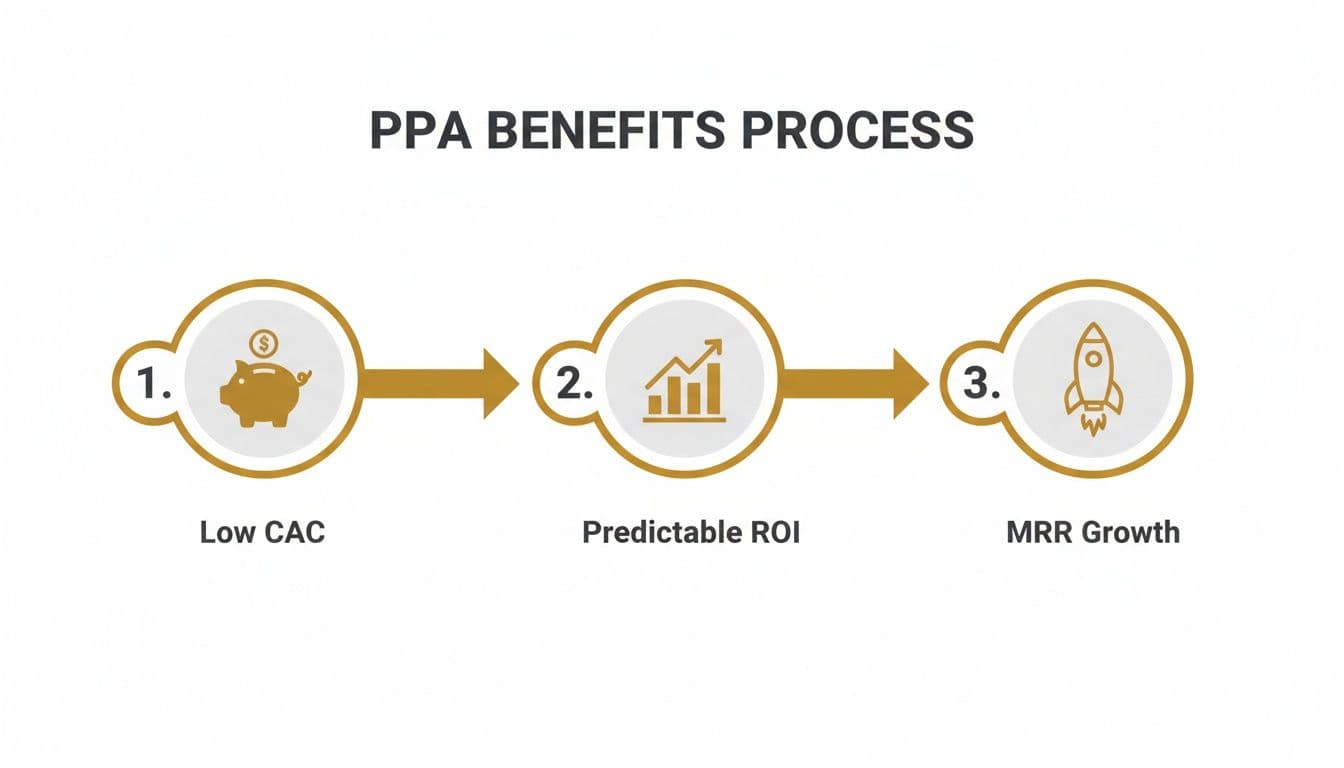
SaaS businesses live and die by CAC. A PPA program turns marketing spend into a fixed, success-based fee. By setting a fair commission for a specific action, you effectively lock in acquisition costs for those customers. Monitoring LTV-to-CAC ratios helps confirm the channel’s efficiency and long-term profitability.3
PPA is especially effective for B2B SaaS. Affiliates can generate high-quality demo requests without the large ad budgets needed to reach decision-makers, lowering and stabilizing CAC.
Creating a Scalable Growth Engine
PPA lets you build a commission-only sales force that scales without adding payroll. Affiliate-driven programs are delivering high returns for many businesses: affiliates often generate significant ROI for advertisers, with the channel growing year over year4.
Modern platforms enable customers to become affiliates instantly, producing a self-perpetuating growth loop:
- Instant activation for authenticated users
- Trusted referrals from real users, which boost conversions
- Automated rewards, keeping promoters engaged
With PPA, every satisfied customer can become a promoter, driving predictable MRR without ballooning fixed marketing costs.
How to Track PPA Affiliate Program Success
A successful program is data-driven. Think of your affiliate program as a funnel: clicks are the top, and completed actions are the bottom. Tracking the right metrics reveals where leads leak and what to improve.
Core Metrics to Monitor
- Click-through rate (CTR): Percentage of users who click an affiliate link. High CTR means the affiliate’s audience and messaging fit your product.
- Conversion rate (CR): Percentage of clicks that complete the desired action. This is the best measure of an affiliate’s real impact.
- Customer lifetime value (CLV or LTV): Total expected revenue from an affiliate-referred customer over their lifetime. High LTV demonstrates quality referrals.
When CTR is high but CR is low, the traffic may be unqualified or the landing experience may not match affiliate messaging. Use this data to align partners and improve results.
Simplifying Attribution and Analysis
Attribution used to mean messy spreadsheets and guesswork, especially when customers interacted with multiple affiliates before converting. Modern affiliate platforms centralize tracking, creating a single source of truth so you can reward top performers and identify underperforming channels without manual reconciliation.5
These platforms track clicks and conversions with unique links and cookies, and present insights in an intuitive dashboard. This clarity lets you focus on growing relationships with high-performing affiliates rather than fighting attribution issues.
Designing a PPA Reward Structure That Motivates
Your commission structure is the heart of a PPA program. If it’s confusing or uncompetitive, partners won’t promote your product. The best structures balance motivating affiliates and protecting your margins.
Choosing the Right Reward Model for SaaS
| Reward Model | How It Works | Best For... | Potential Pitfall |
|---|---|---|---|
| Recurring percentage | Affiliates earn a percentage of subscription revenue for a set period (e.g., first 12 months) | High-LTV SaaS with strong retention | Requires systems for recurring payouts and tracking. |
| Fixed-rate bounty | Single flat payment per new paid customer (e.g., $100) | Low-cost, self-serve SaaS | May not incentivize long-term customer quality. |
| Tiered commissions | Rates increase as affiliates reach thresholds | Scaling top performers | Can discourage new affiliates if top tiers feel out of reach. |
Match your reward model to business goals. High-ticket enterprise SaaS benefits from recurring percentages, while a low-cost tool may thrive with flat bounties. Mixing models is common—for example, a small bounty for trial signups plus recurring payments on conversion.
Automating Payouts to Remove Friction
Manual payouts create friction and erode trust. Use a platform that automates tracking, calculation, and payouts through integrated processors like Stripe. Automation reduces errors and keeps affiliates motivated by ensuring timely, accurate payments.
How to Protect Your Program from Affiliate Fraud
PPA attracts honest, motivated partners, but it can also draw bad actors. The right defenses combine clear program terms, partner vetting, vigilant monitoring, and technology with built-in fraud detection.
Set Clear Terms and Vet Partners
Publish unambiguous rules covering brand bidding, approved promotional methods, and cookie lifespans. Vet applicants by reviewing their site and channels to filter out low-quality or risky partners before they receive links.
Monitor Traffic and Spot Red Flags
Watch for sudden spikes in clicks without conversions, many conversions from a single IP, or activity at odd hours. These patterns often indicate bots or click-farms. Modern risk engines and fraud-detection tools help surface anomalies a human might miss.6
Use Technology as Your Shield
Managed affiliate platforms standardize tracking, authenticate users, and secure payouts. Choosing a platform with fraud detection and payment integrations reduces risk and frees your team to focus on growth.
Launching Your PPA Program with Zero Friction

Old launches required custom tracking, manual onboarding, and spreadsheet payouts. Today’s platforms let you launch in minutes, shifting the work from engineering to strategy.
The Old Way vs. The Modern Way
- The old way required custom code, manual onboarding, and spreadsheets.
- The modern way uses a zero-friction platform for instant onboarding, automated tracking, analytics, and payouts.
With automation, your team can focus on partner relationships, not admin.
Activate Your Program in Three Steps
- Define rewards: Choose fixed bounties, recurring percentages, or a mix.
- Customize the in-app prompt: Turn satisfied users into partners with a clear call-to-action and instant link generation.
- Activate and monitor: Go live, watch analytics, identify top partners, and optimize.
Got Questions About PPA? We’ve Got Answers
What’s a good commission rate for a SaaS PPA program?
A common starting point is 20–50% of the first month, or a recurring 10–20% for a defined period such as 12 months. Set rates based on your LTV and CAC so commissions are motivating but sustainable.
How is PPA different from CPA?
They’re largely the same idea. Pay-Per-Action (PPA) emphasizes partnerships and referrals, while Cost-Per-Action (CPA) is often used in paid advertising. Both pay only when a defined action occurs.
Can I turn existing customers into affiliates?
Yes. Your customers are often the most credible promoters. Use an in-app prompt to generate unique links instantly, lowering friction and increasing participation.
Ready to turn customers into a growth channel? With a zero-friction platform you can launch an effective PPA program quickly and scale payouts automatically.
1.
Influencer Marketing Hub, “Affiliate Marketing Statistics,” [https://influencermarketinghub.com/affiliate-marketing-stats/]
2.
Influencer Marketing Hub, “Affiliate Marketing Statistics,” projection of U.S. affiliate marketing spend to 2027, [https://influencermarketinghub.com/affiliate-marketing-stats/]
3.
LowChurn, “LTV:CAC ratio,” [https://www.lowchurn.com/blog/ltv-cac-ratio]
4.
CouponAffiliates, “Affiliate Marketing Statistics and ROI,” which details industry growth and returns, [https://couponaffiliates.com/affiliate-marketing-statistics/]
5.
ShareMySaaS, “Best affiliate tracking software,” for options that automate attribution and analytics, [https://sharemysaas.com/blog/best-affiliate-tracking-software]
6.
Hyperengage Podcast, “Fraud signals and spend: How modern risk engines work,” for insights on fraud detection, [https://hyperengage.io/podcast/ep-164-fraud-signals-and-spend-how-modern-risk-engines-really-work-ft-robert-kraal-ceo-co-founder-silverflow]
💸 Get 10x More People SharingWith Zero-Friction Signup
Traditional sharing programs lose most potential promoters at signup. ShareMySaaS eliminates that barrier completely — users start sharing with one click, no forms required. Turn every satisfied customer into an active promoter and watch your reach explode.