Discover the best referral program examples from top brands. Learn their strategies, rewards, and how to replicate their success for your own business.
December 30, 2025 (1mo ago)
7 Powerful Referral Program Examples to Model in 2025
Discover the best referral program examples from top brands. Learn their strategies, rewards, and how to replicate their success for your own business.
← Back to blog
7 Referral Program Examples to Model in 2025
Summary: Explore seven top referral program examples, their reward strategies, and actionable steps to replicate success for SaaS, ecommerce, and B2B brands.
Introduction
Referral marketing turns satisfied customers into a trusted acquisition channel—and it works because people trust recommendations from friends and colleagues more than most other forms of advertising1. The best referral programs minimize friction, align incentives, and automate fulfillment so advocates can share easily and businesses can scale reliably.
This article analyzes seven high-performing referral program examples, breaks down the mechanics behind their success, and gives practical takeaways you can implement right away. Where useful, you’ll find links to vendor pages and resources to speed implementation.
1. ShareMySaaS: Zero-Friction In-App Referral Programs
ShareMySaaS leads this list by solving the primary barrier to advocacy: friction. It’s designed for SaaS and subscription businesses and converts authenticated users into promoters with one click, removing sign-up forms and external dashboards that reduce participation.
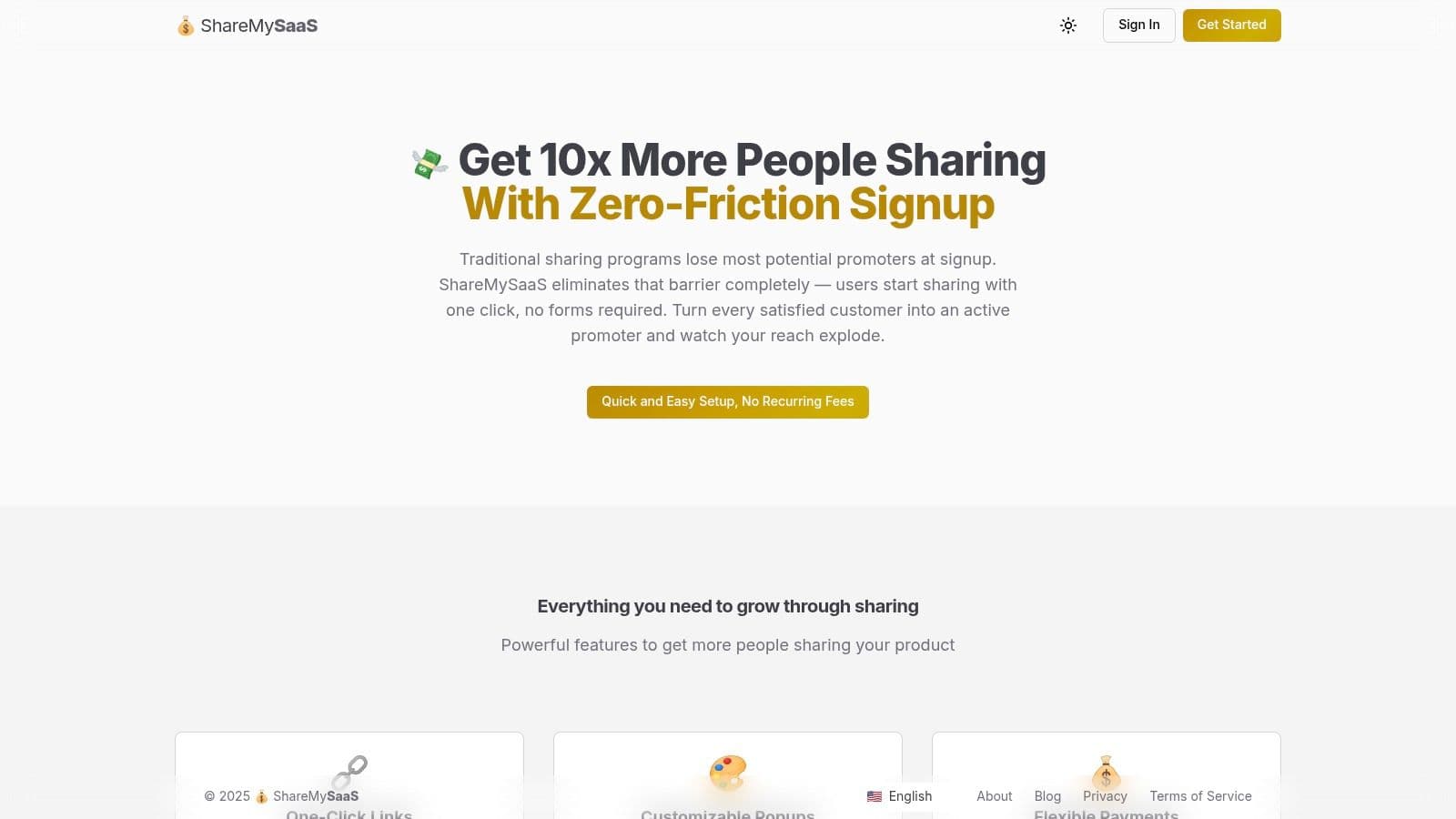
What makes ShareMySaaS effective is its in-flow referral activation: customizable in-app pop-ups generate trackable links for logged-in users instantly. This captures intent at the moment of highest satisfaction without adding administrative burden.
Key features
- One-click link generation via in-app pop-ups
- Automated Stripe payouts for timely reward fulfillment
- Flexible reward structures: recurring commissions, one-time rewards, and tiers
- Success-based pricing with no recurring fees
How to replicate
- Embed referral CTAs inside your product rather than redirecting users
- Automate link generation, tracking, and payouts to remove manual bottlenecks
- Use a performance-based pricing or reward model that aligns cost with revenue
Pricing snapshot
- Starter: 15% fee per payment sent
- Growth: 10% fee after $1k in payments
- Enterprise: 5% fee for annual payouts over $10k
Website: https://sharemysaas.com
2. ReferralCandy
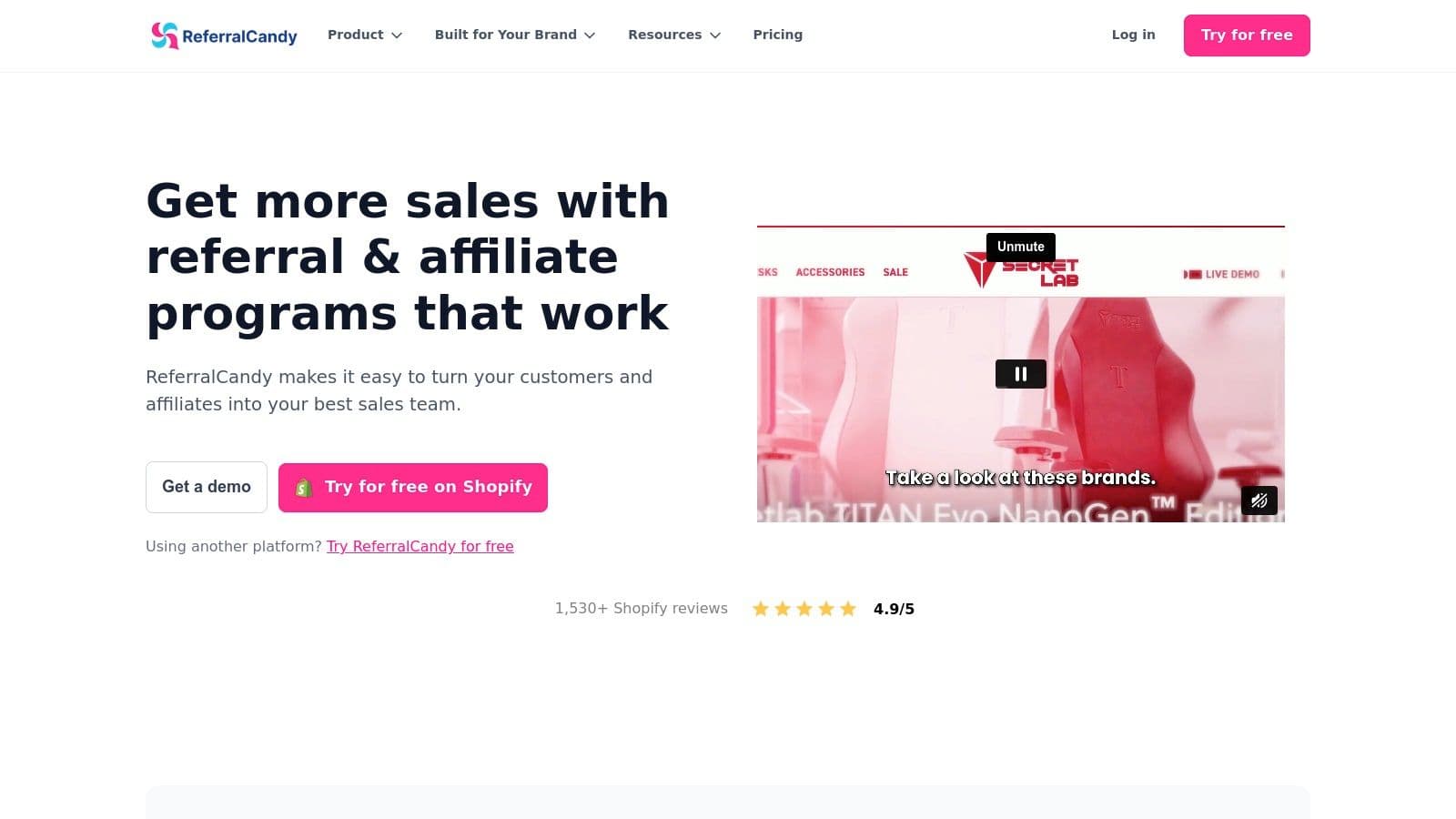
ReferralCandy is well suited for DTC and ecommerce brands that want a fast, proven rollout. The platform combines a mature feature set with an extensive library of examples and playbooks, helping merchants test offers, email sequences, and reward mechanics quickly.
Why it works
- Double-sided incentives (reward for both referrer and friend)
- Strong integrations with Shopify, Klaviyo, and common ecommerce stacks
- Transparent pricing with a performance component to align costs with outcomes
Pricing snapshot
- Premium: $59/month + success fees starting at 3.5%
- Plus: $299/month + lower success fees for higher volume
- Enterprise: custom pricing
Resources: https://www.referralcandy.com/
3. Friendbuy
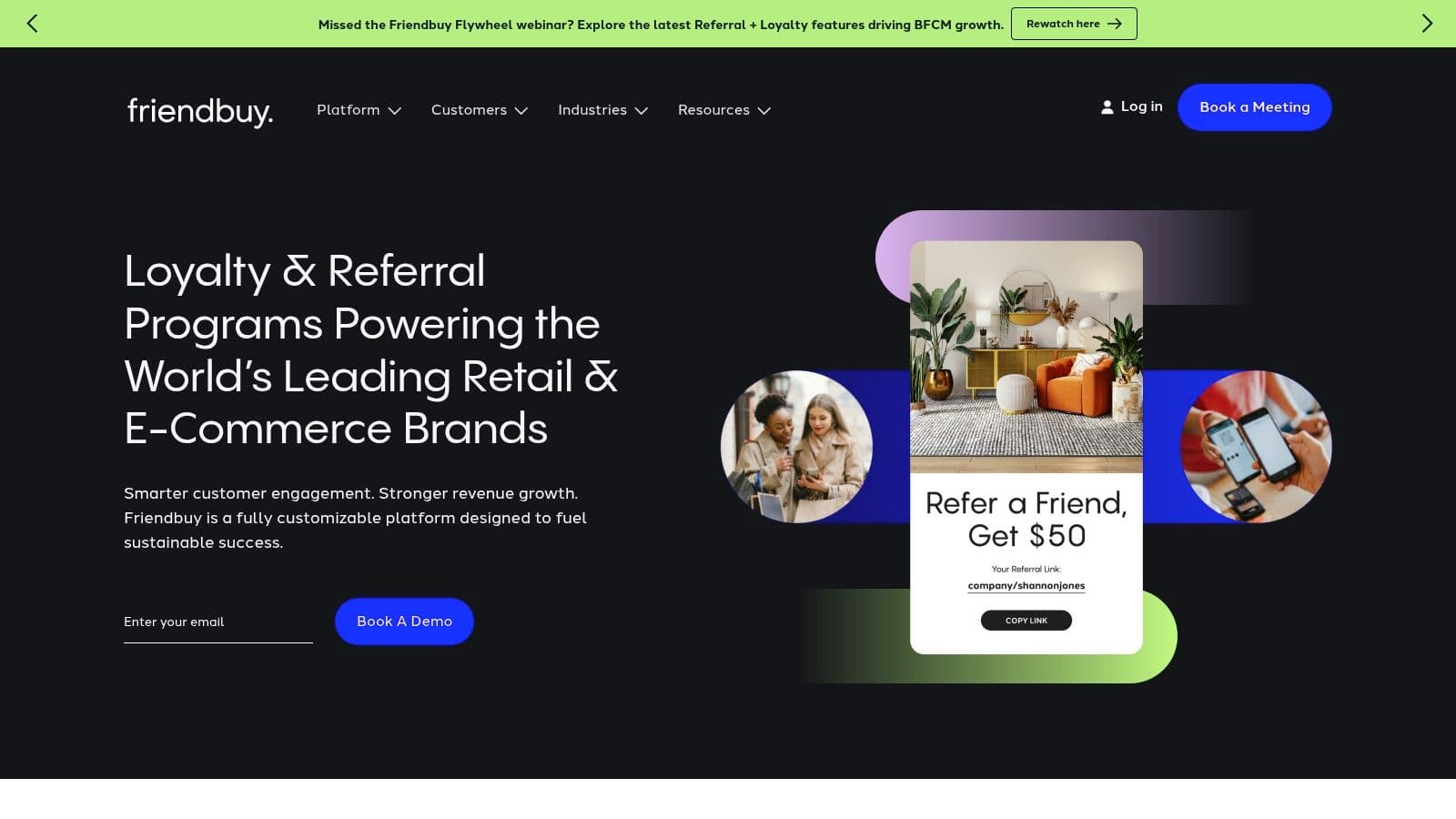
Friendbuy is ideal for brands that want data-driven case studies and rigorous testing. Its library of brand-by-brand breakdowns helps teams model strategies that produced measurable conversion lifts.
Notable strengths
- Advanced A/B testing across the referral funnel
- Deep integrations with ecommerce and marketing tools
- Data-rich case studies that show conversion and CAC impact
Access: demo and custom proposal required
Website: https://www.friendbuy.com/
4. Referral Rock
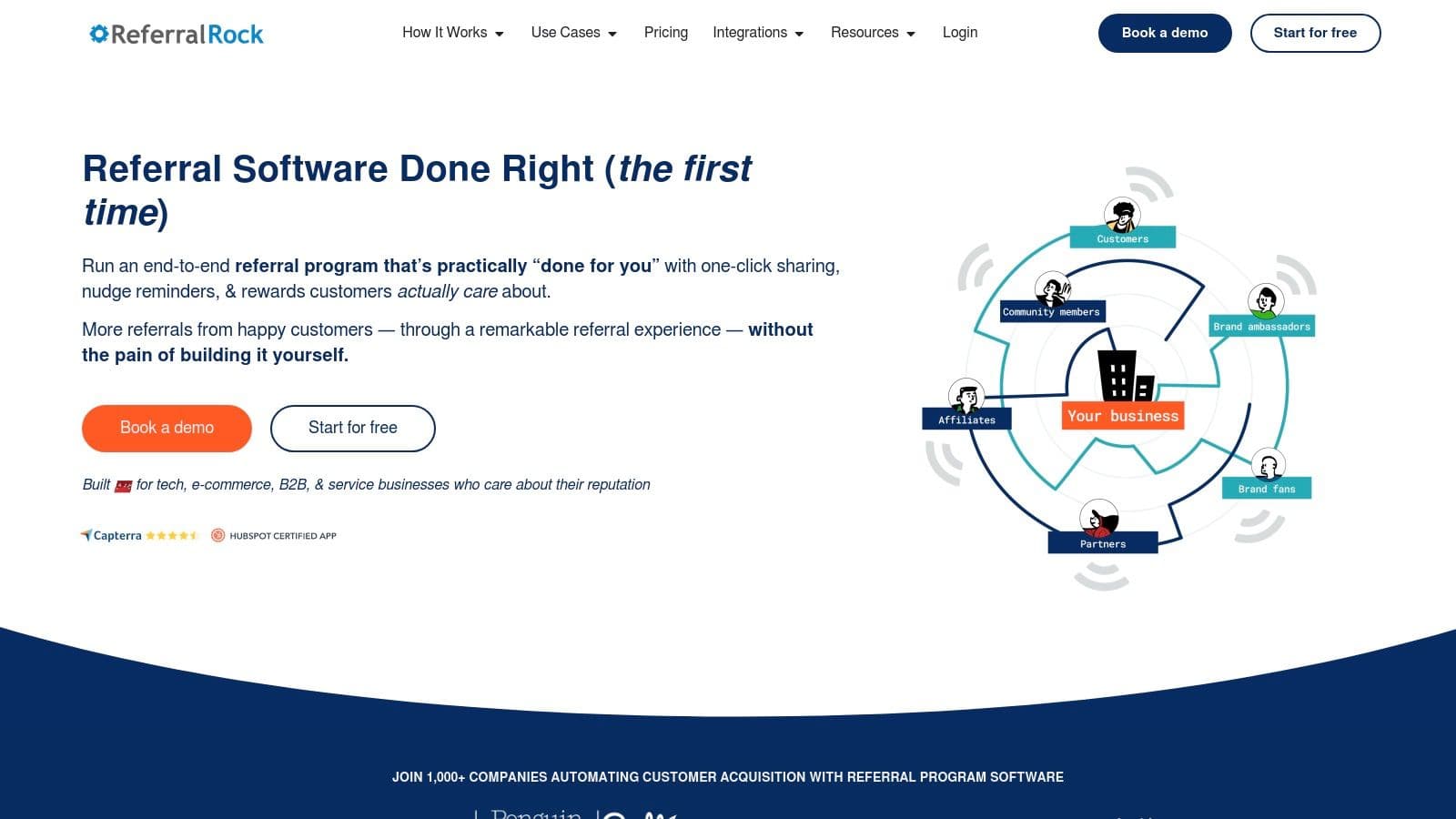
Referral Rock serves service-based and B2B companies that need CRM integrations and a guided setup. It provides hosted member portals and customizable landing pages to create polished advocate experiences.
Capabilities
- Flexible reward builder with tiered and milestone rewards
- Native triggers and CRM integrations (HubSpot, Salesforce via add-ons)
- Transparent pricing and predictable overage model
Pricing snapshot
- Starter: $200/month (500 members)
- Growth: $400/month (10,000 members)
- Established: $800/month (20,000 members)
Website: https://referralrock.com/
5. Talkable
Talkable is an enterprise-grade option that couples platform capabilities with managed optimization. Their teams run A/B tests, tune campaign placements, and protect program integrity with fraud prevention.
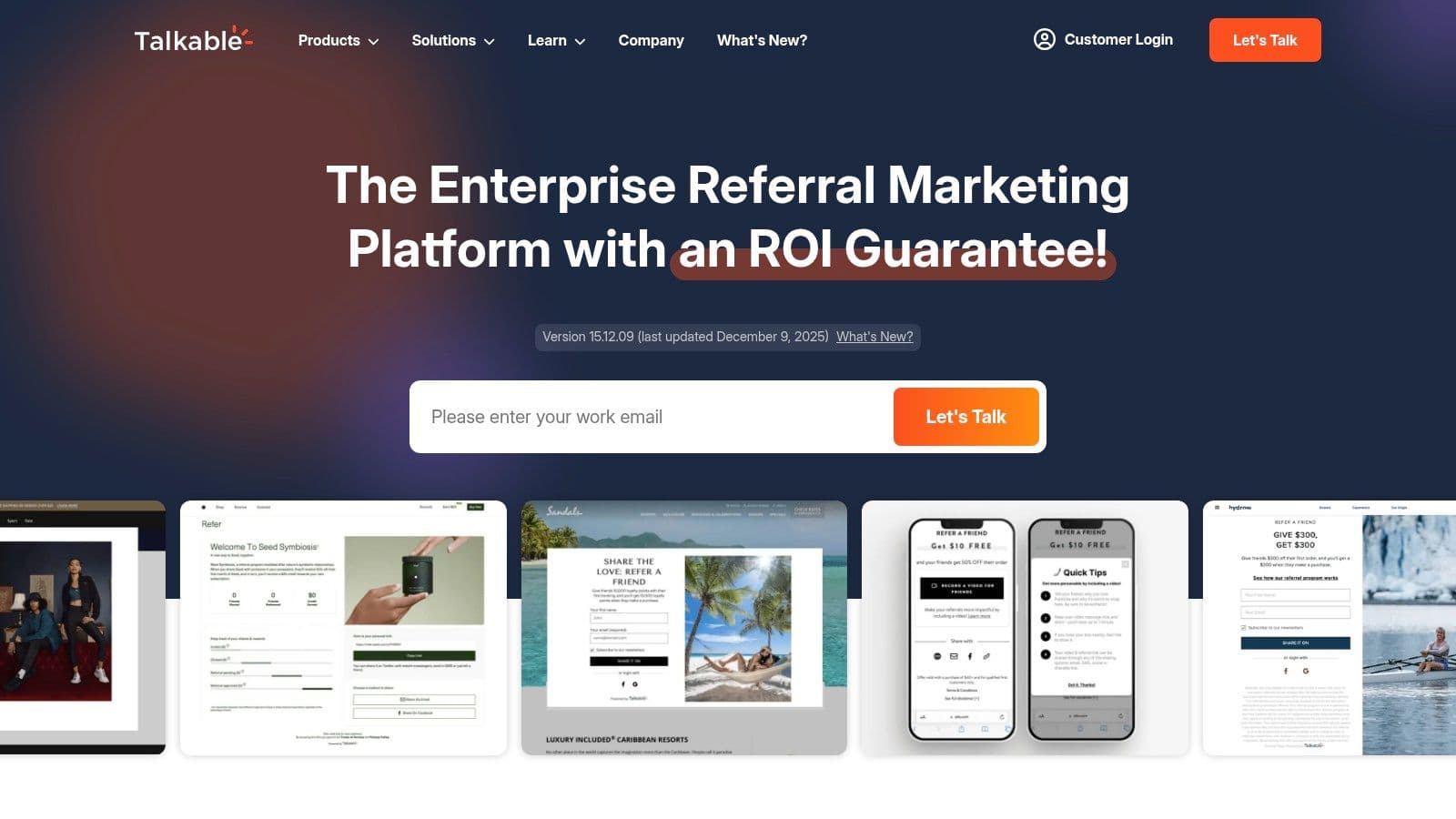
Why enterprise teams pick Talkable
- Managed program optimization and rapid launches
- Advanced fraud prevention and deep segmentation
- Case studies showing measurable ROI lifts
Access: custom quotes following consultation
Website: https://www.talkable.com/
6. SaaSquatch (now part of impact.com)
SaaSquatch specializes in referral and loyalty for SaaS products, offering in-app widgets and the logic to reward users based on product milestones—an ideal fit for product-led growth models.
Strengths
- SaaS-native program logic (multi-tier, event-based triggers)
- Embeddable, low-friction widgets in product UI
- Enterprise-grade security and integrations via impact.com
Access: demo and sales consultation
Website: https://www.saasquatch.com/
7. G2 – Referral Software Category
G2 is not a referral program, but it’s an essential research tool for shortlisting vendors. It aggregates user reviews and enables side-by-side comparisons so you can evaluate usability, integrations, and support before committing.
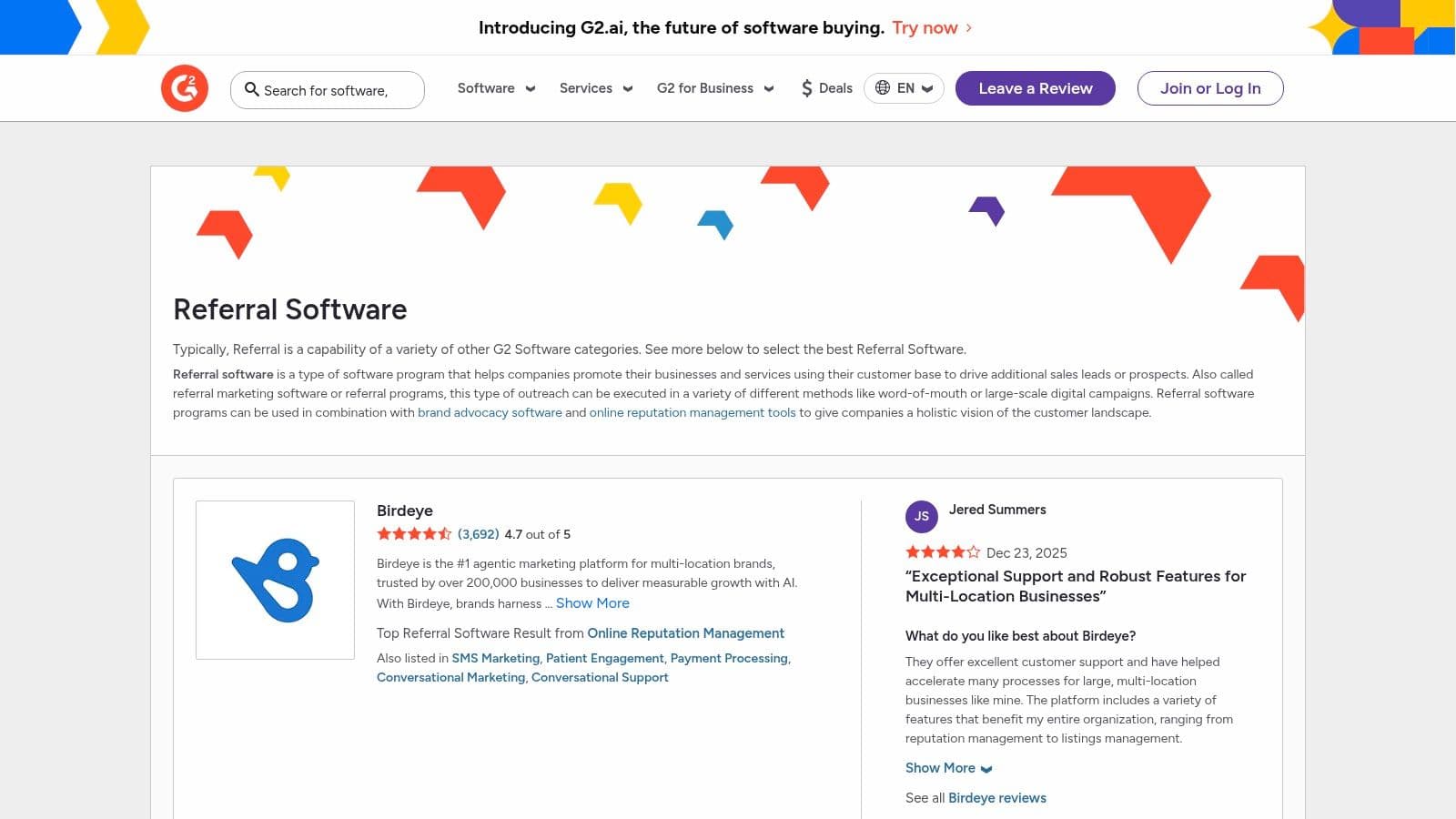
Value for buyers
- Filterable listings and side-by-side comparisons
- Buyer’s guides and aggregated reports
- Free access to user reviews and ratings
Start here: https://www.g2.com/software/referral
Head-to-Head Comparison (Summary)
| Solution | Setup complexity | Best for | Key advantage |
|---|---|---|---|
| ShareMySaaS | Very low | Product-led SaaS | One-click in-app sharing, success-based pricing |
| ReferralCandy | Low | DTC ecommerce | Fast Shopify integration and playbooks |
| Friendbuy | Medium | Data-driven DTC brands | Brand case studies and A/B testing |
| Referral Rock | Low–Medium | B2B/Services | CRM integrations and hosted portals |
| Talkable | Medium | Enterprise brands | Managed optimization and fraud prevention |
| SaaSquatch | Medium | SaaS companies | In-app, event-based referral logic |
| G2 | Very low | Vendor research | Aggregated reviews and comparisons |
From Examples to Execution: Launching Your Referral Program
Across the best programs, three principles dominate: simplicity, aligned incentives, and automation. These combine to create a high-converting, low-friction referral engine that scales while keeping costs predictable. Referred customers also tend to deliver stronger business value, including higher retention and lifetime value, making referrals a high-ROI channel2.
Three-step launch framework
- Step 1: Define your “one thing.” What single action must a referred user take? Anchor the program to that conversion.
- Step 2: Create a win-win incentive. Double-sided rewards—value for both the referrer and the friend—drive higher sharing and conversion.
- Step 3: Measure what matters. Track which advocates and channels drive revenue and optimize attribution to understand the program’s true impact3.
Choose a tool that matches your product and resources. Product-led SaaS teams benefit most from embedded, in-app solutions; ecommerce teams often get the fastest wins from Shopify-friendly tools; enterprise brands may prioritize managed services and fraud prevention.
Quick Q&A: Common Referral Program Questions
Q: How do I start a referral program with minimal development work?
A: Use an in-app plugin or a platform with native integrations for your stack (Shopify, HubSpot, Stripe). Start with a simple double-sided reward and automate link generation and payouts.
Q: What reward structure works best for B2B SaaS versus ecommerce?
A: For B2B SaaS, milestone- or revenue-based commissions work well. For ecommerce, gift cards, discounts, or store credit are easy to communicate and redeem.
Q: How should I measure success in the first 90 days?
A: Track share rate, conversion rate of referred users, cost per acquisition from referrals, and revenue attributed to referrers. Use these to iterate on messaging, placement, and incentive size.
1.
Nielsen, “Global Trust in Advertising,” 2015. [https://www.nielsen.com/wp-content/uploads/sites/3/2019/04/global-trust-in-advertising-report-sept-2015.pdf]
2.
ReferralCandy, “Referral Program Statistics,” data summary on referral customer value and retention. [https://www.referralcandy.com/blog/referral-program-statistics/]
3.
McKinsey & Company, “The Consumer Decision Journey” and related analyses on word-of-mouth impact and attribution best practices. [https://www.mckinsey.com/business-functions/marketing-and-sales/our-insights/the-consumer-decision-journey]
💸 Get 10x More People SharingWith Zero-Friction Signup
Traditional sharing programs lose most potential promoters at signup. ShareMySaaS eliminates that barrier completely — users start sharing with one click, no forms required. Turn every satisfied customer into an active promoter and watch your reach explode.