Struggling to measure marketing ROI? Learn what is an attribution model and discover how to choose the right one to prove and improve your SaaS growth strategy.
January 23, 2026 (9d ago)
What Is an Attribution Model and How Does It Work?
Struggling to measure marketing ROI? Learn what is an attribution model and discover how to choose the right one to prove and improve your SaaS growth strategy.
← Back to blog
What Is an Attribution Model and How Does It Work?
Struggling to measure marketing ROI? Learn what an attribution model is, compare common types, and choose the right one to prove and improve your SaaS growth strategy.
An attribution model in plain language
An attribution model is the set of rules you use to decide which marketing touchpoint gets credit for a conversion. Think of it as the playbook that connects your ads, emails, and social posts to the final sale or sign-up. It’s how you figure out what’s actually working.
Decoding the customer journey with attribution
Picture the customer journey like a soccer team moving the ball down the field. The journey might start with a midfielder (a blog post they found on Google) passing to a forward (a social ad). That forward crosses to a striker (an email with a special offer) who finally scores the goal—the purchase.
So who gets credit for that goal? An attribution model answers that. Without one, you might give all the credit to the striker who scored and ignore the plays by the midfielder and forward. That can lead you to cut the budget for channels that actually started the winning plays.
Why attribution matters
Attribution gives you a clearer picture of your marketing strategy and helps you stop guessing.
- Smarter budget allocation: Put marketing dollars where they’ll make the biggest impact.
- Improved partner programs: For affiliate teams, clear attribution means fair compensation and motivated partners.
- Enhanced customer insights: See the messy, multi-step paths customers take and learn what really influences decisions.
“An attribution model is more than a reporting tool; it’s a strategic compass that guides your marketing investments.”
Attribution grew more important with digital marketing, and today many companies are moving beyond single-touch thinking to measure impact across channels.
The six common attribution models
Every business has a unique customer journey, so there’s no single rulebook for giving credit. Each attribution model is a different lens on which touchpoints matter.
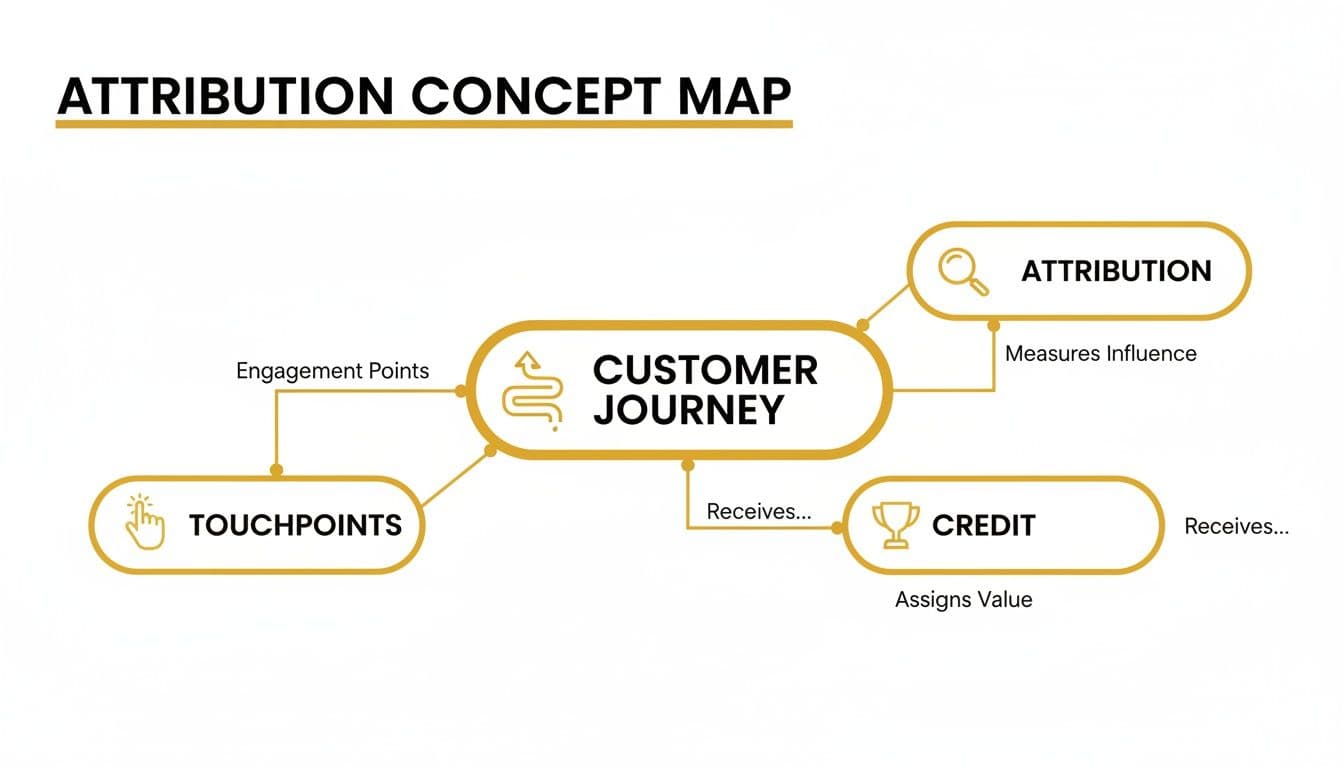
Understanding how these pieces fit together is the first step to pulling actionable insights from your data.
1. First-Touch attribution
First-Touch gives 100% of the credit to the first interaction a customer had with your brand. It’s great for pinpointing which top-of-funnel channels bring new people in.
- Pros: Highlights which channels generate initial interest.
- Cons: Ignores everything that happens after the first touch.
Best for demand-generation teams focused on brand awareness.
2. Last-Touch attribution
Last-Touch gives 100% of the credit to the final touchpoint before conversion. It’s easy to set up and shows which channels are closing deals, but it undervalues awareness and nurturing channels.
Best for businesses with short sales cycles where the last interaction tends to seal the deal.
3. Linear attribution
Linear splits credit equally across every touchpoint in the customer journey. It’s fair and simple, but it assumes every interaction has equal impact.
Best for teams that want a balanced, easy-to-explain view of the full journey.
4. Time-Decay attribution
Time-Decay spreads credit across touchpoints but gives more weight to interactions closer to conversion. It recognizes that recent actions often have more influence while still acknowledging earlier steps.
Best for businesses with longer sales cycles where recent interactions matter.
5. Position-Based attribution
Position-Based (often called U-Shaped) gives large shares of credit to the first and last touchpoints—commonly 40% to the opener, 40% to the closer, and 20% divided among the middle interactions. It rewards both discovery and conversion.
Best for teams that value both lead generation and deal-closing.
6. Data-Driven attribution
Data-Driven uses machine learning to analyze converting and nonconverting paths and assigns credit based on actual behavior. It creates a custom model from your data and can be the most accurate approach when you have enough volume and clean tracking3.
Best for data-mature organizations with high conversion volumes.
| Model | How It Works | Best For | Potential Pitfall |
|---|---|---|---|
| First-Touch | 100% credit to first interaction | Top-of-funnel focus | Ignores nurturing and closing channels |
| Last-Touch | 100% credit to final interaction | Short sales cycles | Undervalues awareness efforts |
| Linear | Equal credit for all touches | Balanced reporting | Assumes all touches are equally valuable |
| Time-Decay | More credit to recent touches | Longer consideration cycles | Can underweight early-stage awareness |
| Position-Based | 40% opener, 40% closer, 20% middle | Value opener and closer | Split may not match actual behavior |
| Data-Driven | ML assigns credit from your data | High-volume, data-driven teams | Requires significant data and setup3 |
There’s no single “best” model—only the best model for your business.
How to choose the right model
Knowing the models is one thing. Picking the right one is strategic. Choose the model that reflects your sales cycle, goals, and how customers find you.
Assess your business and goals
Ask:
- Sales cycle length: How long from first interest to paying customer? Short cycles often work with single-touch models. Long cycles need multi-touch.
- Journey complexity: Do customers interact with a few touchpoints or many?
- Primary objective: Are you focused on awareness or immediate sales?
A SaaS company building brand might favor First-Touch. One focused on quarterly revenue may prefer Last-Touch.
Match models to common scenarios
For short, simple sales cycles:
- Last-Touch shows which channels closed the deal.
- First-Touch highlights channels that drive discovery.
For long, complex sales cycles (typical for B2B SaaS):
- Position-Based balances opener and closer.
- Time-Decay emphasizes recent interactions.
- Data-Driven uses your historical data for the most accurate picture when you have sufficient volume3.
Attribution in affiliate programs
An affiliate program depends on fair, clear credit rules. The model you choose signals what you value and shapes affiliate behavior.

Different models encourage different partner strategies:
- First-Touch rewards affiliates who introduce new audiences with educational content.
- Last-Touch rewards affiliates who drive high-intent traffic and immediate conversions.
- Time-Decay or Position-Based reward a mix of discovery and closing activity, ideal for longer sales cycles.
Modern affiliate platforms automate tracking, apply the chosen attribution rules, and handle payouts, making program management scalable. See how affiliate tracking works in practice on ShareMySaaS resources and guides.
Common implementation challenges
Putting an attribution model in place improves decisions, but real-world data challenges can muddy the picture. Know the pitfalls and how to address them.
Cross-device tracking
Customers often hop between devices. If your analytics treat each session separately, you’ll see fragmented journeys instead of one cohesive path. Fix this by:
- Encouraging login and using authenticated user IDs to stitch sessions together.
- Using probabilistic matching to infer connections between sessions when users aren’t logged in.
- Choosing platforms built for cross-device attribution that combine methods for the best picture2.
Adapting to a cookieless future
Browsers and regulators are changing how third-party cookies work, so first-party data and server-side tracking are more important than ever. Focus on building direct relationships via email and user accounts, and rely more on UTM parameters and first-party analytics to track campaigns1.
Setting realistic lookback windows
Your lookback window should reflect how long prospects typically consider your product. Too short, and you miss early influence. Too long, and you credit irrelevant activity. Use historical data to match the window to your sales cycle.
Turning attribution insights into action
Attribution is a compass for marketing strategy. Use it to shift budget to channels that work, optimize campaigns, and design an affiliate program that rewards meaningful activity.
Your model shows the ads that introduced customers, the content that nurtured them, and the partners who closed deals. That story lets you make data-driven decisions that fuel growth.
Frequently asked questions
Which attribution model should a new SaaS startup use?
Start simple. Last-Touch is easy to implement and helps you see which channels convert. As you grow, layer in multi-touch models like Position-Based or Linear for a fuller view.
How do I track offline conversions?
Connect offline data to your CRM with promo codes, dedicated phone numbers, or by asking new customers how they heard about you. Link that offline data to online identifiers to attribute conversions correctly.
Can I change my attribution model later?
Yes. Run the new model alongside the old one to compare results before switching fully. Re-evaluate attribution as your business and marketing mix change.
Action checklist
- Review your sales cycle and choose a model that matches it.
- Improve tracking: prioritize authenticated user IDs and UTM parameters.
- Use an affiliate platform to automate tracking and payouts.
- Revisit attribution regularly as your business evolves.
Quick Q&A (concise)
Q: What does an attribution model do?
A: It assigns credit to marketing touchpoints so you can see which channels drive conversions.
Q: Which model is best for long B2B sales cycles?
A: Position-Based, Time-Decay, or Data-Driven models work best because they recognize multiple touchpoints.
Q: How do I handle privacy changes and cross-device users?
A: Collect first-party data, require logins where possible, use UTM parameters, and choose platforms that support cross-device attribution and cookieless tracking12.
Ready to turn customers into partners? ShareMySaaS helps you launch and manage an affiliate program with automated tracking, transparent reporting, and streamlined payouts. Learn more at https://sharemysaas.com.
1.
Google. “Privacy Sandbox.” https://blog.google/products/chrome/privacy-sandbox/
2.
Think with Google. “How consumers use multiple devices in the path to purchase.” https://www.thinkwithgoogle.com/consumer-insights/consumer-trends/multi-device-behavior/
3.
Google Ads Help. “About attribution models.” https://support.google.com/google-ads/answer/6311234
💸 Get 10x More People SharingWith Zero-Friction Signup
Traditional sharing programs lose most potential promoters at signup. ShareMySaaS eliminates that barrier completely — users start sharing with one click, no forms required. Turn every satisfied customer into an active promoter and watch your reach explode.