Unlock smarter marketing with our guide on what is attribution modeling. Discover the right models to measure ROI and fuel SaaS growth.
January 5, 2026 (29d ago)
What Is Attribution Modeling A Guide to Smarter Marketing
Unlock smarter marketing with our guide on what is attribution modeling. Discover the right models to measure ROI and fuel SaaS growth.
← Back to blog
Attribution Modeling: Guide to Smarter Marketing
Unlock smarter marketing with our guide on attribution modeling. Discover the right models to measure ROI and fuel SaaS growth.
Introduction
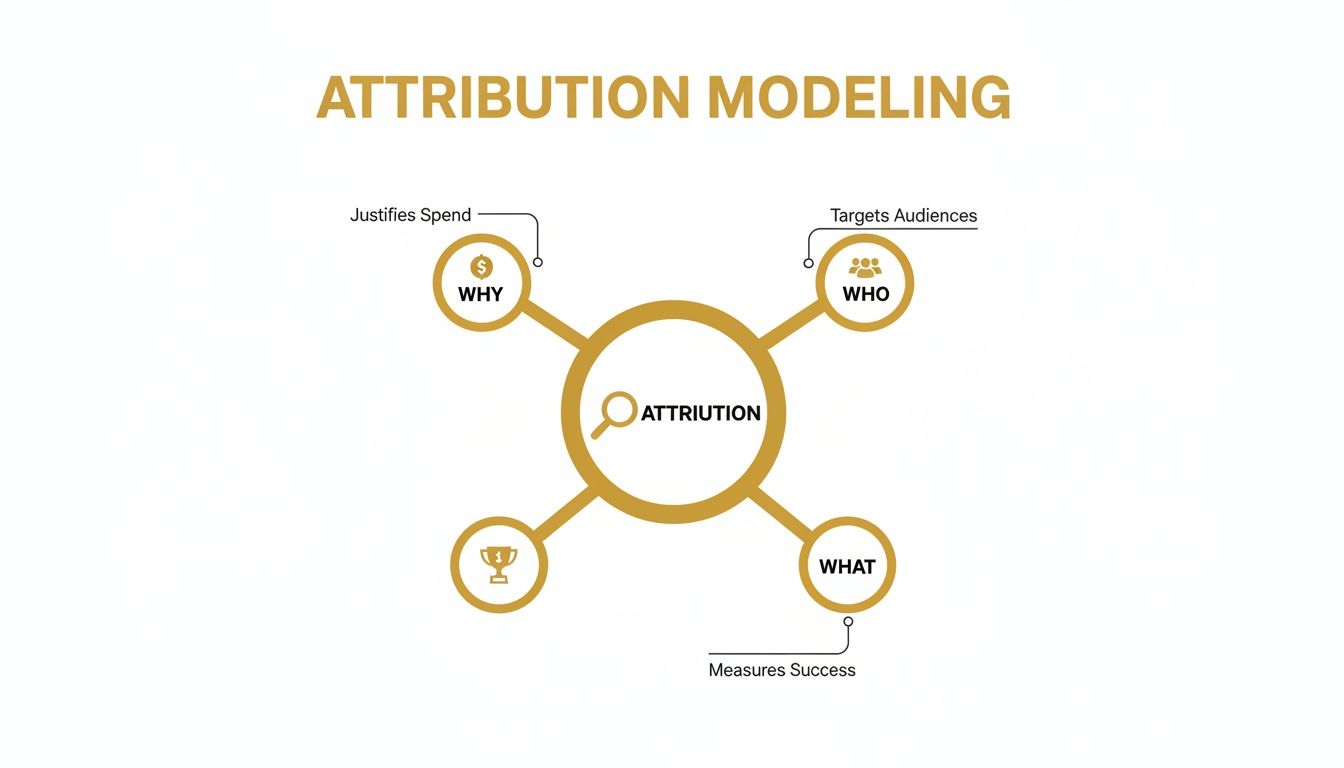
Attribution modeling connects the dots between every marketing touchpoint and the conversions they help create. Instead of guessing which channel deserves credit, attribution gives you a data-backed map of the customer journey so you can invest where it matters most.
Attribution helps you justify spend, optimize budgets, and refine the customer journey to drive real growth for your SaaS or referral program.
What Is Attribution Modeling?
Attribution modeling is the framework marketers use to decide which touchpoints get credit for a conversion. Think of it like a sports analyst watching an entire match: you don’t just give credit to the final goal, you evaluate every pass and play that led to it. With the right model and clean data, attribution stops guesswork and starts producing actionable decisions.
Why Bother With Attribution Modeling?
Picture a customer’s path to purchase as a winding road trip. They might notice a social ad (a billboard), read a helpful blog post (a local guide), and finally click an email link to buy (the driveway). If you only credit the final email, you miss the full journey and risk cutting the channels that built awareness in the first place.
Attribution modeling helps you:
- Confidently show how marketing dollars translate into revenue.
- Shift budget away from underperforming channels and double down on what works.
- See which touchpoints nudge prospects from “just looking” to “ready to buy.”
“Attribution modeling provides one source of truth for marketing and sales, reducing debates about which effort closed the deal and strengthening cross-functional alignment.”
Choosing the right ad-tracking tools is a crucial first step, because your model is only as good as the data feeding it.4
The need for clear attribution is growing fast. The global attribution software market is expected to grow significantly in the coming decade, reflecting how businesses are racing to understand complex customer journeys rather than relying on last-click metrics.1
Exploring Common Attribution Models
Once you know why you need attribution, the next question is how. Attribution models are different lenses on the customer journey. The best choice depends on your business goals, sales cycle length, and channel mix.
No single model fits every situation. A model that’s perfect for a short SaaS free-trial won’t work for a long enterprise sale. Below are the most common models, when to use them, and their blind spots.
Ultimately, attribution isn’t just about numbers. It’s a strategic tool for proving marketing impact and making smarter decisions.
Quick Snapshot of Common Models
| Model Type | How It Assigns Credit | Ideal For | Potential Blind Spot |
|---|---|---|---|
| Last-Click | 100% credit to final touchpoint | Bottom-of-funnel, direct-response campaigns | Ignores earlier awareness and nurturing work |
| First-Click | 100% credit to first touchpoint | Understanding which channels generate awareness | Ignores closing and nurturing tactics |
| Linear | Splits credit equally across all touchpoints | Balanced, high-level view of the funnel | Treats every interaction as equal, even when they’re not |
| Time-Decay | More credit to touchpoints closer to conversion | Long sales cycles where recent interactions matter | Decay rate can be arbitrary without data |
| Position-Based (U-Shaped) | 40% to first touch, 40% to lead-creation touch, 20% to the rest | Lead generation and pipeline-focused strategies | Can undervalue important mid-funnel content |
| Data-Driven | Machine learning assigns credit based on impact | Most accurate, customized view where sufficient data exists | Requires large data sets and can feel like a black box |
Each model tells part of the story. Choose the one aligned with the story you need to read.
Last-Click Attribution
Last-Click gives 100% of credit to the last thing a customer clicked before converting. It’s simple and clear.
- Best for: Very short sales cycles where the final click truly matters.
- Pitfall: It ignores the top and middle of the funnel, undervaluing the content and brand work that started the relationship.
First-Click Attribution
First-Click gives all credit to the channel that introduced the customer.
- Best for: Teams focused on top-of-funnel awareness and lead generation.
- Pitfall: It ignores the nurturing and closing activities that actually converted the lead.
Because both single-touch models are limited, many marketers prefer multi-touch approaches for a fuller picture.
Linear Attribution
Linear splits credit equally among all touchpoints. If a customer had four interactions, each gets 25%.
- Best for: Teams that want a balanced, no-frills view of the entire journey.
- Pitfall: It treats a quick page view the same as a lengthy demo.
Time-Decay Attribution
Time-Decay rewards recency, giving more weight to interactions closer to the conversion.
- Best for: Long B2B sales cycles where later touchpoints often seal the deal.
- Pitfall: Deciding the decay rate can be arbitrary without empirical data.
U-Shaped (Position-Based) Attribution
U-Shaped prioritizes the first touch and the lead-creation touch, usually assigning 40% to each and splitting the remaining 20% across middle interactions.
- Best for: Lead-generation businesses that want to value discovery and conversion moments.
- Pitfall: It can undervalue crucial mid-funnel content.
Data-Driven Attribution
Data-driven attribution uses machine learning to assign credit based on observed impact across converting and non-converting paths. It’s the most customized and often the most accurate approach when you have enough data.
Data-driven methods are becoming the industry standard as teams move away from rule-based assumptions and toward insights grounded in real performance.2
The Power of AI and Data-Driven Attribution
Rule-based models reflect assumptions. Data-driven models let the data speak.
Machine learning can spot patterns humans miss—like a top-of-funnel blog post that makes conversions much more likely weeks later. Those hidden relationships help you reward affiliates fairly, optimize ad spend precisely, and refine the exact sequence that turns a free trial into a paid user.

Data-driven attribution compares converting and non-converting journeys and calculates the statistical impact of each touchpoint. That insight is especially valuable for SaaS and affiliate programs because it reveals the true sources of high-LTV customers and fast conversions.
The trend toward data-driven attribution is reflected in market shifts and growing demand for smarter measurement solutions. Mobile attribution, for example, is a rapidly expanding segment within this space as app usage grows and measurement needs become more complex.3
Putting Data-Driven Insights Into Action
A data-driven model might reveal that an in-app pop-up is the single most influential touchpoint for converting trial users. With that knowledge you can focus product and marketing efforts on the moments that truly move the needle.
It also helps you fairly compensate partners. If a partner’s YouTube video consistently kicks off the highest-value journeys, the model will assign appropriate credit—so you can reward them for their impact, not just the last click.
Proper tracking is non-negotiable. UTM parameters, tracking pixels, and event tracking inside your app are the building blocks of reliable attribution data. For a primer on UTMs, see our guide on Google Analytics UTM parameters.
How to Choose the Right Attribution Model
Picking the right model means matching it to how you actually sell: your sales cycle, channel mix, and business goals.
The perfect model for an enterprise SaaS company with a year-long sales cycle won’t help an e-commerce store selling shirts. Start by answering a few practical questions to guide your choice.
Start With Sales Cycle Length
How long does it take a prospect to become a customer?
- Short (days or weeks): Simple models like Last-Click or First-Click can be effective and actionable.
- Long (months or quarters): Single-touch models won’t capture the full conversation. Time-Decay or Data-Driven attribution is a better fit, especially when you have enough data for machine learning.
Evaluate Your Channel Mix
If you rely on a couple of channels like Google Ads and email, a simpler model might work. If you use content, social, affiliates, paid ads, and events, choose a model that captures multi-channel interactions—Linear is a simple starting point.
Define Your Primary Business Goal
Match your goal to the model:
- Brand awareness: First-Click.
- Understand the full journey: Linear.
- Highlight discovery and conversion moments: U-Shaped.
- Maximize direct sales and ROI: Last-Click or Data-Driven for longer cycles.
By aligning model choice with your sales cycle, channels, and goals, you turn data into clear, actionable intelligence.
Bringing Attribution to Your Referral Program
For referral programs, attribution is the difference between paying for short-term signups and rewarding partners who send your best customers.
Referrals can start with a partner’s blog post, an in-app share, or a quick recommendation in a private chat. A last-click model often misses the partner activities that initially created awareness. To build a fair, scalable referral program, you need a system that sees the entire journey.
Track in-app sharing, content influence, and offline recommendations. Modern referral platforms standardize tracking across channels and connect early touchpoints to eventual conversions so partners get the credit they deserve.
Designing Custom Reward Structures
Solid attribution data allows you to move beyond one-size-fits-all commissions:
- Tiered rewards for partners who drive higher LTV.
- First-touch bonuses for partners who introduce new users.
- Performance-based payouts tied to thresholds or goals.
Platforms like ShareMySaaS automate payouts and make it easier to reward partners based on the rules you set.
Motivating Partners with Real-Time Data
A partner dashboard with clicks, conversions, and upcoming payouts makes partners more engaged. When they can see impact in real time, they double down on what works, creating a virtuous growth cycle.
Common Attribution Pitfalls to Avoid
Attribution is powerful, but there are common traps that lead teams astray.
A major mistake is relying solely on a single, overly simple model—especially Last-Click. It’s tempting because it’s easy, but it can mislead teams into cutting channels that actually fill the funnel.
Another blind spot is offline and non-digital interactions: trade shows, in-person demos, or word-of-mouth recommendations. These are often decisive but hard to capture with standard digital tools.
Overcoming Data Blind Spots
Reduce blind spots by:
- Logging offline interactions in your CRM.
- Asking new sign-ups how they heard about you.
- Ensuring your tracking pixels and event instrumentation are correct.
The biggest pitfall isn’t picking the wrong model—it’s collecting data and then failing to act. Use attribution to form hypotheses, run tests, and adjust. A good-enough model you use is better than a perfect model you never apply.
Frequently Asked Questions
How Often Should I Review My Attribution Model?
Review attribution at least quarterly, and sooner after major changes like big campaigns, new channels, or pricing updates.
Can I Use Attribution With a Small Budget?
Yes. Start simple with tools like Google Analytics and a Last-Click or First-Click model. As you collect data, migrate to more nuanced models.
How Do Privacy Changes Affect Attribution?
With third-party cookies being phased out, first-party data is more important than ever. Focus on building relationships and capturing data you own, like referral signals and in-app events.4
Three Quick Q&A Summaries
Q: Which attribution model should a short-sales-cycle SaaS use?
A: For short cycles, Last-Click or First-Click is practical and actionable; they’re easy to implement and will surface what’s closing deals now.
Q: How can I make referral payouts fair when multiple touchpoints exist?
A: Use multi-touch or data-driven attribution to assign credit across the journey, then create tiered or performance-based rewards to compensate partners fairly.
Q: What do I do when my data is incomplete or offline interactions matter?
A: Log offline touchpoints in your CRM, ask users how they found you, and ensure tracking pixels and UTMs are implemented correctly so your model has the best possible data.
1.
Fortune Business Insights, “Attribution Software Market Size, Share & COVID-19 Impact Analysis,” https://www.fortunebusinessinsights.com
2.
MarketsandMarkets, “Multi-Touch Attribution Market,” https://www.marketsandmarkets.com
3.
Grand View Research, “Mobile Attribution Market Size, Share & Trends Analysis Report,” https://www.grandviewresearch.com
4.
Google, “Privacy Sandbox,” https://blog.google/products/chrome/privacy-sandbox
💸 Get 10x More People SharingWith Zero-Friction Signup
Traditional sharing programs lose most potential promoters at signup. ShareMySaaS eliminates that barrier completely — users start sharing with one click, no forms required. Turn every satisfied customer into an active promoter and watch your reach explode.