Learn how to hire the right affiliate program manager for your SaaS. This guide covers responsibilities, KPIs, interview questions, and onboarding.
January 31, 2026 (1d ago)
Your Guide to Hiring an Affiliate Program Manager
Learn how to hire the right affiliate program manager for your SaaS. This guide covers responsibilities, KPIs, interview questions, and onboarding.
← Back to blog
Title: How to Hire an Affiliate Program Manager
Summary: Learn how to hire the right affiliate program manager for your SaaS. This guide covers responsibilities, KPIs, interview questions, and onboarding.
Introduction: Learn how to hire the right affiliate program manager for your SaaS. This guide covers responsibilities, KPIs, interview questions, and onboarding.
So, what exactly is an affiliate program manager? In short, they’re the strategic mind behind building and running a network of partners—your affiliates—who help bring in new customers and revenue. They oversee the entire affiliate marketing channel from start to finish, acting as the crucial connection between your brand and the people promoting it.
What an Affiliate Program Manager Really Does

Think of your affiliate program manager as the conductor of an orchestra. Each affiliate—a blogger, an influencer, or even another tech company—is an individual musician. The manager’s job is to bring them all together, harmonizing their unique efforts to create a powerful engine for sustained growth. This role is far more than a simple job description; it’s a critical function that turns potential into real profit.
A great affiliate manager does a lot more than just hand out links and watch the clicks roll in. They must be a relationship builder, a data analyst, and a strategic thinker all wrapped into one. Their mission is to transform passive product users and casual fans into active, motivated brand advocates who consistently send high-value customers your way.
The Strategic Value of the Role
The main goal is to build and scale a performance-based way to acquire customers. This isn't just another marketing line item; it’s a cost-effective, scalable engine for growth. The manager makes sure that engine runs smoothly.
Here’s a closer look at what falls under their responsibility:
- Partner recruitment: Always on the lookout for new affiliates, carefully vetting and onboarding partners who fit the brand and target audience.
- Relationship nurturing: Building long-term connections with top-performing partners to keep them engaged and motivated.
- Performance optimization: Digging into data, tweaking commission structures, and giving affiliates the creative assets they need to succeed.
- Program management: Ensuring tracking and attribution are accurate, and managing timely payouts. Learn more in our comprehensive guide on affiliate program management.
To put it simply, an affiliate manager’s responsibilities are directly tied to tangible business growth.
Core Responsibilities of a SaaS Affiliate Program Manager
| Responsibility Area | Key Tasks | Impact on SaaS Growth |
|---|---|---|
| Partner strategy & recruitment | Identifying, vetting, and onboarding high-potential affiliates (influencers, bloggers, industry experts). | Expands market reach and drives targeted traffic from trusted sources. |
| Relationship management | Nurturing relationships with top partners through regular communication, support, and motivation. | Increases affiliate loyalty and engagement, leading to more consistent, high-quality referrals. |
| Performance & optimization | Analyzing KPIs (clicks, conversions, LTV), A/B testing creative, and refining commission structures. | Improves conversion rates, lowers customer acquisition cost (CAC), and maximizes program ROI. |
| Operational execution | Managing affiliate platforms, ensuring accurate tracking, processing payments, and handling compliance. | Creates a smooth, reliable experience for partners, which is essential for scaling the program. |
| Creative & asset development | Collaborating with marketing to provide affiliates with effective banners, swipe copy, and promotional materials. | Arms partners with the tools they need to convert their audience, directly boosting sales. |
This blend of strategy, relationship-building, and operational know-how makes the affiliate manager a true growth driver for any SaaS business.
More Than an Operational Hire
In the crowded SaaS market, finding efficient ways to acquire customers is everything. The affiliate program manager is a force multiplier for your marketing team, turning a passive channel into an active community of partners who are genuinely invested in your success. This strategic approach leads to better referrals and customers with higher lifetime value (LTV).
“An effective affiliate program isn’t a ‘set it and forget it’ channel,” notes many growth leaders. It requires constant attention, strategic adjustment, and genuine relationship-building, all orchestrated by the affiliate program manager. Their work directly influences CAC and overall ROI.
The growing importance of this role is also reflected in compensation: average pay for affiliate marketing manager roles often sits around the low six figures in total compensation, which reflects the role’s measurable impact on revenue and ROI.1
A Week in the Life of an Affiliate Manager

Ever wonder what an affiliate program manager actually does all day? It’s part talent scout, part problem-solver, and part data scientist. Each day brings new priorities that demand a unique mix of skills.
To pull back the curtain, a typical week balances three core functions: proactive growth, reactive support, and strategic analysis.
Proactive Growth and Partner Activation
A big chunk of the week, especially early on, is about outreach and activation. Monday and Tuesday are prime for recruitment—finding SaaS bloggers, YouTube reviewers, or complementary tech partners. Outreach is personalized, not templated.
Afternoons often focus on onboarding new affiliates. A great manager will:
- Schedule a kickoff call to build a real connection and answer questions.
- Send a curated asset pack tailored to the affiliate’s niche.
- Map out a “first 30 days” plan with clear, achievable goals.
This hands-on approach makes partners feel valued from day one and increases the odds they’ll become active promoters. Modern tools like ShareMySaaS can automate initial sign-up, freeing managers to focus on high-impact personal touches.
Reactive Support and Troubleshooting
No matter how well you plan, things break. Midweek is often for reactive support—helping top performers resolve tracking issues, updating promo materials after a rebrand, or handling commission questions. Fast resolution protects revenue and partner relationships.
A core truth: a small portion of partners often generate the majority of revenue, so prioritizing support for that tier is essential.
Strategic Analysis and Optimization
End-of-week time is for stepping back and analyzing data. Managers ask questions like:
- Which partners bring customers with the highest LTV?
- Are commission tiers motivating mid-level partners to increase activity?
- Which creatives and landing pages are converting best?
They might run A/B tests, launch a limited commission bonus, or reallocate resources to high-LTV partners. This data-driven approach elevates the program into a sophisticated acquisition channel.
Measuring What Matters for Program Success
Tracking clicks and impressions isn’t enough. To prove the affiliate channel’s value, focus on metrics that tie to revenue and long-term customer value.
Core KPIs for a SaaS Affiliate Program
Every SaaS affiliate manager should monitor a concise set of KPIs:
- Affiliate-generated revenue: total monthly or quarterly recurring revenue from affiliates.
- Customer acquisition cost (CAC): total affiliate commissions and program costs divided by new customers acquired.
- Customer lifetime value (LTV): expected revenue from a customer acquired via an affiliate.
- Conversion rate (CVR): percentage of affiliate clicks that convert to trials or paid subscriptions.
- Active affiliates: number of partners generating at least one click or conversion in a given period.
These metrics shift the conversation from “how many clicks” to “how much profitable, long-term revenue.”
Interpreting Data to Make Smarter Decisions
Data alone isn’t enough. A skilled manager interprets KPIs to identify top partners, optimize creative, and reallocate incentives. For example, high-LTV customers from a small partner warrant VIP treatment and co-marketing. Conversely, high-click, low-conversion affiliates may indicate audience mismatch or messaging problems. Understanding attribution models is key; learn more in our guide on what an attribution model is.
Industry growth underscores the opportunity: affiliate marketing continues to expand, with forecasts projecting significant increases in program adoption and spending over the next few years.2
How to Find and Hire the Right Manager
Finding a great affiliate program manager can feel like searching for a unicorn. You need someone who’s part salesperson, part analyst, and part relationship builder. The process begins before posting a job ad: define clear outcomes for the role so you attract the right candidates.
Crafting a Job Description That Attracts Talent
Treat your job description as a sales pitch to candidates. Be specific about outcomes, for example: “Recruit and activate 50 new high-value content partners in your first six months.” Include:
- The mission: What’s the big-picture goal (drive new MRR, expand into a market, build brand advocacy)?
- Key responsibilities: Frame these as outcomes, e.g., “Re-engage dormant partners to increase revenue contribution by 25%.”
- Required skills: Mention affiliate platforms, analytics tools, and partner negotiation experience.
- The opportunity: Why should a top manager join your company? Talk about culture, growth, and autonomy.
Conducting Interviews That Reveal True Potential
When interviewing, dig into strategy, problem-solving, and relationship skills. Ask for concrete examples rather than hypotheticals. The best candidates explain the why behind their decisions.
Here are strong interview prompts to evaluate core skills.
Interview Question Checklist for Affiliate Manager Candidates
| Skill category | Sample interview question | What to look for in the answer |
|---|---|---|
| Strategic thinking | “How would you recruit the first 50 affiliates for our product?” | A segmented approach that outlines outreach tactics for different partner types. |
| Relationship building | “Describe a time you re-engaged an inactive high-value partner. What steps did you take?” | Evidence of empathy, creative problem-solving, and focus on mutual benefit. |
| Data literacy | “Walk me through the KPIs you’d use to measure program health.” | Mentions metrics beyond clicks, such as LTV, CAC, and conversion rates. |
| Problem solving | “A top affiliate’s conversion rate drops 50%. What’s your immediate plan?” | A calm, logical process: check tracking, communicate, analyze traffic sources, and test user journey. |
By following this playbook—from a sharp job description to targeted interview questions—you improve the odds of hiring a manager who will turn affiliates into a predictable growth channel.
Your New Manager’s First 90 Days
Hiring a great manager is a win, but the real work begins on day one. A clear 30–60–90 onboarding plan gives new hires direction and the tools they need to succeed.
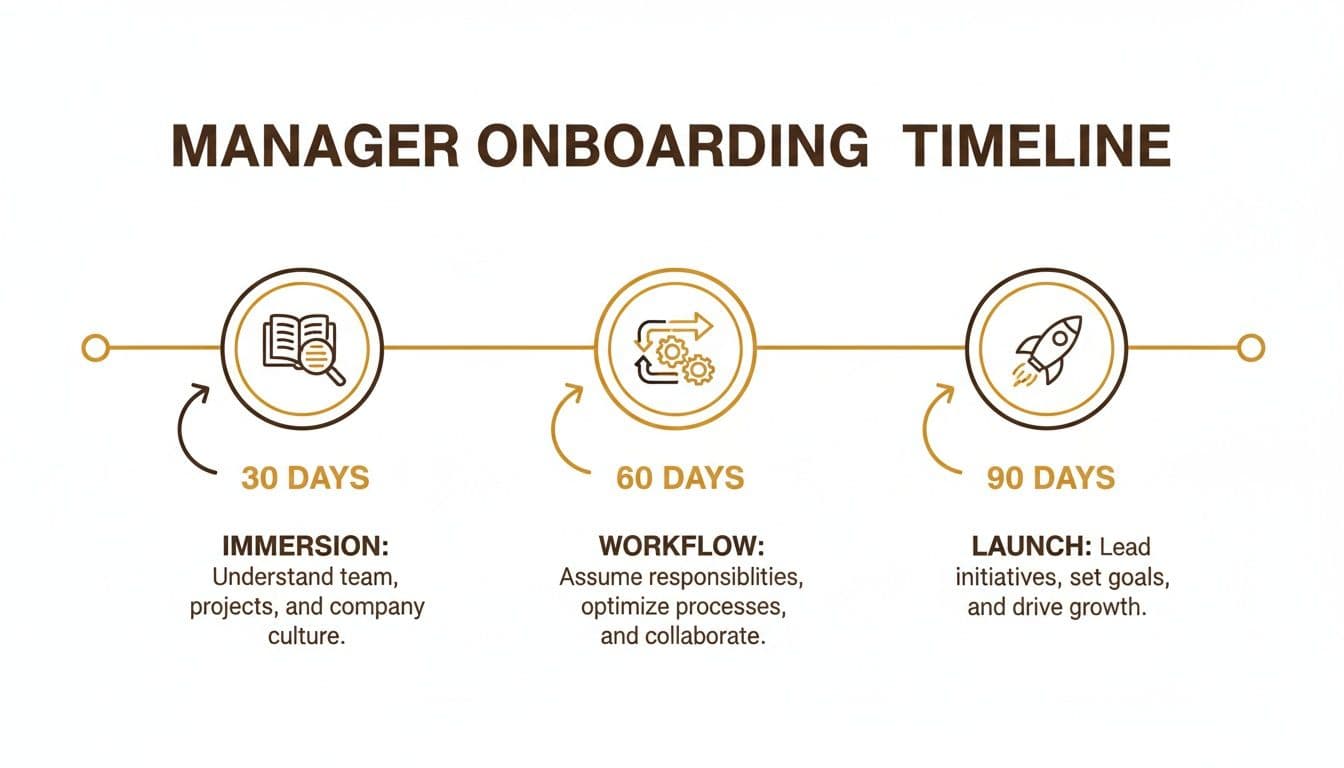
Phase 1: The First 30 Days of Immersion
Focus on product mastery, customer empathy, and team integration. Have the new manager shadow sales and support calls, complete product training, and meet key stakeholders.
Phase 2: Days 31–60 for Auditing and Building
This phase centers on auditing the current program, building partner assets, and evaluating tooling. Objectives include a program audit, creating a partner kit, and assessing the affiliate platform.
Phase 3: Days 61–90 for Activation and Strategy
By month three, the manager should launch targeted recruitment, run quick-win campaigns with early partners, and present a 6–12 month roadmap to leadership.
Empowering Your Manager with the Right Tools

An affiliate manager is only as effective as the tools they have. A modern, integrated affiliate platform automates onboarding, tracking, and payouts, freeing the manager to focus on strategy and relationships.
Without a solid platform, managers spend hours on manual tasks that don’t scale. Tracking issues are a common hurdle in proving program value and optimizing performance, so reliable tracking and attribution are essential.3
A robust platform can:
- Automate onboarding and link generation.
- Provide accurate, real-time click and conversion data.
- Streamline payouts through integrations like Stripe.
Explore the best affiliate tracking software to find tools that let your manager focus on growth.
Answering Your Top Questions About Affiliate Managers
Can we wait to hire one?
You can, but usually that’s a short-term fix. When affiliate management is tacked onto someone’s existing workload, recruitment slows and partners feel neglected. A dedicated manager turns a passive channel into a proactive growth engine.
In-house or agency?
An in-house manager becomes part of your company’s DNA and delivers deep brand alignment. An agency can move fast and brings networks, but may lack long-term brand integration. For many SaaS companies building community and long-term partnerships, an in-house hire is the better choice.
Ready to empower your affiliate manager and partners? ShareMySaaS turns users into promoters with a single click, automating everything from link creation to payouts. See how you can launch a zero-friction affiliate program at https://sharemysaas.com.
Quick Q&A — Common Questions
What does an affiliate program manager actually do?
They recruit and onboard affiliates, nurture relationships, analyze performance, optimize commissions and creatives, and manage tracking and payouts to drive revenue.
What KPIs should I track first?
Start with affiliate-generated revenue, CAC, LTV, conversion rate, and active affiliates to measure both short-term performance and long-term value.
How do I know if I need one now?
If affiliate management is causing inconsistent recruitment, missed tracking issues, or partner churn, it’s time to hire a dedicated manager.
1.
Glassdoor, “Affiliate Marketing Manager Salaries,” https://www.glassdoor.com/Salaries/affiliate-marketing-manager-salary-SRCH_KO0,28.htm
2.
Post Affiliate Pro, “Affiliate Marketing Industry Size & Projections,” https://www.postaffiliatepro.com/blog/affiliate-marketing-industry-size-2025/
3.
Impact, “The State of Partner Marketing,” https://impact.com/blog/partner-marketing/state-of-partner-marketing/
💸 Get 10x More People SharingWith Zero-Friction Signup
Traditional sharing programs lose most potential promoters at signup. ShareMySaaS eliminates that barrier completely — users start sharing with one click, no forms required. Turn every satisfied customer into an active promoter and watch your reach explode.