Discover top conversion optimization best practices for SaaS and affiliate funnels. Learn to boost signups, engagement, and revenue with actionable tips.
January 2, 2026 (1mo ago)
10 SaaS Conversion Optimization Best Practices for 2025
Discover top conversion optimization best practices for SaaS and affiliate funnels. Learn to boost signups, engagement, and revenue with actionable tips.
← Back to blog
10 SaaS Conversion Optimization Best Practices for 2025
Discover top conversion optimization best practices for SaaS and affiliate funnels. Learn to boost signups, engagement, and revenue with actionable tips.
Introduction
In the competitive SaaS landscape, traffic alone won’t drive growth; turning visitors into loyal, paying customers does. Conversion rate optimization (CRO) is the systematic process of increasing the share of users who complete a desired action — signups, referrals, or upgrades — and turning acquisition into measurable revenue. This guide focuses on practical, testable tactics you can apply across landing pages, onboarding, affiliate flows, and in-app experiences to lift activation and lifetime value.
1. Reduce Friction in User Onboarding and Sign-Up
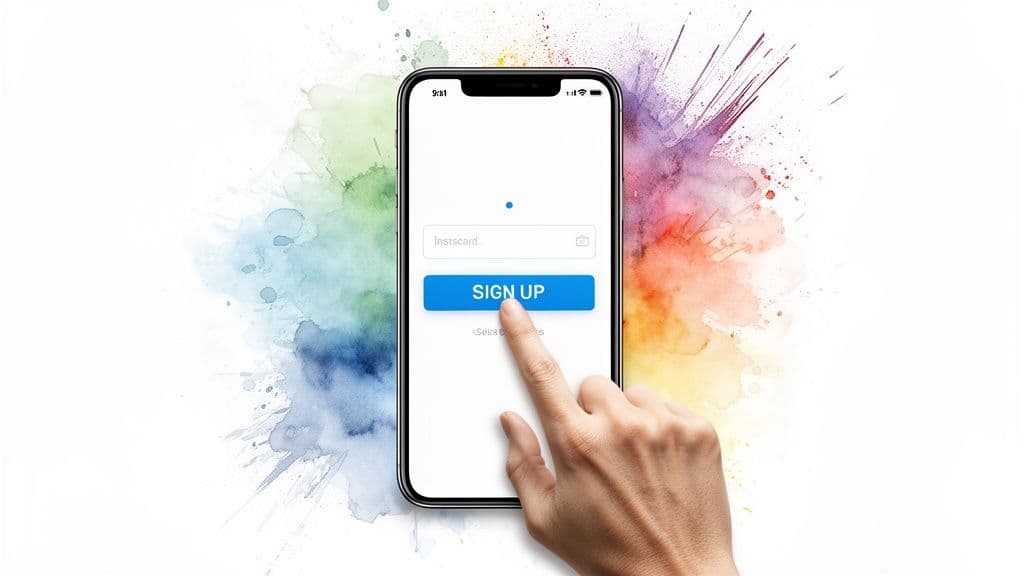
Minimize the effort required for users to sign up or take key actions. Every extra field, click, or slow load is a potential exit point. Create a frictionless path to the product’s “aha” moment by asking for the minimum necessary information and deferring optional details until users are engaged.
Why it works and when to use it
Reducing cognitive load speeds time-to-value and increases activation rates. It's especially important for product-led SaaS and referral experiences where momentum matters. For example, single-click affiliate activation via in-app pop-ups bypasses lengthy registration and drives instant participation.
Actionable tips
- Implement social and SSO logins (Google, LinkedIn, GitHub) to remove password friction.
- Strip down signup forms to essentials; collect extra details later via progressive profiling.
- Use in-app activation for referral or affiliate flows so logged-in users don’t need to re-enter information.
2. Leverage Social Proof and User Testimonials
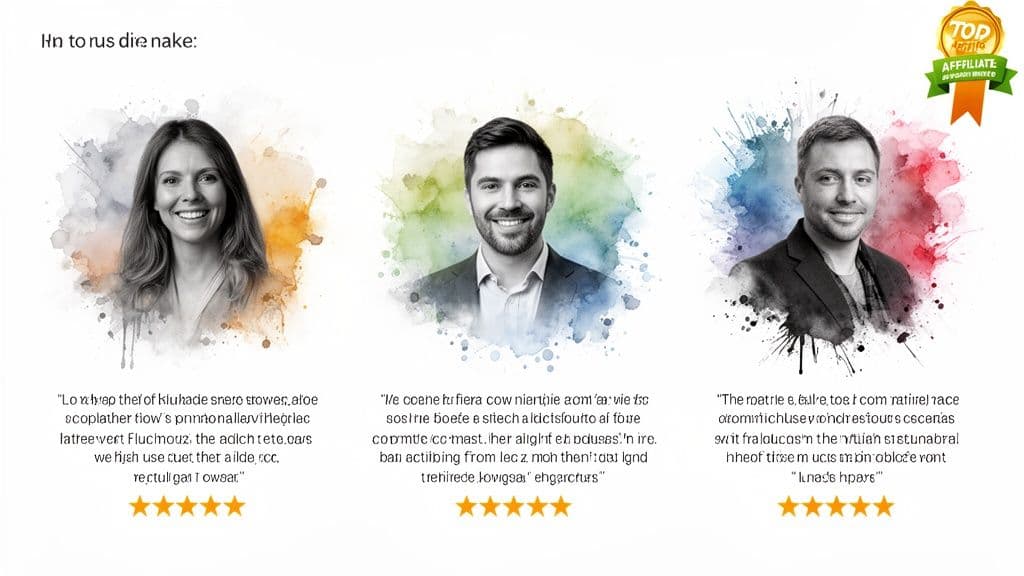
People rely on others when making purchase decisions. Show authentic customer reviews, case studies, and user-generated content to validate your claims and reduce perceived risk. This is essential for driving signups and recruiting affiliates.
Why it works and when to use it
Social proof taps into well-documented influence principles and is critical for higher-consideration decisions. Use it on landing pages, pricing pages, and affiliate leaderboards to reduce hesitation and motivate action.5
Actionable tips
- Feature testimonials with specific results and metrics.
- Showcase diverse use cases to help different personas relate.
- Create a “Top Performers” leaderboard to gamify affiliate participation.
- Use video testimonials for higher emotional impact.
- Embed third-party review widgets (G2, Capterra, Trustpilot).
3. Implement Clear Value Proposition and Benefit-Driven Messaging
Users want to know “What’s in it for me?” Lead with benefits rather than features. Communicate the primary outcome your product delivers in one concise statement that appears above the fold.
Why it works and when to use it
Benefit-driven messaging connects directly to user motivation and is critical in hero sections, ads, and onboarding. Segment messaging by persona so each audience sees the most relevant outcome.
Actionable tips
- Start with the pain point and use benefit-first language.
- Create distinct value propositions for different personas.
- A/B test headlines and core propositions to find what resonates.
- Use specific, quantifiable claims where possible (for example, “99.9% uptime”).
- Maintain message consistency across touchpoints.
4. Optimize Call-to-Action (CTA) Design, Placement, and Copy
The CTA is the gateway to conversion. Make it visually distinct, action-oriented, and benefit-driven. Replace generic labels like “Submit” with copy that frames value, for example, “Start Earning Commissions.”
Why it works and when to use it
A clear CTA reduces decision fatigue and guides users to the next step. Use priority placement above the fold and a strong visual hierarchy to emphasize the primary action.
Actionable tips
- Use first-person, action-oriented copy such as “Get My Free Demo.”
- Add micro-copy under CTAs (e.g., “No credit card required”) to lower hesitation.
- Place primary CTA above the fold and make it high-contrast.
- A/B test elements independently: color, copy, size, and placement.
- For mobile, ensure CTAs are large, tappable, and not obscured.
5. Use A/B Testing and Data-Driven Optimization
Replace guesswork with experiments. Test one variable at a time to learn what truly moves the needle and build a culture of continuous improvement.
Why it works and when to use it
A/B testing isolates causal impacts of design and copy changes. Start with high-impact elements like headlines, hero CTAs, and pricing layouts to get the most value from limited traffic.3
Actionable tips
- Prioritize tests on headline, primary CTA, hero image, and core proposition.
- Test one variable at a time to get clear results; multivariate tests need more traffic.
- Run tests until you reach statistical significance (commonly 95% confidence).3
- Track and document hypotheses, variations, and outcomes.
- Test reward structures and messaging in affiliate funnels to optimize recruitment and activation.
6. Ensure Mobile Responsiveness and Fast Page Load Speed
Mobile-first performance is non-negotiable. Slow experiences increase abandonment and reduce conversions. Audit and optimize every touchpoint that a mobile user encounters, including in-app modals and dashboards.
Why it works and when to use it
Core Web Vitals affect both user experience and search rankings, so performance improvements help SEO and conversions.4 Faster pages lower bounce rates and keep users engaged long enough to convert.1
Actionable tips
- Audit pages with Google PageSpeed Insights and Lighthouse.
- Compress images and use modern formats like WebP.
- Defer non-critical JavaScript and CSS; implement lazy loading for media.
- Monitor LCP, FID, and CLS to maintain a smooth experience.4
- Use a CDN and browser caching to improve repeat visit speed.
7. Create Targeted Landing Pages for Different User Segments
One-size-fits-all pages underperform. Build dedicated landing pages that match the ad copy, traffic source, and user persona to increase relevance and conversion.
Why it works and when to use it
Segmentation and message-to-market fit raise conversion rates and ad quality scores. Use persona-specific headlines, proof points, and CTAs to match the visitor’s intent.
Actionable tips
- Define your top 3–5 personas and create tailored pages for each.
- Align headlines and CTAs with the referring ad or campaign.
- Use persona-relevant case studies and logos.
- Track performance per landing page to allocate budget to the highest-converting segments.
8. Implement Trust Signals and Security Indicators
Trust reduces hesitation. Display security badges, compliance certifications, and clear policies to reassure users when they share data or connect payment methods.
Why it works and when to use it
Security indicators and certifications matter most when financial or sensitive data is involved. For enterprise customers, SOC 2 or ISO certifications can be conversion drivers.
Actionable tips
- Place compliance logos and SSL indicators near forms and CTAs.
- Highlight secure partnerships, for example, “Secure payouts via Stripe.”
- Publish clear, easy-to-find privacy and security pages.
- Use HTTPS everywhere as a baseline expectation.
9. Optimize Email Marketing for Conversions and Engagement
Email remains a high-ROI channel for nurturing and converting users. Focus on targeted sequences that onboard, inform, and re-engage users with personalized data and clear next steps.
Why it works and when to use it
Segmented, automated email sequences significantly lift engagement and conversions; email continues to deliver strong returns on marketing spend.2
Actionable tips
- Build segmented lists based on behavior and lifecycle stage.
- Create a 5–7 message welcome sequence for new partners that includes setup steps and tips.
- Personalize messages with dynamic data like referral earnings and link performance.
- Automate performance updates to keep affiliates motivated.
- A/B test subject lines, send times, and CTAs.
10. Leverage Video Content to Explain Value and Build Trust
Video helps explain complex workflows quickly and builds an emotional connection. Use short demos and explainer clips to reduce friction and answer questions before they’re asked.
Why it works and when to use it
Video engages both visual and auditory senses, improving retention and time on page. Short product demos are especially effective for showing how affiliate activation works in a few steps.
Actionable tips
- Keep explainer videos to 60–90 seconds for top-of-funnel content.
- Place primary videos above the fold on landing pages.
- Add clear CTAs at the end of videos, such as “Start Your Free Trial.”
- Include captions and optimize for autoplay muted on page load.
- A/B test pages with and without video to measure their actual impact.
10-Point Conversion Optimization Comparison
| Initiative | Implementation Complexity | Resource Requirements | Expected Outcomes | Ideal Use Cases | Key Advantages |
|---|---|---|---|---|---|
| Reduce friction in onboarding | Low–Medium | Moderate | ↑ conversions 15–50% | New user signup, in-app affiliate pop-ups | Faster time-to-value |
| Social proof and testimonials | Low | Low–Medium | ↑ trust and conversions 20–50% | Landing/pricing pages, affiliate leaderboards | Credibility and peer influence5 |
| Clear value proposition | Medium | Low–Medium | ↑ landing conversions 10–30% | Hero sections, persona pages | Faster qualification |
| CTA design & copy | Low–Medium | Low | ↑ CTR 20–45% | CTAs across pages and emails | Clarifies next step |
| A/B testing | Medium–High | Medium–High | Per-test lift 5–15% | High-traffic funnels | Data-driven decisions3 |
| Mobile performance | Medium | Medium | 1s faster → better conversions | Mobile-first audiences | Better UX and SEO14 |
| Targeted landing pages | Medium–High | Medium | ↑ conversions 20–40% | Persona-specific campaigns | Higher relevance |
| Trust signals & security | Medium | High | ↑ conversions 10–30% | Checkout, payouts | Reduces anxiety |
| Email optimization | Medium | Low–Medium | High ROI, sustained engagement | Onboarding, re-engagement | Cost-effective nurture2 |
| Video content | Medium | Medium–High | ↑ conversions 20–80% | Product demos, explainers | Engaging and memorable |
Putting Theory Into Practice: Your Path to Higher Conversions
Optimization is an ongoing process of small, measurable improvements. Start by identifying the biggest leak in your primary funnel, form a simple hypothesis, and run a controlled A/B test. Over time, iterating on focused experiments compounds into meaningful growth.
Core principles to remember
- Clarity over clutter: Eliminate ambiguity and answer “What’s in it for me?” quickly.
- Trust as a currency: Every badge, review, and performance improvement builds credibility.
- Data-informed empathy: Combine quantitative testing with qualitative user insight to choose the right experiments.
First steps
- Find your biggest drop-off with analytics.
- Make a single, testable hypothesis (for example, change CTA copy to emphasize value).
- Launch a properly scoped A/B test and learn from the results.
For further reading, see our guide to product-led growth examples and referral program inspiration in referral program examples. For tracking, review our guide to UTM parameters.
Ready to apply zero-friction principles to your affiliate and referral programs? ShareMySaaS provides turnkey infrastructure to launch, track, and automate partner programs. Visit ShareMySaaS to learn more.
Frequently Asked Questions
Q: Which single change usually delivers the fastest lift in conversions?
A: Start with the primary CTA and headline above the fold. They have high visibility and often deliver quick, measurable wins when you test benefit-driven copy and button prominence.
Q: How long should I run an A/B test before deciding?
A: Run tests until you reach a predefined sample size and a confidence level you trust, commonly 95%. Avoid early stopping based on short-term fluctuations to prevent incorrect decisions.3
Q: What’s the most common mobile mistake that kills conversions?
A: Slow page load and non-responsive CTAs. Mobile users abandon pages that take too long to load, so prioritize performance and tappable CTAs to reduce friction.14
1.
Google, “Find Out How You Stack Up to New Industry Benchmarks for Mobile Page Speed,” Think with Google, https://www.thinkwithgoogle.com/marketing-resources/data-measurement/mobile-page-speed-load-time-statistics/
2.
Litmus, “How to Measure Email Marketing ROI,” Litmus Blog, https://www.litmus.com/blog/how-to-measure-email-marketing-roi/
3.
Optimizely, “A/B Testing,” Optimizely Knowledge Base, https://www.optimizely.com/optimization-glossary/ab-testing/
4.
Google Web Vitals, “Core Web Vitals,” Web.Dev, https://web.dev/vitals/
5.
Robert B. Cialdini, Influence: The Psychology of Persuasion, Harper Business; 1st edition, https://www.amazon.com/Influence-Psychology-Persuasion-Robert-Cialdini/dp/006124189X
💸 Get 10x More People SharingWith Zero-Friction Signup
Traditional sharing programs lose most potential promoters at signup. ShareMySaaS eliminates that barrier completely — users start sharing with one click, no forms required. Turn every satisfied customer into an active promoter and watch your reach explode.