Learn how do I create an affiliate link that powers SaaS growth. This guide covers smart tracking, frictionless delivery, and program setup for real results.
December 28, 2025 (2mo ago)
How Do I Create an Affiliate Link for SaaS Growth
Learn how do I create an affiliate link that powers SaaS growth. This guide covers smart tracking, frictionless delivery, and program setup for real results.
← Back to blog
Create Affiliate Links for SaaS Growth
Learn how to create affiliate links that power SaaS growth with reliable tracking, frictionless delivery, and a program foundation built for scale. This guide walks through link anatomy, in-app delivery, commission design, tracking best practices, and compliance so you get measurable results.

Your Blueprint for a High-Performing Affiliate Link
An affiliate link is more than a hyperlink — it’s a tracking mechanism that gives you a clear line of sight from a partner’s promotion to a sale. Without that clarity, you’re guessing which partnerships move the needle. A good SaaS affiliate link has three core parts: a base destination, a stable affiliate ID, and UTM tags for campaign-level insight.
Deconstructing the Affiliate URL
A partner like “SaaS-Insider” might use a link like:
https://yourproduct.com/pricing?ref=saasinsider123&utm_campaign=feature_launch
Breakdown:
- Base URL (
https://yourproduct.com/pricing): The landing page relevant to the partner’s promotion. - Affiliate ID (
?ref=saasinsider123): The unique token that credits the partner; you may also seeaffidorpartnerid. - UTM Parameter (
&utm_campaign=feature_launch): Identifies the marketing campaign driving the click.
Key takeaway: A well-structured affiliate link is your program’s single source of truth. It guarantees fair attribution and delivers the granular data needed to measure ROI and optimize spend.
Anatomy of an Effective SaaS Affiliate Link
| Component | Example | Purpose |
|---|---|---|
| Base URL | https://yourproduct.com/ | Core destination for the click. |
| Path | pricing | Specific page such as pricing or features. |
| Query Separator | ? | Starts tracking parameters. |
| Affiliate ID | ref=saasinsider123 | Identifies and credits the affiliate. |
| Parameter Separator | & | Separates multiple parameters. |
| UTM Source | utm_source=blog_review | Identifies traffic source. |
| UTM Campaign | utm_campaign=q3_launch | Groups campaign traffic. |
Understanding these parts helps you build links that work and feed actionable analytics.
From Basic to Advanced Link Creation
Beyond the basics, include a stable affiliate ID, campaign-specific UTMs, and optionally click-level identifiers for analytics and fraud detection. Example:
https://example.com/signup?ref=AFF123&utm_source=affiliate&utm_medium=partner
Mastering this structure turns links into a strategic growth engine. For a deeper dive, see our guide on how to create affiliate links.
Why Frictionless Link Creation Is a Growth Superpower
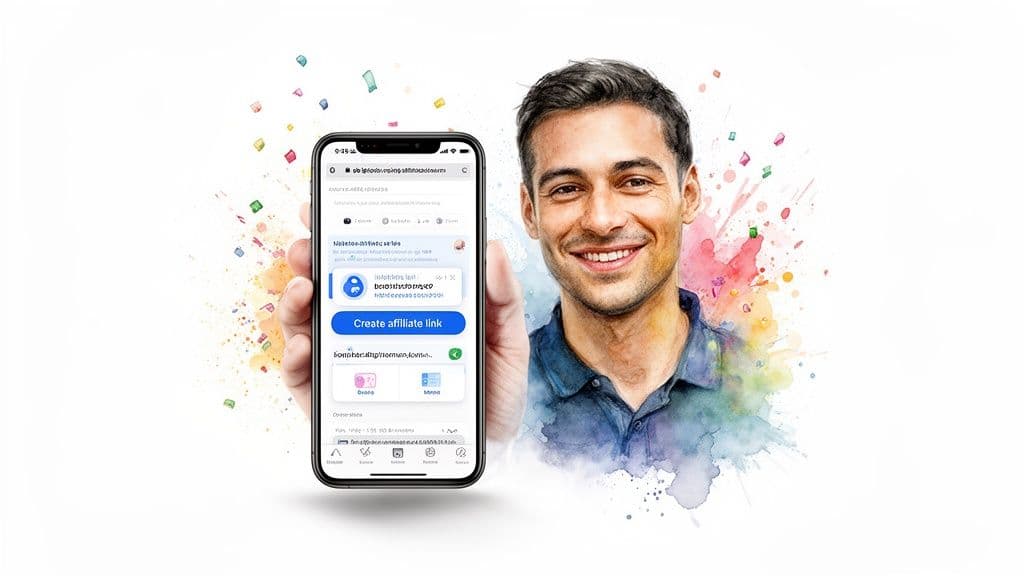
Turning happy customers into promoters is easiest when generating a link takes seconds. Manual signups, clunky forms, and long approval queues kill momentum and leave referrals on the table. Embedding instant link creation in-product captures user enthusiasm at its peak and dramatically increases participation. With U.S. affiliate marketing spend projected to grow, scalable tracking for every link is essential1.
Moving Beyond Manual Processes
Traditional programs require separate portals and multi-step approvals that extinguish sharing intent. Capture users in the moment — after they hit a milestone or upgrade — with an instant, in-app prompt that shows their unique link ready to copy. That removes friction and turns advocacy into immediate action.
By embedding link creation into the product, the question “how do I create an affiliate link?” gets answered instantly and naturally.
Aligning Affiliates with Product-Led Growth
Treat affiliate link creation as a product feature. When users can grab a link from their dashboard or a contextual popup, sharing becomes the logical next step. This leads to:
- Faster activation — users become partners in seconds.
- Higher participation — lower barriers mean more promoters.
- Authentic advocacy — referrals from real users who know your product.
These effects compound as more customers share, creating a sustainable acquisition channel. For trends on affiliate spend and growth, see industry data1.
Building Your Affiliate Program Foundation
A link is just the tip of the iceberg. Underneath you need motivating rewards, trustworthy tracking, and seamless payouts. For SaaS, recurring commissions align affiliate incentives with your retention goals and encourage partners to seek high-quality customers.
Designing a Commission Structure That Motivates
Avoid one-size-fits-all payouts. Consider these models:
- Recurring percentage: 10–30% of monthly subscription to encourage long-term retention.
- Tiered commissions: Higher rates as affiliates hit volume milestones.
- Hybrid models: Small fixed bounty for signups plus recurring revenue share for conversions.
Review competitor programs to benchmark your offer, for example Klap's affiliate program.
Automating Payouts to Build Trust
Late or incorrect payments erode trust. Automate payouts with a reliable payments provider so affiliates receive correct, timely compensation. Automating through Stripe or similar providers signals professionalism and reduces admin overhead2.
A robust payout flow handles calculations, currency conversions, and timely distributions so your team can focus on recruiting and supporting top partners.
If you’re building a program from scratch, our guide on how to create an affiliate program offers a complete roadmap.
Getting Links Into the Hands of Your Promoters
Generating a unique affiliate link is only the start. You must deliver it at the moment users are most likely to share — right after a win, upgrade, or milestone. Burying referral links in a dashboard misses those moments.
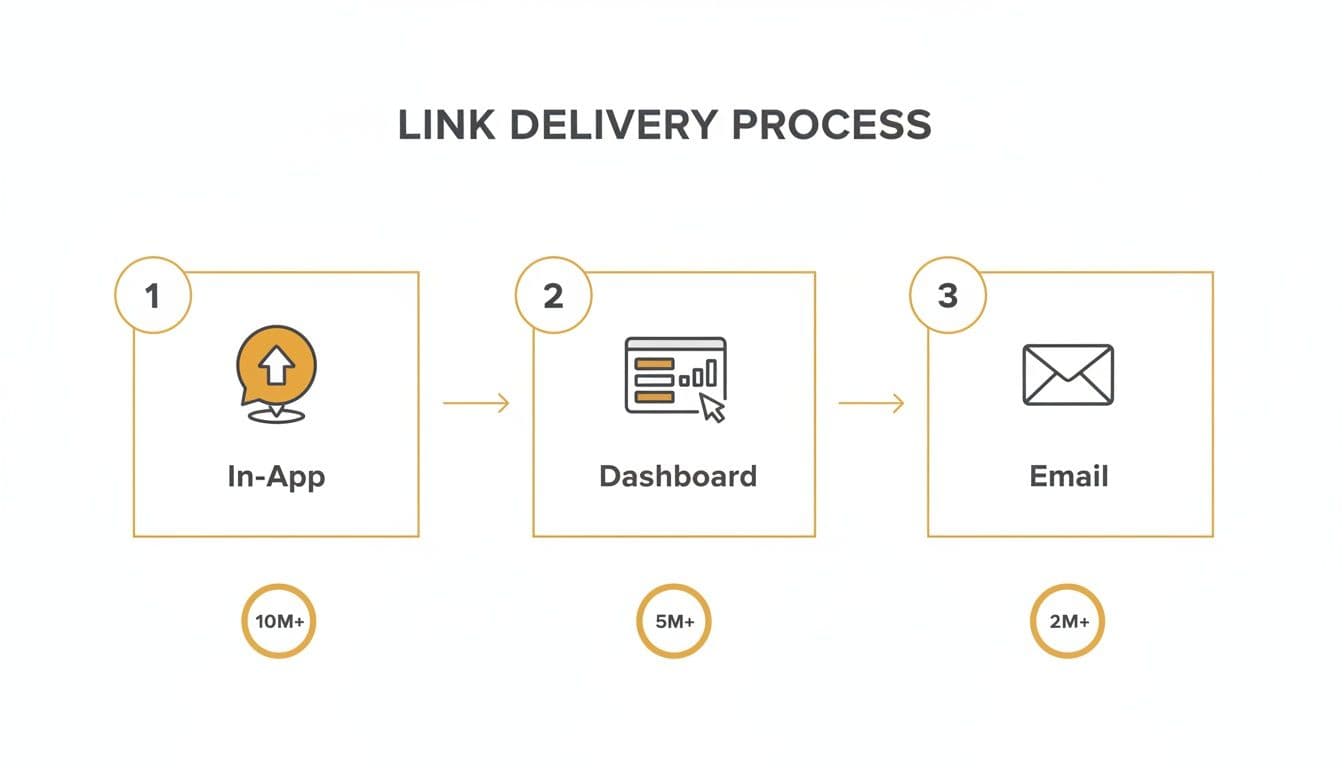
Delivering Links with In-App Prompts
Use contextual popups after positive actions. Show the user their ready-to-copy link and a concise incentive message, like “Share and earn 20%.” Keep the UI simple: a clear copy button and an easy close option are essential for a helpful UX.
Exploring Other Powerful Delivery Channels
A multi-channel approach reaches more users:
- Dedicated affiliate dashboards for power users.
- Targeted email campaigns when users hit milestones.
- Permanent account settings like a “Refer & Earn” tab.
Combining immediate prompts with on-demand access makes sharing natural and easy.
Mastering Tracking and Measurement
Tracking is where programs succeed or fail. Browser-level tracking falters against ad blockers and cookie restrictions, so server-side tracking is now central to reliable attribution3. Capture clicks and conversions on the server to preserve data integrity across the entire customer lifecycle.
Building a Resilient Tracking System
Server-side tracking creates a direct line between your servers and your affiliate platform, bypassing browser blockers. This helps attribute long-term revenue — like recurring subscription payments — back to the correct affiliate. If you’re not using server-side tracking, you risk undercounting referrals and mispaying partners.
Also consider multi-touch attribution to understand how affiliates interact with your other channels and which touchpoints drive conversions4.
Data Integrity and Compliance
Trustworthy measurement needs:
- An immutable affiliate ID.
- Detailed logs with timestamps and event data to detect fraud.
- Conversion event details, including order value and subscription specifics.
UTM parameters add campaign-level granularity for reporting; if you need a refresher, see our guide on Google Analytics UTM parameters.
Also include clear affiliate disclosures to comply with regulations and maintain trust.
Got Questions About SaaS Affiliate Links? Let’s Clear Things Up.
What’s the real difference between an affiliate link and a referral link?
Affiliate links are for formal, performance-based partnerships with marketers and publishers who earn cash commissions. Referral links are typically for existing customers and reward them with product credits or perks. The same tracking tech can support both, so build a flexible system.
How long should my affiliate tracking cookie last?
For SaaS, 30–90 days is common. B2B buyers often take weeks to convert, so a fair attribution window prevents short cookie windows from cheating affiliates out of deserved commissions. Match the window to your average time-to-conversion.
Can I customize affiliate link URLs?
Yes — branded or vanity links boost credibility and shareability. Use short, memorable paths like yoursaas.com/partner/top-reviewer when possible; good affiliate platforms make custom links simple to generate.
Quick Q&A (Common User Questions)
Q: How do I ensure affiliates get credited when users convert weeks later? A: Use a fair attribution window aligned to your sales cycle (30–90 days) and server-side tracking to persist attribution across sessions.
Q: What’s the simplest way to remove friction for affiliates? A: Provide instant in-app link generation with a copy button and include a persistent “Refer & Earn” tab in account settings.
Q: How do I prevent disputes over payouts? A: Keep immutable affiliate IDs, detailed logs with timestamps, and automate payouts through a trusted provider so payments are timely and transparent.
Ready to turn users into a growth engine? ShareMySaaS helps you launch a zero-friction affiliate program in minutes, deliver instant links in-app, and automate payouts with Stripe. Get started for free at ShareMySaaS.
1.
Affiliate marketing spend and trends. https://affiliatestatistics.marketing
2.
Stripe documentation on payouts and automated payments. https://stripe.com/docs/payouts
3.
Google Developers: Server-side tagging and the benefits of server-side tracking. https://developers.google.com/tag-platform/gtagjs/server-side-tagging
4.
Multi-touch attribution overview and methodology. https://www.cometly.com/post/multi-touch-attribution
💸 Get 10x More People SharingWith Zero-Friction Signup
Traditional sharing programs lose most potential promoters at signup. ShareMySaaS eliminates that barrier completely — users start sharing with one click, no forms required. Turn every satisfied customer into an active promoter and watch your reach explode.