Discover how pay on performance marketing can scale your SaaS with measurable results, and learn models, tracking, and launch steps.
January 4, 2026 (1mo ago)
Pay on Performance Marketing: SaaS Growth Made Simple
Discover how pay on performance marketing can scale your SaaS with measurable results, and learn models, tracking, and launch steps.
← Back to blog
Pay-on-Performance Marketing: SaaS Growth Made Simple
Summary: Discover how pay-on-performance marketing can scale your SaaS with measurable results, and learn models, tracking, and launch steps.
Introduction
Pay-on-performance marketing is a low-risk way to grow your SaaS: you only pay for real results. Instead of spending on impressions or clicks that may never convert, you reward partners after they deliver a valuable action—like a new paid subscription or a qualified demo request. This approach aligns incentives, reduces upfront spend, and makes growth measurable and repeatable.
Shifting from Paying for Clicks to Paying for Results

Think of pay-on-performance like hiring a sales team you only pay after they close a deal. It moves your investment from impressions and clicks to actual revenue. The model shifts financial risk onto marketing partners and turns affiliates, influencers, and loyal customers into an extension of your sales force.
The Power of Performance-Based Partnerships
Compensation is tied directly to concrete goals. For SaaS that usually means:
- New paid subscriptions: a commission for each converted customer.
- Qualified leads: a flat fee for demo requests or verified leads.
- In-app purchases or upgrades: a percentage of revenue for upsells.
This ensures your marketing dollars drive measurable growth. The global affiliate marketing industry is now a multibillion-dollar market1, and partnerships are an increasingly central channel for revenue generation2.
“By rewarding outcomes instead of effort, pay-on-performance marketing creates a genuine win-win: partners get paid for real value, and your business gets predictable returns.”
Whether through affiliate links, referral codes, or custom campaigns, the goal is scalable growth with minimal upfront risk. Learn more about partner marketing in our guide on what is partner marketing.
Exploring Common Payment Models and Structures
Choosing the right payment structure is essential. The commission model fuels partner motivation and should align with the result you value most—typically long-term customer value for SaaS.
Recurring Percentage Commissions
Recurring percentage commissions fit subscription businesses naturally. For example, a partner who refers a $100/month customer and earns 20% pockets $20 each month that customer remains active. This encourages partners to seek high-quality customers with low churn.
Fixed-Fee Rewards
Fixed fees are useful when the key action is an early step in the funnel. Examples:
- $50 for a qualified demo attendee
- $10 for a free-trial sign-up
- $150 for any new paid subscription
Fixed fees make budgeting predictable and are great for early-stage growth campaigns. See different affiliate marketing models for more ideas.
Tiered Commission Structures
Tiered commissions reward volume and keep top partners engaged. A simple tier could be:
- Bronze (1–10 sales/month): 20% recurring
- Silver (11–25 sales/month): 25% recurring
- Gold (26+ sales/month): 30% recurring
Tiered systems create clear goals and loyalty. For a template, see our tiered commission structure guide.
Hybrid Models
Hybrid plans mix models to reward multiple actions. For example, a $25 flat fee for a demo plus a 15% recurring commission if that lead converts. Hybrid programs incentivize both volume and quality while covering the whole customer journey.
The Tech That Makes It All Work: Tracking and Attribution
Trust depends on accurate tracking and fair attribution. Partners must know they’ll get credit for conversions, and you must be sure you only pay for verified results.
Every partner gets a unique tracking link—an affiliate link that carries a digital identifier. That identifier follows a user to your site and connects the partner to actions they drive.
How Do You Actually Track a Referral?
Two common tracking methods:
- Browser cookies: set a cookie with the partner ID when a user clicks a link so the partner gets credit if the user converts later.
- Server-to-server (postback) tracking: a direct server call records conversions, avoiding cookie issues and ad blockers.
A robust platform will support both and offer transparent reporting. Explore modern tools in our roundup of the best affiliate tracking software.
Who Gets the Credit? Choosing an Attribution Model
Attribution defines which touchpoint earns the commission when multiple partners touched a customer. Common models:
- First-click attribution rewards awareness-building partners.
- Last-click attribution credits the final touchpoint that closed the sale.
Pick the model that matches your strategy. A reliable, real-time dashboard is essential: many marketers are expanding budgets for performance partnerships, yet automation adoption still lags—making accurate, real-time attribution critical to scale3.
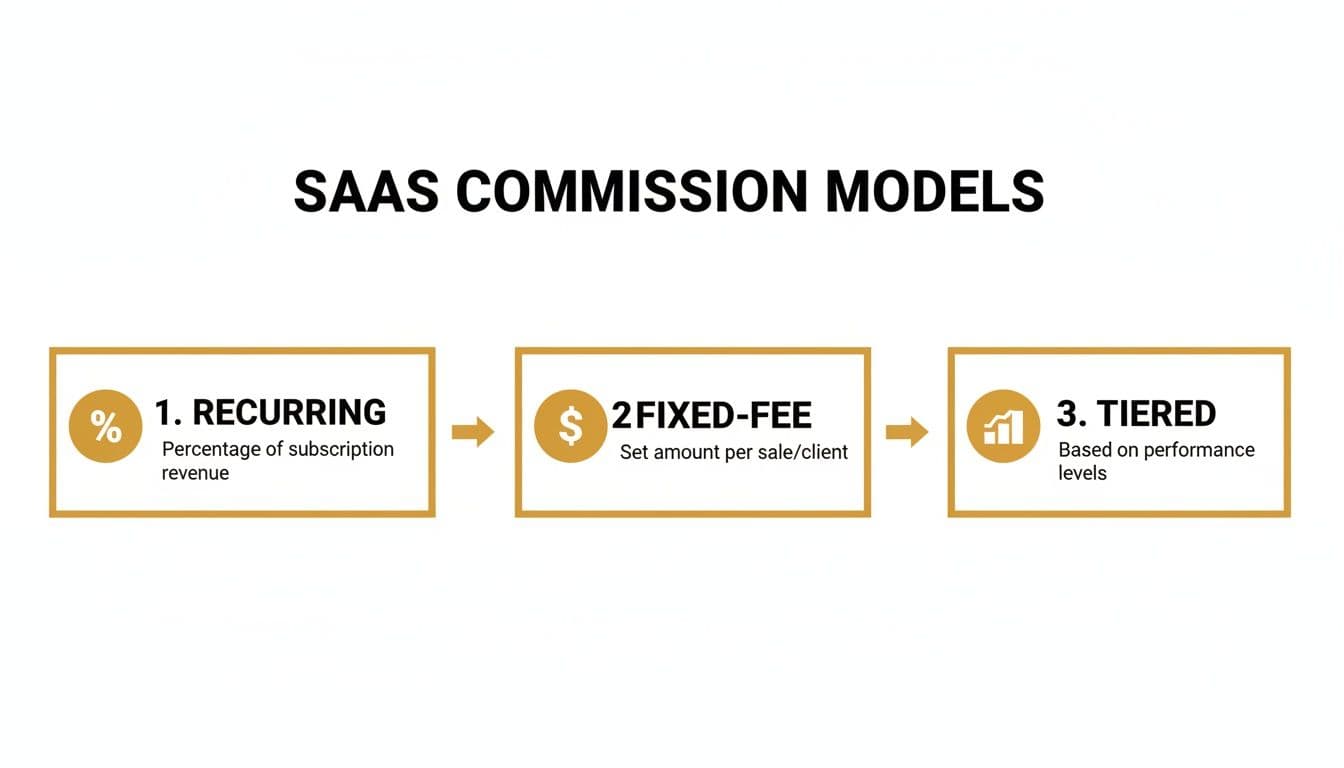
This flow demonstrates how recurring, fixed, and tiered commissions are triggered by the conversions your tracking logs.
Key Performance Indicators You Must Measure
You can’t manage what you don’t measure. Pay-on-performance programs succeed when you track business-focused KPIs rather than vanity metrics.
Conversion Rate (CR)
CR is the percentage of referred visitors who take the desired action. It’s the clearest signal of partner traffic quality.
Customer Acquisition Cost (CAC)
CAC is the total commission you pay per new customer. Keeping CAC sustainable is essential to profitable growth.
Lifetime Value (LTV)
LTV estimates the total revenue a customer generates over time. Comparing LTV to CAC (aiming for a 3:1 ratio or higher) tells you whether growth is truly profitable. Many advertisers still overlook lifetime metrics when optimizing programs, which limits long-term success4.
Essential KPIs for Your Dashboard
- Conversion Rate: measures partner traffic quality
- Customer Acquisition Cost (CAC): measures cost-effectiveness
- Lifetime Value (LTV): identifies long-term customer value
- LTV-to-CAC Ratio: indicates sustainable growth
- Churn Rate: flags partner-sourced retention issues
Consistent tracking turns your partner program into a data-driven growth engine.
How to Get Your First Campaign Off the Ground
Launching a program is a sequence of practical steps. Start small, test, and scale what works.
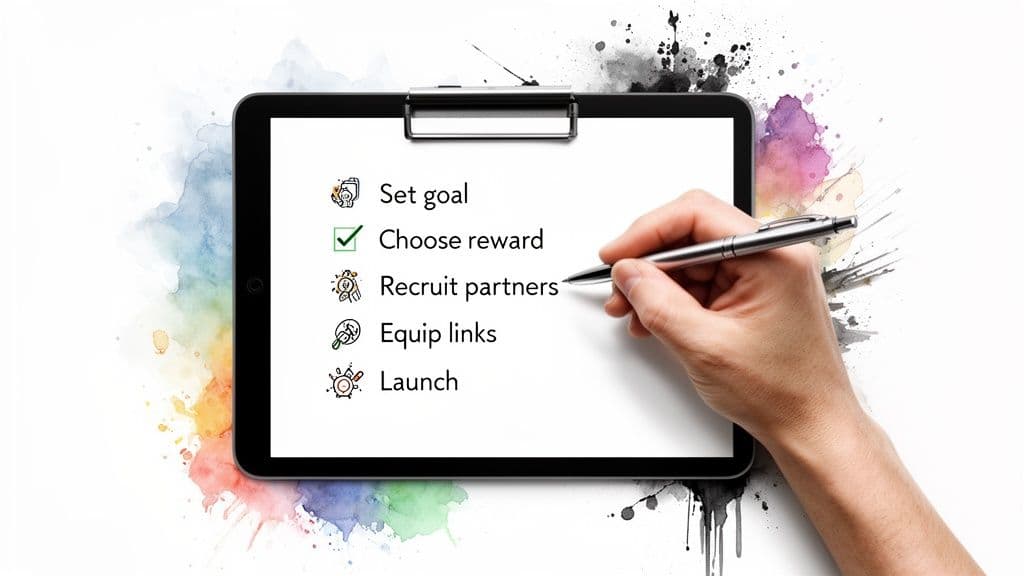
Step 1: Set a Specific, Tangible Goal
Define a numeric, time-bound target, for example:
- Acquire 50 new paying customers from partners in 90 days
- Generate $10,000 in new MRR from referrals in six months
- Drive 200 qualified trial sign-ups from partners by quarter-end
A clear goal informs commission design and partner recruitment.
Step 2: Choose the Right Reward Structure
Start simple. A recurring percentage (20–30%) is often the best fit for subscription businesses because it aligns partner incentives with customer retention.
Step 3: Recruit Your Initial Partners
Begin with quality over quantity. Recruit:
- Power users and long-term customers
- Customers who left positive reviews
- Consultants, agencies, and non-competing influencers in your niche
A small, engaged cohort helps you iterate quickly.
Step 4: Equip Your Partners for Success
Reduce friction. Provide:
- A unique, easy-to-share affiliate link
- Simple messaging and templates for outreach
- A transparent dashboard to track clicks, referrals, and commissions
Making promotion effortless turns partners into an effective extension of your team.
Managing Compliance and Automated Payouts
Trust and efficiency keep partners engaged. Clear rules and automated payouts form the operational backbone.
Setting Clear Rules of Engagement
Your partner agreement should specify:
- Commission rates, payment model, and cookie duration
- Promotional guidelines, including paid search rules
- Compliance requirements, such as FTC disclosure obligations
Clarity prevents disputes and protects your brand.
The Power of Automated Payouts
Automation prevents payment mistakes and saves time. Integrating with a payment processor like Stripe ensures partners are paid accurately and on schedule. Platforms such as ShareMySaaS can handle tracking, calculation, and Stripe-based payouts so your team can focus on growth.
Frequently Asked Questions
Is this the same as affiliate marketing?
Pay-on-performance is the broader strategy of paying for results; affiliate marketing is one common tactic within that strategy. Referral programs and influencer partnerships are other forms of performance marketing.
How much commission should I offer?
For many SaaS businesses, 20–30% recurring is a strong starting point. Adjust based on margins, customer LTV, competitor rates, and partner influence.
What are the biggest mistakes to avoid?
Top mistakes are unreliable tracking, poor communication, and delayed or inaccurate payouts. Get tracking and payments right from day one to build trust.
Q&A — Common Questions and Short Answers
Q: How quickly can I see results from pay-on-performance marketing?
A: You can see initial traction in weeks when you recruit active partners, but meaningful MRR growth typically appears over months as referrals convert and subscription revenue compounds.
Q: Which partners drive the best long-term value?
A: Partners who refer qualified leads and enterprise customers usually deliver higher LTV. Track LTV by partner to identify your most valuable sources.
Q: How do I prevent fraud or low-quality referrals?
A: Use robust tracking, set clear qualification rules, require demo verification for lead payouts, and monitor conversion and churn rates to flag low-quality traffic.
💸 Get 10x More People SharingWith Zero-Friction Signup
Traditional sharing programs lose most potential promoters at signup. ShareMySaaS eliminates that barrier completely — users start sharing with one click, no forms required. Turn every satisfied customer into an active promoter and watch your reach explode.